



In the last week before exams, a strange thing happens: you open your phone to “take a short break,” and 20 minutes disappear. Nothing dramatic. No single moment you can point to. Just a smooth slide from one clip to the next, one headline to the next, one comment thread to the next.
That feeling is exactly what IB Digital Society wants you to notice. Not the brand names. Not whether you “like” social media. The system underneath--the media platform as a machine that sorts attention, rewards certain behaviors, and quietly shapes what feels normal.
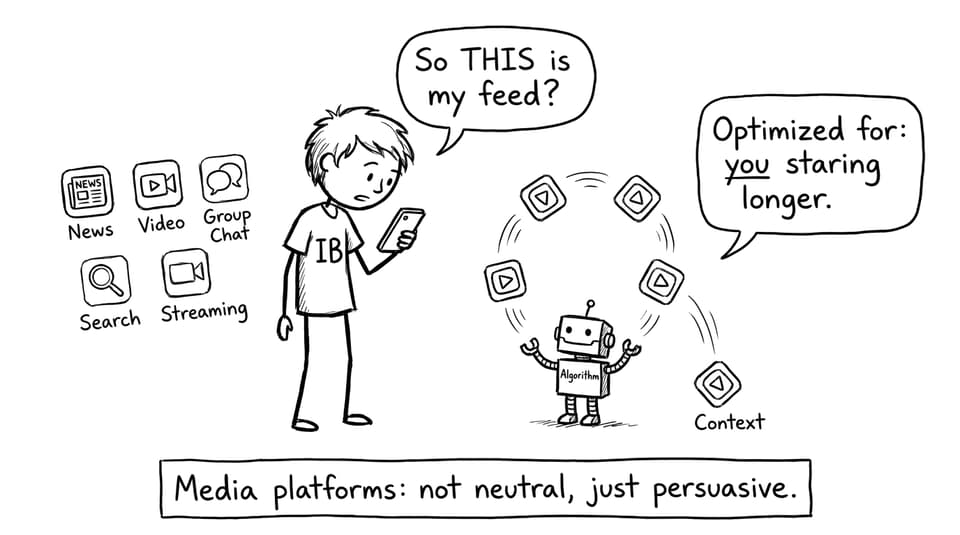
Media platforms in IB Digital Society (what to study)
In IB Digital Society, media platforms are digital systems that distribute information, entertainment, or user-generated content to large audiences. They often blend traditional media functions with algorithmic ranking, data analytics, and monetization.
Use this quick checklist when revising IB Digital Society media platforms:
-
Identify the platform’s purpose (news, video, messaging, streaming, hybrid)
-
Map the system (inputs, rules, outputs, feedback loops)
-
Explain the influence mechanism (ranking, recommendation, amplification)
-
Connect to power (who controls visibility, moderation, data)
-
Evaluate ethical issues (transparency, manipulation, accountability)
For a clear course overview and resources, start with the IB Digital Society resources hub.
Digital influence: what it means for IB Digital Society
Digital influence is the ability of media platforms to shape opinions, behaviors, and decision-making. In IB Digital Society, you get more credit for explaining how influence is produced than for announcing that it exists.
Digital influence usually shows up through:
-
Content ranking and recommendation (what appears first, what appears next)
-
Visibility and amplification (who gets boosted, who gets buried)
-
Repetition and exposure (familiarity feels like truth)
-
Framing (what counts as the “main issue,” what is ignored)
If you need a concept lens to organize your examples, revise themes using IB Digital Society: Key Themes Explained.
Algorithms and influence in IB Digital Society
Algorithms are the quiet engine of most media platforms. They decide what is prioritized, for whom, and under what conditions. In IB Digital Society, aim to describe an algorithm as a decision process with goals, inputs, and outputs--not “just code.”
A simple exam-ready structure:
-
Goal: engagement, retention, profit, safety, accuracy
-
Inputs: user data, content signals, social network data, prior behavior
-
Outputs: rankings, recommendations, removals, flags, notifications
-
Feedback loop: output changes behavior, which changes future inputs
To tighten this skill, use IB Digital Society: Algorithms Explained for Exams and then practice with the 3.5 Media Questionbank.
Power and control on media platforms
Power in media platforms often looks like something softer than force: it is the ability to shape visibility. If a platform can elevate certain voices, limit reach, remove content, or steer attention with design, it holds real influence over public narratives.
For IB Digital Society, ask power questions like:
-
Who controls distribution rules and moderation standards?
-
How transparent are ranking and enforcement decisions?
-
What appeal process exists (and who can realistically use it)?
-
Who benefits from the platform’s business model?
When you write, avoid generalizations like “social media controls people.” Instead, show the mechanism: “Ranking prioritizes engagement signals, which amplifies outrage content, which shifts perceived norms.” That is IB Digital Society thinking.
Misinformation and platform design
Misinformation is not just “people lying.” Platforms can unintentionally reward misleading content because it is emotionally engaging, fast to consume, and easy to share.
Evaluate misinformation in IB Digital Society with balanced responsibility:
-
Platform design choices (sharing friction, virality features, ranking goals)
-
User behavior (confirmation bias, social identity, low media literacy)
-
Governance (policy enforcement, transparency reports, regulation limits)

Exam writing: how to score when given an unseen platform example
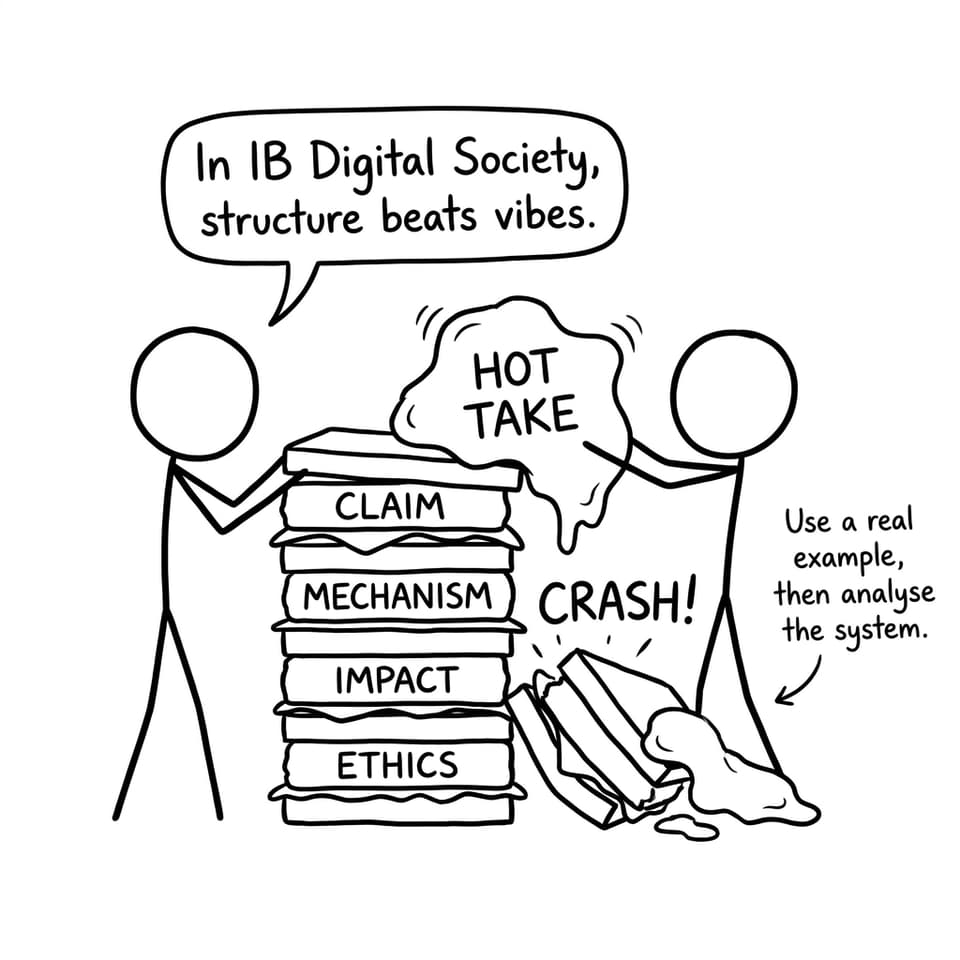
Unseen examples are where IB Digital Society rewards structure. When a stimulus mentions a new app, a trending story, or a content controversy, you can respond confidently if you treat the platform as a system.
Try this mini-template:
-
Define the media platform as a digital system
-
Identify one influence mechanism (ranking, recommendation, amplification)
-
Analyze impacts on individuals and communities
-
Evaluate power and ethics (transparency, accountability, harm)
-
Conclude with a justified judgment (not moral outrage)
To build speed, do short timed sets with RevisionDojo’s Questionbank feature, then use IB Digital Society Topic 3 - Content to patch any weak areas.
Using media platforms as an IA focus
Media platforms work well for the IB Digital Society Internal Assessment when you narrow your inquiry to one mechanism and one context. “How social media affects people” is too wide. “How recommendation systems shape political information exposure for first-time voters” is closer to an inquiry you can actually evaluate.
If you want a clear framework and criterion guidance, use the IB Digital Society Internal Assessment Guide and browse support in the Digital Society coursework guide.
Conclusion: treat media platforms as systems, not scenery
Media platforms feel like background noise until you study them closely. Then you realize they are not neutral stages for human behavior--they are active systems shaping visibility, attention, and belief. That is the heart of IB Digital Society: noticing the mechanism, naming the power, and evaluating the ethics.
If you want a single place to revise media platforms, practice exam-style questions, build flashcard recall, and get feedback fast, use RevisionDojo’s IB Digital Society hub, then drill your weakest areas with the Questionbank and targeted topic pages. Your goal is simple: fewer opinions, more mechanisms. That’s where the marks are.