


The moment exponents start costing marks
In IB Math, exponent rules don’t usually fail you in the “hard” questions. They fail you in the quiet moments, when the algebra looks routine, you relax, and one tiny index flips a whole method mark into a dead end.
That’s why the laws of exponents matter so much in IB Mathematics: Analysis and Approaches (AA) at both SL and HL. They show up early in Number & Algebra, then return in functions, logarithms, calculus, and modelling. If your exponent habits are shaky, you’ll feel it everywhere.
If you want a bigger-picture overview of the course, see IB Math Analysis and Approaches: Complete Guide for SL & HL.
Quick checklist: the exponent laws you actually use
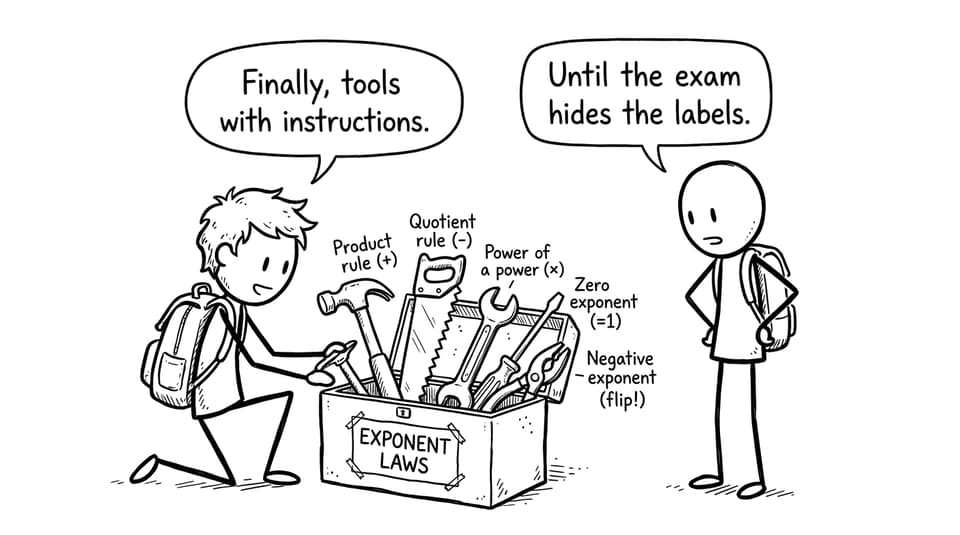
For IB Math, you’ll repeatedly rely on these five:
-
Product rule: (a^m a^n = a^{m+n})
-
Quotient rule: (\frac{a^m}{a^n} = a^{m-n}) ((a\neq 0))
-
Power of a power: ((a^m)^n = a^{mn})
-
Zero exponent: (a^0 = 1) ((a\neq 0))
-
Negative exponent: (a^{-n} = \frac{1}{a^n})
The hidden condition behind almost all of them: the base must match. In IB Math, most exponent errors come from ignoring that sentence.
To practise these in the exact AA syllabus subtopic, use SL 1.7, Laws of exponents and logs.
Laws of exponents explained (the “why”, not just the rule)
Product rule: add exponents when bases match
Think of (a^m) as “(m) copies of (a) multiplied together.”
(a^m a^n) becomes (m+n) copies of (a), so the index adds:
In IB Math, this is everywhere: simplifying algebra, building exponential models, and cleaning expressions before differentiation.
Quotient rule: subtract exponents when dividing
If multiplication stacks repeated factors, division cancels them:
A useful habit for IB Math Paper 1 (non-calculator) is to rewrite division as “cancel common factors” mentally before you even touch indices.
For more exam-structure context, see How to Prepare for IB Math AA SL Paper 1.
Power of a power: multiply exponents
When you raise (a^m) to another power, you are repeating the repetition:
This rule becomes especially important later in IB Math when you simplify function transformations and exponential-log forms.
Zero and negative exponents: the “quiet” marks
These are the ones students “know” but still mishandle under pressure.
-
Zero exponent: (a^0=1) (for (a\neq 0))
-
Negative exponent: (a^{-n}=\frac{1}{a^n})
In IB Math, a clean approach is to rewrite negative exponents as fractions early. It reduces sign mistakes and makes your final answer look examiner-friendly.
Common IB Math mistakes (and how to stop making them)
Mixing bases
(2^3\cdot 3^3\neq 6^6). The only clean merge is when the base is the same. If bases differ, you may be able to factor, but you cannot apply a same-base exponent law.
Distributing exponents incorrectly
A classic trap:
Exponent laws don’t replace expansion rules. In IB Math, this mistake shows up in algebraic simplification and function work.
Forgetting what a negative exponent means
(x^{-2}) is not “negative.” It’s a reciprocal: (\frac{1}{x^2}). Many Paper 1 solutions collapse because a student keeps negative powers until the final line, then rushes the rewrite.
How to revise exponent laws efficiently with RevisionDojo
A calm, repeatable loop works best for IB Math:
-
Learn: use the AA hub IB Mathematics Analysis and Approaches Resources and the syllabus-aligned SL 1.7 notes.
-
Drill: practise in SL 1.7 Questionbank and also mix in Number and Algebra Questionbank so the rules appear in different disguises.
-
Lock it in: build recall with RevisionDojo Flashcards, then use AI Chat to ask “Which law applies here and why?” until your reasoning becomes automatic.
When you’re ready for timed practice, RevisionDojo’s Mock Exams and Predicted Papers help you practise the same exponent discipline under real pressure. If you want feedback on method and presentation, the Grading tools and Tutors can spot patterns you’ll miss alone. And if exponent slips are popping up inside larger topics (like exponentials or calculus), RevisionDojo Study Notes keep the explanations close to the questions.
Bringing it home: make IB Math easier by making exponents automatic
In IB Math, exponent laws are less about memory and more about trust. You want to trust that when you see matching bases, your hands know what to do: add, subtract, multiply, flip. That trust frees your attention for the harder parts of AA SL and HL: modelling, reasoning, and multi-step structure.
If you want exponent laws to stop being a recurring mistake and start being an automatic advantage, begin with the SL 1.7 notes, then drill the SL 1.7 Questionbank. From there, use RevisionDojo’s Flashcards, AI Chat, and Grading tools to tighten accuracy, and walk into your next IB Math exam knowing the “small stuff” won’t take you down.


