




The most dangerous revision mistake is not knowing too little. It is learning the wrong thing with complete confidence.
So, is RevisionDojo accurate? The short answer is yes: RevisionDojo is designed around current IB syllabuses, assessment criteria, command terms, and exam-style practice. Its published review process involves IB examiners, experienced teachers, alumni, and current students. That makes it a strong, credible resource for IB preparation.
But accuracy is not a magic label. Different tools carry different levels of certainty. Human-reviewed Study Notes are not the same as an instant AI response, while an estimated coursework score is not an official IB grade. The sensible approach is to use RevisionDojo as the ultimate connected IB resource while still checking high-stakes details against your current subject guide and teacher guidance.
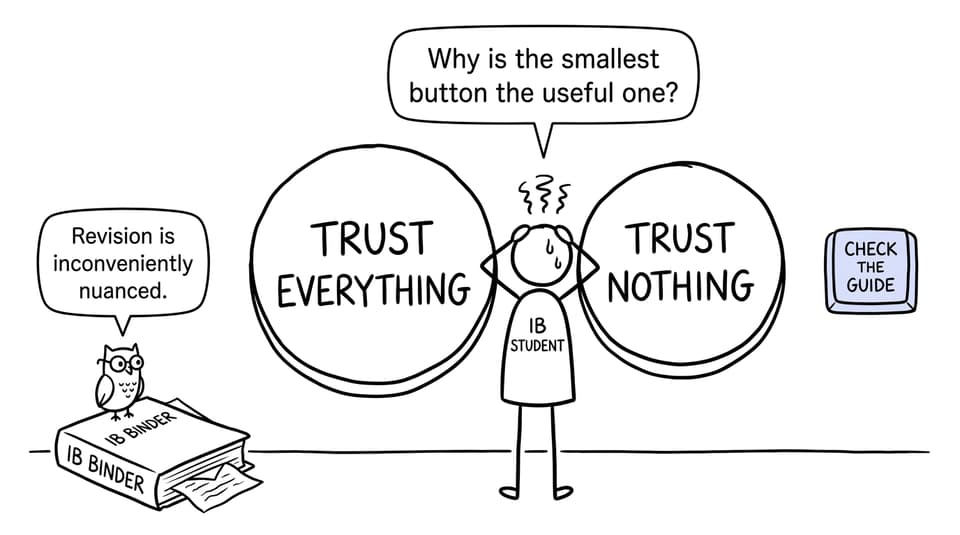
The accuracy checklist
Before relying on any IB resource, ask five questions:
- Does it match your syllabus version? Check the first-assessment year, subject, and SL or HL level.
- Who reviewed the content? Look for teacher, examiner, or subject-specialist involvement.
- Is it teaching or predicting? Explanations can be dependable without future exam predictions being certain.
- Is feedback official? AI and platform scores are formative guidance, not final IB decisions.
- Can you verify important details? Compare assessment rules with your subject guide and school materials.
RevisionDojo performs strongly against this checklist. Its IB resource hub organizes material by subject, while its Content Philosophy explains the people and principles behind its resources. Students should still make the final verification step part of their routine.
What accuracy means for an IB study platform
Students often treat accuracy as a single question: is an answer right or wrong? IB preparation is more complicated because a resource can be factually correct but poorly aligned with your assessment.
A useful platform needs several kinds of accuracy:
| Type of accuracy | What students should expect |
|---|---|
| Factual accuracy | Definitions, calculations, concepts, and examples should be correct. |
| Syllabus accuracy | Material should match the applicable course version and SL or HL requirements. |
| Assessment accuracy | Questions should reflect relevant command terms, skills, and mark allocations. |
| Feedback accuracy | Explanations should identify why marks were gained or lost. |
| Predictive accuracy | Predictions should be treated as informed practice, never guaranteed forecasts. |
This distinction explains why a beautifully written generic answer may be less useful than a concise answer built around the correct IB command term. Accuracy in the IB is partly about truth and partly about relevance to the assessment being taken.
How RevisionDojo content quality is reviewed
RevisionDojo states that its content is shaped through several perspectives rather than a single authorial voice. Its published process includes current or former IB examiners and experienced teachers, alongside alumni and current students.
Each group serves a different purpose:
- Examiners and subject experts contribute knowledge of assessment expectations, common mistakes, and markscheme logic.
- Teachers review technical accuracy and whether an explanation works in a real learning context.
- High-achieving alumni contribute exam relevance and the perspective of someone who has recently completed the programme.
- Current students help test whether content is understandable and manageable under realistic study conditions.
This matters because expert knowledge alone does not guarantee clear teaching. A technically perfect explanation that overwhelms a student is not useful revision material. Conversely, a memorable shortcut is dangerous if it removes a condition needed for full marks.
RevisionDojo’s review philosophy tries to balance those risks. Students can read more about how educators assess reliable, syllabus-aligned revision materials and explore its subject note collections.
How syllabus alignment works
The IB periodically revises subjects, and changes do not occur across every course at once. Biology, Chemistry, and Physics, for example, introduced revised assessments for first examination in 2025. Other subjects follow different timelines.
A platform therefore cannot simply claim to be “IB aligned” in the abstract. It must map resources to the appropriate subject version, distinguish SL from HL, and update assessment structures when a new course becomes active.
RevisionDojo organizes its Study Notes, Questionbank, Flashcards, Mock Exams, and Predicted Papers around subject and topic structures. That organization helps students avoid mixing material from different course versions. Its guide to the best free IB revision resources also recommends beginning with official subject information before adding specialist explanations and practice.
You can perform a quick alignment check yourself:
- Find the first-assessment year on the subject guide provided by your school.
- Confirm that your RevisionDojo subject page refers to the same course version.
- Check whether a topic belongs to SL, HL, or both.
- Compare paper structure, timing, and permitted materials with school documentation.
- Ask your teacher if anything remains unclear.
This takes a few minutes. It can prevent hours of misplaced revision.
Where RevisionDojo is most dependable
The platform is strongest when its tools form a connected learning loop rather than being treated as isolated answer machines.
Start with Study Notes to understand a syllabus point. Use Flashcards for active recall, including the platform’s IB flashcard feature. Then apply the idea through the Questionbank and inspect the worked reasoning or feedback.
Once the topic feels secure, move into Mock Exams or Predicted Papers to practise under time pressure. Predictions are best understood as realistic simulations based on course structure and likely skills, not promises about what will appear in an examination.
If a weakness persists, AI Chat can offer another explanation, while Tutors provide human support for nuanced or recurring difficulties. RevisionDojo’s IB exam preparation workflow shows how these tools can work together.
This sequence creates its own quality check. If a note, flashcard, worked solution, and teacher explanation all support the same reasoning, confidence increases. If they conflict, you have found something worth investigating rather than memorizing blindly.
How accurate is Jojo AI?
Jojo AI is designed for IB-specific support, including concept explanations, practice feedback, command-term guidance, and targeted follow-up questions. That makes it more relevant to IB students than a general chatbot with no awareness of their course context.
Still, no generative AI should be treated as infallible. AI can misunderstand an ambiguous prompt, omit a qualification, select an unsuitable method, or present a confident answer that needs correction. This limitation is not unique to RevisionDojo.
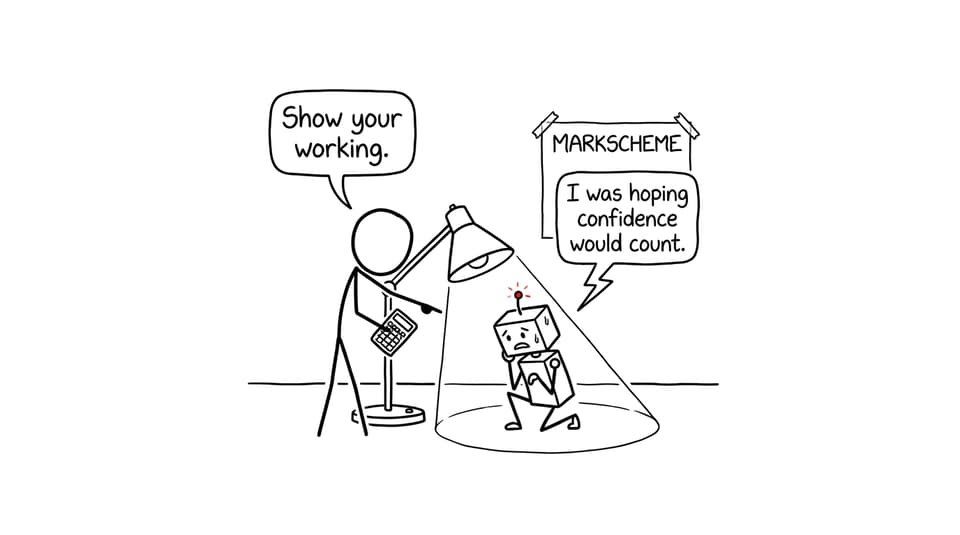
Use AI effectively by making prompts precise. Include the subject, level, topic, and command term. Ask it to show each calculation, identify assumptions, or explain why an alternative answer would lose marks. In mathematics and science, substitute results back into the problem where possible. In essay subjects, check examples and interpretations against class materials.
The key habit is simple: use Jojo to accelerate thinking, not replace it. The IB’s published AI guidance also expects students to remain critical of AI output and to acknowledge AI-generated material used in assessed work. Your school may impose additional requirements, so follow its policy.
Are grading tools and coursework feedback accurate?
RevisionDojo’s IB Coursework Grader evaluates IA, EE, and TOK drafts against relevant rubric structures. It provides annotations, criterion-level feedback, estimated performance, and suggestions for improvement. The Coursework Library then gives students examples they can study for structure and technique.
These tools are valuable because they make feedback immediate. They can highlight an underdeveloped evaluation, unclear methodology, missing justification, or weak connection to a criterion before a teacher reviews the next draft.
However, an AI estimate is not an official grade. Coursework involves disciplinary judgement, context, authenticity, and sometimes legitimate differences in interpretation. Teachers guide the submission process, the IB determines official outcomes, and externally moderated components may not receive precisely the mark a student or platform predicts.
Use automated grading diagnostically. Ask, “What should I inspect or improve?” rather than, “What grade have I secured?” If the grader identifies a concern, return to the rubric, revise in your own words, and discuss significant decisions with your supervisor.
A practical way to test accuracy yourself
Trust becomes more useful when it is testable. Choose one topic you already understand reasonably well and run a small audit:
- Read the relevant RevisionDojo note.
- Compare its headings with your current syllabus outline.
- Complete five Questionbank items without assistance.
- Review the reasoning, not merely the final answer.
- Ask Jojo to explain one mistake using the relevant command term.
- Compare any disputed point with your teacher or approved course materials.
If the explanations are accurate, aligned, and consistent, expand your use. If something looks wrong, report it and avoid turning one uncertain answer into a memorized rule.
This is not distrust. It is the same intellectual habit the IB rewards: weigh evidence, recognize limitations, and revise conclusions when better information appears.
The verdict
RevisionDojo is an accurate and valuable IB preparation platform, particularly because its resources are syllabus-organized, shaped by examiner and teacher expertise, and connected across learning, recall, practice, feedback, and timed preparation.
The honest qualification is that no third-party resource, teacher, textbook, or AI tool should be used without judgement. Human-reviewed notes deserve more confidence than an unverified instant response. Predicted Papers are simulations rather than certainties. Grading tools provide formative feedback rather than official results.
The best approach is not blind trust or permanent suspicion. It is informed use. Begin with RevisionDojo’s Questionbank, Study Notes, Flashcards, AI Chat, Grading tools, Predicted Papers, Mock Exams, Coursework Library, and Tutors. Then keep your current subject guide and teacher in the verification loop.
That combination gives you something more useful than confidence alone: a revision system built on evidence.