


A question can change the whole room
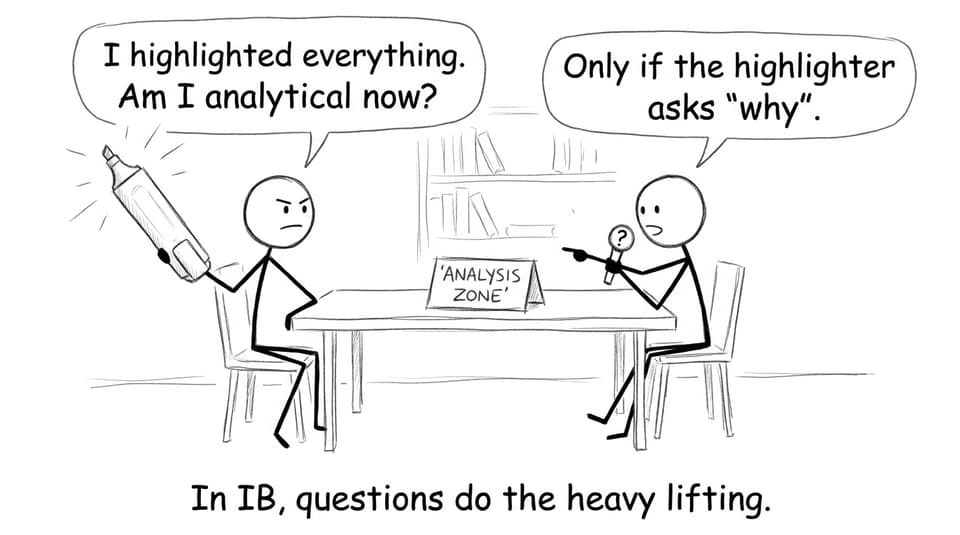
The funniest thing about the IB is that you can do all the reading, highlight all the lines, and still walk into a discussion feeling like you brought a spoon to a chess match. Someone asks a single question you didn’t expect, and suddenly the topic becomes three-dimensional. It’s not that you didn’t “know” the content. It’s that you didn’t have a handle for it.
That handle is questioning.
In the IB, the best analytical discussions (and the best exam answers) rarely begin with “What is…?” They begin with “Why does that matter?”, “What would change if…?”, or “Which interpretation survives the evidence?” The skill isn’t sounding smart. The skill is asking questions that force thinking.
This post shows you how to improve questioning techniques to foster analytical discussion, using routines you can practise alone or with friends. It’s built for IB students preparing for exams, because questioning is one of the most reliable ways to turn revision into performance.
Quick checklist: your “analytical discussion starter kit”
Use this the next time you revise a IB topic and want to think, not just reread.
-
Write one “why/how” question before you open your notes.
-
Add one counterclaim question (“What would someone disagree with here?”).
-
Use one evidence question (“What specific evidence would prove this?”).
-
Force a link question (“How does this connect to another topic or concept?”).
-
Finish with a criteria question (“What would a top-mark response need?”).
To practise these quickly, build short sets in the Questionbank feature and then ask follow-ups on your own answers.
Why questioning techniques matter for IB exam performance
Analytical discussion is not just a classroom vibe. It’s exam preparation in disguise.
In the IB, high-mark responses tend to do a few consistent things: they interpret command terms properly, they justify claims with evidence, and they show awareness of alternatives or limitations. Those are questioning moves.
When you improve questioning techniques, you naturally start doing what the IB rewards:
-
Defining what the question is really asking (command terms and scope).
-
Separating claim from evidence (and noticing gaps).
-
Evaluating perspectives (not just describing them).
-
Explaining implications (why a point matters).
If you want a structured home base for this style of learning, the RevisionDojo for IB page lays out how Study Notes, practice, feedback, and tracking fit together.
Build fewer, better questions (quality beats quantity)
Most students “revise” by collecting facts. But analytical discussion starts when you stop collecting and start pressing.
Try this: for any IB topic, write only three questions.
The Three-Question Rule
-
Meaning question: What does this concept actually mean in my own words?
-
Mechanism question: Why does it work like this? What causes what?
-
Judgement question: So what? When does this explanation fail or get debated?
In IB Biology this might be: “How does selection pressure change allele frequency over time, and what evidence would convince a skeptic?” In IB History it might be: “Which cause matters most, and how would we know we’re not over-weighting one source?” Same pattern, different content.
To keep it exam-aligned, you can grab a topic, practise it, then reflect using the RevisionDojo Study Notes workflow as your spine.
Use question ladders to move from recall to analysis
Analytical discussion often dies because everyone stays on the same rung: definition, definition, definition.
A question ladder deliberately climbs.
A simple ladder you can reuse in any IB subject
-
Clarify: “What does this term mean here?”
-
Apply: “How would it work in a new situation?”
-
Analyse: “What parts interact, and what is the relationship?”
-
Evaluate: “Which explanation is strongest, and what is the limitation?”
-
Create: “What new model/argument/solution could fit the evidence?”
Here’s the trick: when revising, don’t just answer one rung. Ask the next rung immediately.
Do it with a timer and a small set from the IB English A Lang & Lit Questionbank or the IB Chemistry Questionbank and you’ll feel the shift: you’re no longer rehearsing facts, you’re rehearsing judgement.
Wait time: the simplest tool nobody uses
If you’re revising with friends, this one change upgrades your whole discussion: after asking a question, wait five seconds.
It sounds childish. It works.
The IB rewards answers with structure and evidence. Those don’t arrive instantly. “Wait time” creates a tiny buffer where your brain stops improvising and starts reasoning.
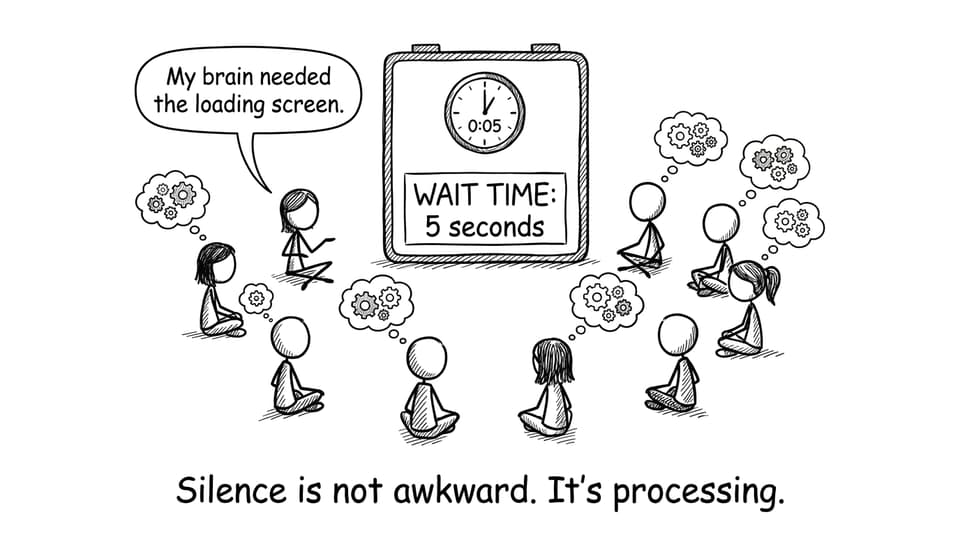
If you’re practising solo, you can simulate wait time by writing the question, closing your notes, and forcing yourself to pause before you answer. That pause exposes what you actually know.
Make discussion student-led with follow-up prompts
The fastest way to foster analytical discussion is to stop letting answers end the conversation.
Use follow-ups that demand reasoning:
-
“What makes you say that?”
-
“What’s the best evidence for that claim?”
-
“What assumption is hiding inside your answer?”
-
“What would someone argue against this?”
-
“How does this connect to a different unit?”
In IB terms, these follow-ups train you for the same moves you’ll need under timed pressure: justification, evaluation, synthesis.
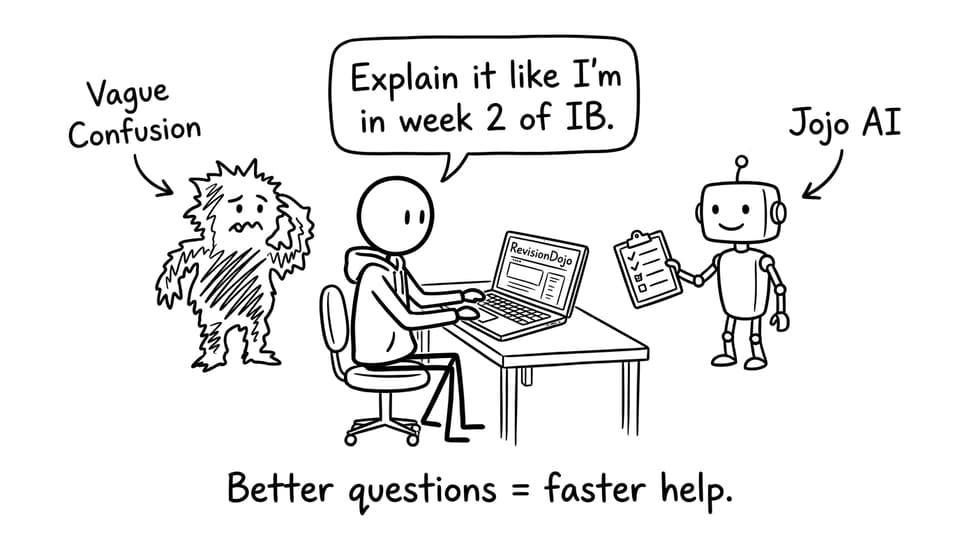
To make this habit stick, practise a short set, then ask Jojo for follow-ups. Start with the RevisionDojo Questionbank feature, answer one question, then generate three follow-up questions yourself.
Use “question stems” to sound analytical even when you’re tired
Sometimes you can think deeply, you just can’t find the language quickly. Question stems solve that.
Keep a mini bank in your notes:
-
“To what extent…”
-
“How far does the evidence suggest…”
-
“What is the most significant factor…”
-
“What would change if we removed…”
-
“Which interpretation best fits…”
Build these into your daily retention routine with IB Flashcards with Spaced Repetition. Put the stem on the front, and on the back write a real example from your subject. Your questioning techniques improve because the language becomes automatic.
Turn questioning into a feedback loop with RevisionDojo tools
Good questions are only half the story. The other half is feedback: did your answer actually meet the level the IB expects?
Here’s a loop that stays calm and practical:
-
Understand: use IB Subject Note Collections to get the clean explanation.
-
Apply: practise with the Questionbank feature.
-
Interrogate: ask one deeper “why” question about your own answer.
-
Fix: use RevisionDojo Grader for criterion-style feedback on longer writing.
-
Retain: use the Flashcards feature to keep key reasoning moves alive.
If you’re training for full timing and stamina, add one weekly simulation with IB Predicted Papers and then use your mistakes to generate better questions for the next week.
FAQ
How do questioning techniques help with IB command terms?
In the IB, command terms are basically question instructions in disguise. “Analyse” is asking you to break something into parts and explain relationships. “Evaluate” is asking you to judge using criteria, and to acknowledge limitations. When you practise questioning techniques, you start naturally generating the kinds of prompts those command terms require. That means when you see a new exam question, you’re not guessing what the examiner wants. You’re already fluent in the logic behind the task. Over time, your answers become less descriptive because your own questions force you into justification and judgement. The result is better structure, clearer evidence use, and fewer irrelevant paragraphs.
I freeze in class discussions. What questions should I ask when I’m nervous?
Start with “clarifying” questions that are still analytical. Ask, “What does that term mean in this context?” or “What evidence are we using for that claim?” Those questions buy you time while still steering the group toward reasoning. Next, use a simple counterpoint prompt: “Is there an alternative explanation?” You don’t need to deliver a perfect argument on the spot; you just need to move the discussion one level deeper. After class, recreate the moment using a small set in the IB Questionbank and practise follow-ups until they feel normal. That repetition turns fear into familiarity.
How can I practise analytical discussion alone as an IB student?
Solo practice is possible if you treat your notes like a conversation partner. Choose one topic from RevisionDojo for IB, read a short section, then write three questions: meaning, mechanism, judgement. Answer without looking, then check your answer and write one follow-up that exposes what you missed. Next, convert the weak spot into a flashcard so it reappears later, not “sometime.” If you’re stuck, use AI Chat inside RevisionDojo to ask a precise question based on your error, not a vague “explain this topic.” Finally, once per week, pressure-test yourself with a timed paper from the predicted paper sets and turn mistakes into new questions for the next cycle.
Closing: make IB analysis feel inevitable
The secret isn’t having more to say. It’s having better questions to ask.
When your questioning techniques improve, analytical discussion stops being a personality trait and becomes a routine. You clarify, you challenge, you connect, you evaluate. That’s what the IB is measuring, whether it’s a seminar, a lab conclusion, a commentary, or a timed response.
If you want one place to practise that loop without juggling tools, use RevisionDojo as your home base: Study Notes for clarity, Flashcards for retention, Questionbank for targeted practice, AI Chat and Grading tools for feedback, and Predicted Papers and Mock Exams for timing. Build better questions today, and your next IB discussion (and your next IB exam) will feel less like a performance and more like proof.