
The IB World Religions IA is a 1,500-1,800 word investigative study of an aspect of religious experience, practice, or belief. To do well, you need more than accurate information. You need a focused question, informed preliminary research, an appropriate investigation, clearly selected findings, and critical reflection on both your evidence and your methods.
The assessment is marked out of 30 across five criteria: A is worth 8 marks, B is worth 3, C is worth 6, D is worth 10, and E is worth 3. That distribution tells you something important. Almost one-third of the marks sit in critical reflection and evaluation. A polished description of a religious practice is not enough.
This guide takes you through the complete process, from choosing a question to checking the final word count. For the precise language behind each band, use your teacher's current course materials alongside this IB World Religions IA criteria guide.
IB World Religions IA overview
A strong World Religions investigative study normally follows this chain:
- Choose a specific aspect of lived religion.
- Complete preliminary reading before finalizing the question.
- Write a focused research question that can be investigated locally and ethically.
- Select methods capable of producing relevant evidence.
- Obtain informed consent and respect community boundaries.
- Identify findings rather than recounting every research activity.
- Interpret agreements, differences, limitations, and unexpected evidence.
- Evaluate your methods and suggest realistic further research.
- Reference every borrowed idea and remain within 1,500-1,800 words.
| Criterion | Focus | Maximum marks | Suggested working allocation |
|---|---|---|---|
| A | Rationale and preliminary research | 8 | 350-450 words |
| B | Plan for the study | 3 | 150-200 words |
| C | Summary of significant findings | 6 | 300-400 words |
| D | Critical reflection and evaluation | 10 | 550-650 words |
| E | References and format | 3 | Embedded throughout |
These allocations are planning suggestions, not prescribed section limits. Adjust them to suit your investigation, but protect enough space for Criterion D.
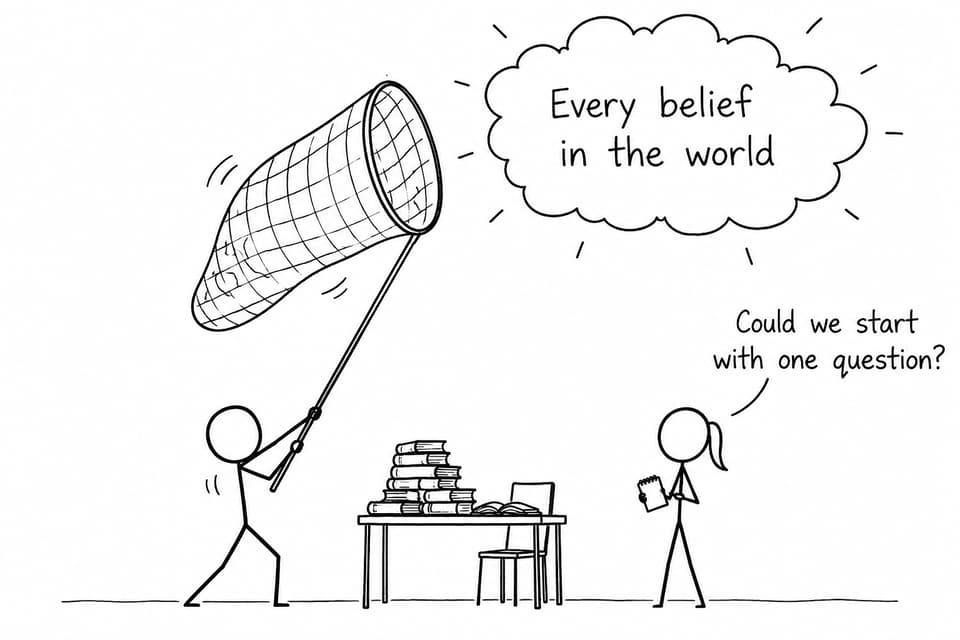
An investigation becomes manageable when curiosity is narrowed into one answerable question.
Step one: choose a question you can genuinely investigate
The first temptation is to choose a large topic because it feels important. Questions such as “How does prayer affect Muslims?” or “What is the meaning of pilgrimage in Hinduism?” sound substantial, but they contain too many people, interpretations, places, and variables for 1,800 words.
A useful question usually identifies several boundaries:
- Tradition or community: Which religious group?
- Practice or belief: What exact feature will you study?
- Participants: Whose experiences or interpretations matter?
- Context: Where does the investigation take place?
- Analytical direction: Are you exploring meaning, identity, authority, change, or community?
A hypothetical focused question might be:
To what extent do volunteers at one local gurdwara understand participation in langar as an expression of sewa?
This is not automatically a high-scoring question, but it is workable. It identifies a community, practice, concept, and group of participants. It also leaves room for different interpretations instead of assuming that every volunteer thinks alike.
Use RevisionDojo's guidance on choosing a focus and writing the research question to test whether your proposed inquiry is specific, investigable, and connected to religious experience.
Criterion A: rationale and preliminary research, 8 marks
Criterion A asks why the investigation is worth conducting and how preliminary research shaped it. Personal curiosity can explain where an idea began, but “I have always been interested in Buddhism” is not a developed academic rationale.
Build preliminary research in layers
Begin with a small but varied foundation:
- Read reliable scholarship introducing the belief or practice.
- Consult appropriate primary religious material where relevant.
- Investigate the local or denominational context of your participants.
- Compare interpretations rather than searching only for one accepted definition.
- Record complete bibliographic details immediately.
Suppose you investigate meditation in a local Buddhist community. Preliminary research might reveal that meditation has different purposes across traditions and practitioners. That discovery should narrow your question. It might also stop you from treating one participant's account as representative of Buddhism as a whole.
Explain what each important source changed
Do not turn Criterion A into an annotated reading list. Connect the research to decisions:
- A scholarly source clarified the theological concept behind the practice.
- A primary source established an important traditional teaching.
- Research on lived religion suggested that practice may differ from formal doctrine.
- Information about the local community helped define suitable participants.
The strongest rationale creates a visible line from background reading to research question. RevisionDojo Study Notes and AI Chat can help you clarify unfamiliar terminology, but every factual claim in the submitted investigation should still be checked against credible sources and referenced properly.
Criterion B: plan for the study, 3 marks
Criterion B is small, but it tests whether your design can answer your question. A vague plan produces vague evidence.
State what you will do, with whom, where appropriate, and why. Your plan might include semi-structured interviews, an observation, analysis of community materials, or a combination of methods. Explain how each method relates to the question.
For example:
- Interview three adult volunteers to explore individual interpretations of sewa.
- Observe one langar service, with permission, to understand how responsibilities are organized.
- Compare participant accounts with preliminary scholarship and relevant religious sources.
A plan should also acknowledge scale. Three interviews can reveal three situated perspectives. They cannot establish what all Sikhs believe.
Before beginning, make a realistic schedule for reading, permissions, data collection, drafting, and revision. RevisionDojo's World Religions IA timeline shows why preliminary research and ethical approval must come before fieldwork, not after it.
Fieldwork ethics: investigate people without treating them as data points
Religious identity can involve private experiences, family relationships, community tensions, and sacred commitments. Ethical research is therefore part of good method, not an administrative extra.
Before an interview or observation:
- Explain the purpose of the school investigation in accessible language.
- Request informed, voluntary consent.
- Tell participants how notes, recordings, and quotations will be used.
- Allow participants to decline questions or withdraw.
- Ask before recording audio, taking photographs, or naming anyone.
- Protect identifying details when anonymity has been promised.
- Follow school safeguards and obtain the required adult permission when minors are involved.
- Ask community leaders about rules for sacred spaces, clothing, photography, and observation.
- Store recordings and notes securely, then dispose of them according to school guidance.
Do not use deception. Do not pressure someone to explain beliefs they regard as private. Do not assume that attendance at a religious site gives permission to observe or quote everyone present.
Ethics also affects representation. Avoid presenting one person as the voice of an entire religion, and preserve the intended meaning of quotations. RevisionDojo's guides to ethical IA research and referencing and handling ethical issues in an EE or IA provide useful checks before data collection begins.
Designing questions that produce usable evidence
Good fieldwork depends partly on the questions you ask. A participant may understand a practice deeply but still provide a short or confusing answer if your wording is abstract, leading, or overloaded. Your interview schedule should invite explanation without pushing people toward the conclusion you expect.
Before writing questions, return to the research question and identify what you actually need to learn. If you are investigating how volunteers interpret sewa, asking only how often they attend the gurdwara will not be enough. Attendance may provide context, but interpretation requires questions about meaning, motivation, experience, and change.
Useful question types include:
- Opening questions: “How did you first become involved in langar?”
- Meaning questions: “What does this form of service mean to you personally?”
- Example questions: “Can you describe an occasion that captures that meaning?”
- Comparison questions: “Has your understanding changed since you began volunteering?”
- Reflective prompts: “Do you think other volunteers might understand the practice differently?”
Avoid combining several ideas in one question. “How does langar express equality, community, humility, and religious duty?” assumes those concepts are all present and asks the participant to process four claims at once. Separate questions are clearer and leave room for the participant to reject your categories.
Pilot, listen, and document consistently
A short pilot interview can reveal questions that sound sensible on paper but fail in conversation. Test the schedule with an appropriate person who is not part of the final sample, if your teacher approves. Look for technical language, hidden assumptions, repetition, and questions that consistently produce only yes or no.
During the real interview, follow the schedule without treating it as a script. Ask neutral follow-up questions when a participant introduces an important idea. Silence can be useful because people often need time to formulate an answer. However, do not turn an interview into a debate or use follow-ups to steer someone back toward your preferred interpretation.
After each session, label notes or recordings consistently and write a brief methodological memo. Record the setting, duration, interruptions, relevant non-identifying context, and any question that seemed unclear. These details can later explain differences in the evidence. They also give Criterion D something concrete to evaluate instead of forcing you to rely on vague memories.
Finally, separate exact quotations from paraphrases in your notes. Quotation marks should indicate a participant's actual words, not your reconstruction several days later. Careful documentation protects both academic accuracy and the participant whose experience you are representing.
Criterion C: summary of significant findings, 6 marks
Criterion C is not a diary of what happened. It is a selective account of the evidence that matters most to your question.
Organize the section by themes rather than chronology. If interviews produced three recurring ideas, those ideas may become the structure. Within each theme, combine concise evidence with enough context for the reader to understand its significance.
A useful pattern is:
- State the finding.
- Present supporting evidence.
- Identify variation or an exception.
- Connect the finding to the research question.
Imagine that two langar volunteers emphasize equality, while another places greater emphasis on personal discipline and duty. A weak summary smooths these answers into one claim. A stronger summary preserves the difference and shows that the same practice can carry overlapping meanings.
Distinguish evidence types carefully. An interview reports a participant's interpretation. An observation records something you noticed in a particular setting. A scholarly source offers an academic analysis. None should quietly be substituted for another.
RevisionDojo's Coursework Library can help you notice how academic reports select and organize evidence. Use examples to study structure, never to borrow wording or replicate another student's investigation.
Criterion D: critical reflection and evaluation, 10 marks
Criterion D carries the most marks because inquiry becomes valuable when you examine what the evidence means and how confidently it can be interpreted.
Interpret instead of repeating
Move beyond “Participant A said...” by asking:
- How does this evidence answer the question?
- Does it support or complicate the preliminary research?
- Why might participants interpret the same practice differently?
- Is the difference related to role, age, experience, denomination, or context?
- What alternative explanation is plausible?
Return to the hypothetical langar investigation. If every interviewee associates service with equality but only some describe it as a spiritual discipline, the analysis should preserve both findings. You might conclude that a shared practice permits several connected religious meanings. You should not claim that one interview uncovered the definitive meaning of langar.
Reflect on assumptions and positionality
Consider what you expected before the investigation. Perhaps preliminary reading made doctrine appear more uniform than participants' accounts suggested. Perhaps your interview wording assumed a distinction between “religious” and “cultural” meaning that participants did not accept.
Reflection is strongest when it identifies how an assumption influenced the study and explains what changed. This is more useful than simply stating that you learned a lot.
Evaluate each method specifically
Avoid generic lines such as “More time would have improved the investigation.” Name the limitation, its effect, and a practical response.
| Method issue | Effect on interpretation | Realistic improvement |
|---|---|---|
| Participants were recruited through one leader | The sample may favor highly involved members | Recruit through more than one community channel |
| Interviews occurred at the religious site | Participants may have emphasized community-approved language | Offer a neutral or participant-chosen setting |
| Observation covered one event | The event may not reflect ordinary practice | Observe on multiple dates, with permission |
| Questions were too abstract | Answers may reflect confusion rather than disagreement | Pilot questions and add concrete prompts |
Evaluation does not destroy your investigation. It defines what your evidence can and cannot support.
Reach a measured conclusion
Answer the research question directly, then qualify the answer. Explain the most important insight, identify meaningful variation, and state the limits of generalization. End with a specific avenue for further research, such as comparing newer and long-standing volunteers or examining another local community using the same method.
RevisionDojo Grading tools and AI Chat can challenge you to identify unsupported leaps, while an experienced RevisionDojo Tutor can help you distinguish description from reflection. The thinking and final wording must remain your own.
Criterion E: references and format, 3 marks
Criterion E rewards consistent presentation and academic documentation. Referencing is not something to repair five minutes before submission.
Check that you have:
- Cited paraphrases, direct quotations, images, community materials, and ideas derived from sources.
- Used one citation system consistently.
- Included complete entries in the bibliography.
- Applied clear section headings matching the investigation's logic.
- Presented quotations accurately and identified anonymized participants consistently.
- Added the required word count and remained within 1,500-1,800 words.
The published course guidance sets a maximum of 1,800 words. Material beyond that limit is not a hidden bonus, and exceeding it can affect Criterion E. Appendices should preserve supporting material where permitted, not carry analysis that belongs in the report. Follow your teacher's current instructions on what is included in the word count and what supporting documents must be submitted.
A practical 1,500-1,800 word editing strategy
First, draft for logical completeness. Then edit toward the limit rather than trying to compose exactly 1,800 words on the first attempt.
On the second pass, ask whether every paragraph performs one identifiable job. Remove lengthy historical background unless it is necessary to understand the question. Replace interview transcripts with selected evidence. Cut repeated explanations of the practice and protect the reflection section from last-minute compression.
RevisionDojo Flashcards and the Questionbank are useful for course knowledge, but the IA requires a different habit: sustained inquiry. Predicted Papers and Mock Exams can support the assessed examination components while you reserve dedicated sessions for coursework. That separation prevents urgent exam revision from consuming every IA deadline.
Final submission checklist
Before submitting, verify the following:
- The research question is precise and appears consistently.
- The rationale explains academic significance, not only personal interest.
- Preliminary sources shaped the investigation.
- The plan explains and justifies the selected methods.
- Consent and community expectations were respected.
- Findings are selected by significance rather than chronology.
- Participant differences have not been erased.
- Reflection answers the question and engages with relevant research.
- Method limitations are linked to their consequences.
- The conclusion does not generalize beyond the evidence.
- Citations and bibliography entries correspond.
- The report contains 1,500-1,800 words under your school's counting rules.
An effective IB World Religions IA is modest in scope but serious in thought. It does not try to explain an entire tradition. It listens carefully to a limited body of evidence, places that evidence in context, and remains honest about what can be concluded.
RevisionDojo brings that process together through its Study Notes, Questionbank, Flashcards, AI Chat, Grading tools, Coursework Library, Predicted Papers, Mock Exams, and Tutors. The tools matter because they reduce friction. The deeper value is that they leave you more time for the part no template can replace: thinking responsibly about what another person's religious experience means.