
Leaving a question blank in an IB exam feels like a small, quiet decision. No dramatic explosion. No invigilator gasping. Just a white space that stares back at you.
But that blank space carries a loud message to the marker: there is nothing here to reward.
And in the IB, marks are not a vibe. They're evidence.
This article walks through what actually happens if you leave questions blank in IB exams, why it hurts more than most students expect, and what to do instead when time, stress, or uncertainty pushes you toward the nuclear option of writing nothing. We'll keep it practical, exam-room real, and focused on how IB marking works across subjects.
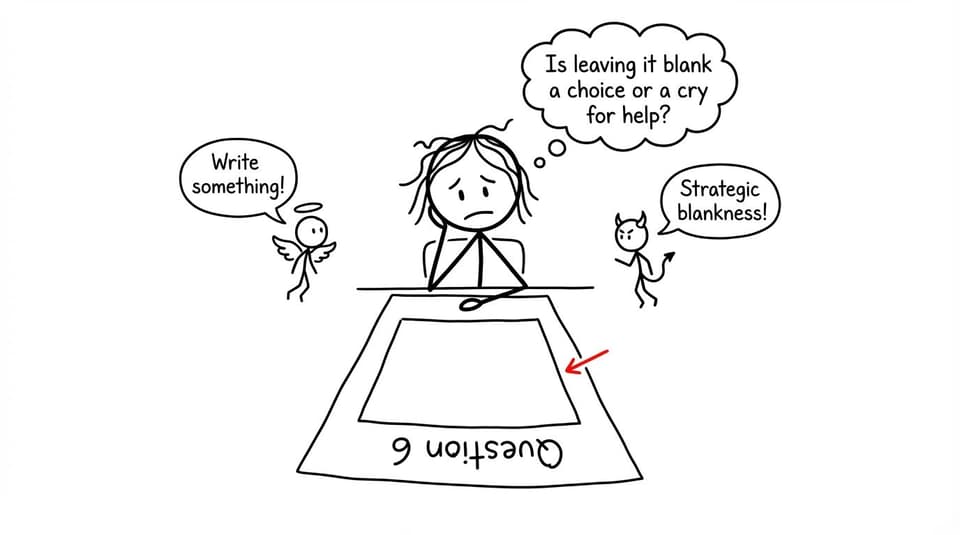
Quick checklist: should you ever leave an IB question blank?
Use this as your 10-second decision tool in an IB exam:
- If there's no penalty for wrong answers (most IB written papers), attempt something.
- If method marks exist (math, sciences), show working, even if unsure.
- If it's an essay/short response (humanities, languages), write a skeleton answer with key terms.
- If it's multiple choice (some IB papers), guess unless told otherwise.
- If time is the issue, triage: collect easy marks first, then return.
Blank answers usually guarantee 0 marks. A messy attempt can still earn partial marks in IB because examiners are trained to reward method, reasoning, and relevant ideas.
What happens if you leave questions blank in IB?
In most IB assessments, leaving questions blank means the examiner has nothing to mark. That almost always becomes 0 for that part.
The more important detail is opportunity cost. In an IB paper, many questions are designed so that:
- early steps are worth marks (definitions, formulas, setup)
- later steps are worth additional marks (calculation, evaluation, conclusion)
If you leave it blank, you miss all layers of available credit. If you attempt it, you might still pick up marks on the earlier layers.
There's also a psychological aftershock: when you knowingly leave something blank, you often carry that regret into the next question. In IB exams, momentum matters. One blank can become a time sink because your brain keeps reopening the decision.
The IB marking reality: you don't need perfection to earn marks
A useful way to think about IB marking is this: examiners are not hunting for reasons to punish you. They are trained to look for marking points.
That's why a half-finished answer can outperform a blank answer by a lot.
Method marks: the IB's hidden safety net
In IB maths and IB sciences, method marks are a quiet gift. You can:
- use the wrong value but apply the right process
- make an arithmetic slip but show correct reasoning
- draw the correct diagram even if the final conclusion is off
Those are marks you can't earn if the page is empty.
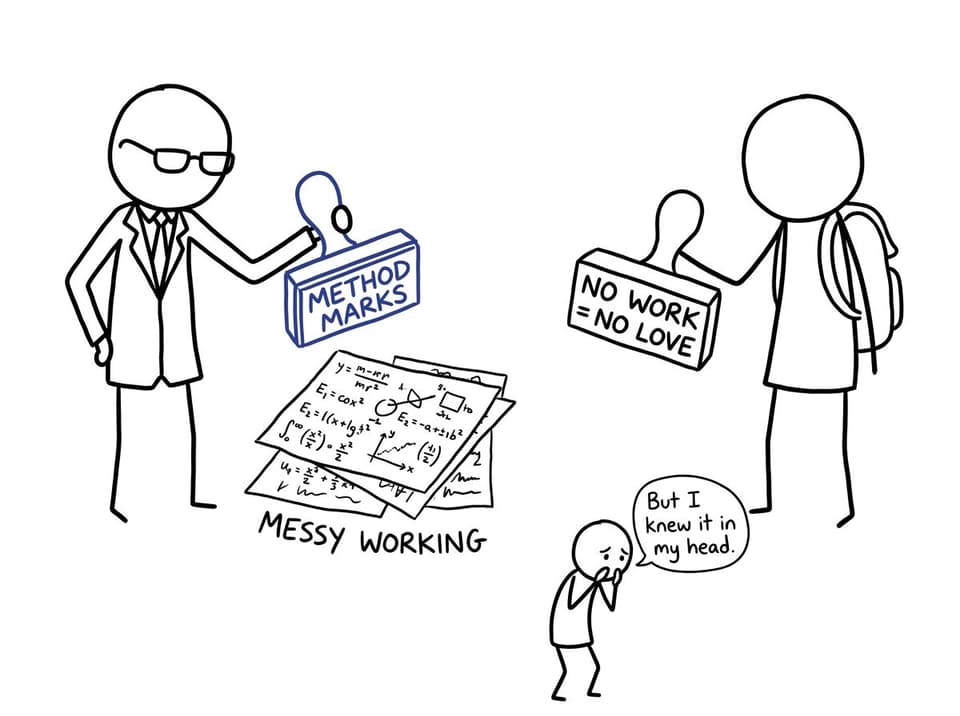
"Correct-but-not-shown" often earns less in IB
One of the harshest surprises in IB is when a student thinks, "I knew it, I just didn't write it."
In an IB exam, the marker can only award what is visible. This is especially true for:
- calculations (units, significant figures, workings)
- evaluations (comparisons, limitations, justified conclusions)
- essays (argument structure, examples, terminology)
A blank answer is invisible evidence. A short, imperfect attempt is visible evidence.
When students leave IB questions blank (and what to do instead)
Most blanks come from predictable situations. The fix is usually not "be smarter." It's "use a better default move under stress."
Scenario: "I don't know this topic at all"
In IB, "I don't know" is rarely 100% true. You might still know:
- a definition
- a diagram label
- a relevant principle
- a case study name
- an equation
What to do instead of leaving it blank:
- Write one correct sentence using subject vocabulary.
- Add a labeled diagram if relevant (bio, chem, physics, geography).
- State the formula and substitute what you can.
Even if you only secure 1-2 marks, that can be the difference between grade boundaries later.
Scenario: "I'm running out of time"
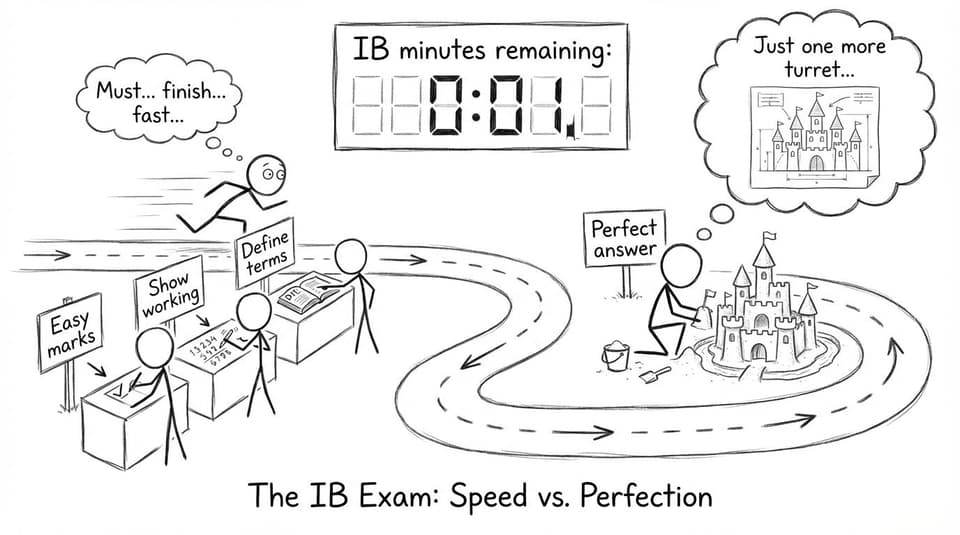
Time pressure is the most common reason IB students leave questions blank. It often happens because earlier answers became too "perfect."
Perfection is expensive in minutes.
What to do instead:
- Switch to mark-maximizing mode: grab easy marks across the paper.
- Write bullet-point logic for long responses.
- Use headings for essays: claim, evidence, explanation, link.
- If a question has parts (a), (b), (c), answer the highest-yield parts first.
Scenario: "I'm scared a wrong answer will lose marks"
This fear is common, but in most IB written papers there is no negative marking. That means a wrong attempt does not subtract from your score. The usual outcome is simply: correct earns marks, incorrect earns none.
What to do instead:
- Attempt with clear reasoning.
- For multiple choice, make an educated guess and move on.
- For calculations, show method and units.
If you're unsure about a specific paper format, ask your teacher and confirm with official instructions for that subject. But as a general IB exam strategy, guessing is often better than leaving it blank.
Subject-by-subject: how blank answers hurt in IB
Different IB subjects punish blank answers in different ways.
IB Maths: blank answers erase method marks
In IB Maths, blank answers are especially costly because many marks are awarded for:
- stating the correct formula
- rearranging correctly
- showing intermediate steps
- using correct notation
Even if you can't finish, showing structure can earn marks. A blank answer earns none.
IB Sciences: diagrams and units can save you
In IB Physics, IB Chemistry, and IB Biology, you can often earn marks by:
- drawing a diagram or graph with labels
- stating a law or principle
- writing units and significant figures
- describing a method or control variable
Blank responses give the examiner nothing to reward.
IB Humanities: structure earns credit, even when details are thin
In IB History, IB Economics, IB Geography, and similar subjects, a partially developed response can still gain marks for:
- relevant terminology
- a clear claim
- a basic chain of reasoning
- a brief evaluation
A short paragraph with correct concepts is often better than a blank page.
IB Languages: something beats silence
In language papers, leaving blanks can be doubly painful because:
- comprehension questions often award marks for key points
- writing tasks reward communication and organization
Even simple sentences can earn credit. A blank answer can't.
The best "never blank" tactics for IB exam day
If you want one dependable IB rule: earn something everywhere.
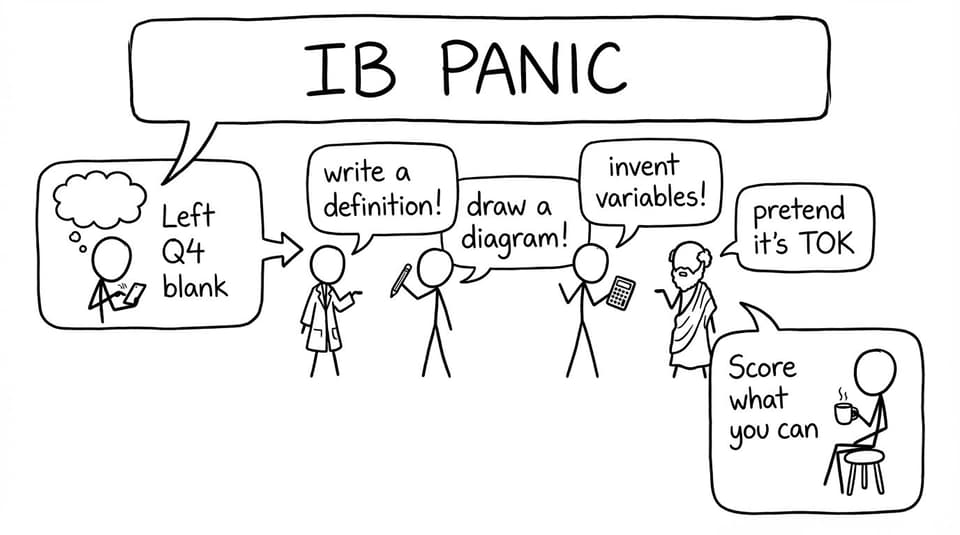
Use the "30-second salvage"
When you're stuck, give yourself 30 seconds to write any of the following:
- a definition
- a formula
- a diagram
- a case study/example
- one correct inference
Then move on. This prevents the emotional spiral that creates more blanks.
Write for the markscheme, not for your ego
IB markschemes reward specific things: key terms, steps, justification, evaluation. Your job is to place those on the page.
A calm way to train this is to practice with:
- timed question sets
- mark-by-mark review
- examiner-style feedback
This is where RevisionDojo is built to help. Use the RevisionDojo Questionbank to practice under time, then use Study Notes and Flashcards to patch weak topics fast. If you need quick clarity mid-revision, AI Chat can help you turn "I don't get this" into a plan you can execute.
Triage like an adult: easy marks first
A surprising number of IB students lose marks not from difficulty, but from misplaced time.
Try this approach:
- First pass: answer questions you can do quickly.
- Second pass: medium questions with clear method marks.
- Final pass: the heavy questions.
This reduces the risk of leaving multiple questions blank at the end.
How RevisionDojo helps you stop leaving IB questions blank
Blank answers are rarely a knowledge problem alone. They're usually a systems problem: timing, confidence, and exam habits.
RevisionDojo is designed to make those systems feel predictable:
- Questionbank to drill IB-style prompts until the structure becomes automatic.
- Study Notes to rebuild weak units without drowning in textbooks.
- Flashcards to keep definitions, processes, and key terms ready under pressure.
- AI Chat for instant explanations when you're stuck and tempted to avoid the topic.
- Grading tools to learn what earns marks (and what doesn't).
- Predicted Papers and Mock Exams to simulate the real IB time-pressure environment.
- Coursework Library to reduce background stress so you can focus on exam technique.
- Tutors when you need a human to spot the pattern behind your blanks.
The goal is simple: make "attempt something" your default, because you've trained what "something" looks like.
Closing: In IB, blanks are silent and expensive
The IB doesn't punish you for being human under pressure. But it does reward what you put on the page.
A blank answer is a locked door: no method marks, no reasoning marks, no chance of partial credit. A rough attempt is at least an open window.
If you want fewer blanks in your next IB exam, train the exact habit you'll rely on when your brain goes quiet: salvage something, then move. Build that reflex with timed practice, markscheme-aware review, and realistic mocks.
When you're ready to make that feel automatic, use RevisionDojo's Questionbank, Mock Exams, Predicted Papers, Study Notes, Flashcards, AI Chat, Grading tools, and Tutors to practice the one skill that quietly raises grades: never giving the examiner an empty page in IB.