IB subject selection regret often begins with one thought: I picked wrong. If that thought arrives during September, October, or November, do not ignore it, but do not immediately rebuild your timetable either. Identify the real problem, check university prerequisites, speak to your Diploma Programme coordinator, and compare the cost of switching with the cost of staying.
Early action matters because missed lessons accumulate. Yet difficulty alone does not prove that a subject is wrong for you. The opening months of the Diploma Programme can make almost every reasonable choice feel questionable.
The goal is not to eliminate discomfort. It is to determine whether that discomfort reflects normal adjustment, an ineffective study system, or a genuine mismatch between you and the course.
Your immediate checklist
Before requesting a change:
- Write down exactly why you regret the subject.
- Separate subject difficulty from teaching style, workload, or one disappointing result.
- Check official entry requirements for several realistic university courses.
- Confirm that your proposed combination preserves IB subject-group and HL requirements.
- Ask your coordinator about deadlines, timetable blocks, class capacity, and registration.
- Request a topic-by-topic catch-up list from the receiving teacher.
- Compare a 14-day recovery plan with a 14-day switching plan.
- Decide using evidence, not the mood created by one difficult week.
The IB Diploma normally includes six subjects, with three or four studied at Higher Level. A change must therefore work across your entire diploma, not merely remove one unpleasant lesson.
First, name the type of regret
Subject regret is a broad label for several different problems. Treating them as identical can lead to an expensive decision.
The subject is harder than expected
New command terms, unfamiliar assessments, and faster teaching can temporarily make a suitable subject feel impossible. Ask whether you understand the material after a clear explanation and focused practice. If your understanding improves, the problem may be method rather than fit.
Use IB revision notes organised by subject, then attempt a small set of relevant questions. Improvement after targeted work is useful evidence, even if the subject still feels demanding.
You dislike how the subject is assessed
A student may enjoy psychology but dislike extended written responses. Another may like scientific ideas but struggle with calculations, data analysis, or practical work. Course titles reveal themes, not the weekly experience of producing marks.
Review the correct subject guide, assessment components, and HL or SL expectations. RevisionDojo's guide to choosing subjects through the IB subject guides can help you examine the real course rather than the version you imagined during enrolment.
Your university plans have changed
This is the most urgent form of regret. Some university programmes specify particular subjects or levels, especially in mathematics, sciences, medicine, and engineering. Requirements vary between universities and admission cycles, so advice from friends is not enough.
Check official admissions pages for each course you might realistically pursue. Record whether every subject is required, recommended, or simply helpful. If your current combination closes an important pathway, bring that evidence to your coordinator promptly.
The workload is damaging your wider diploma
One difficult HL can consume time needed for five other subjects, TOK, the Extended Essay, CAS, and life outside school. For 7-10 days, record how long the subject takes and whether the problem is understanding, recall, writing, or speed. An IB Study Planner can make the imbalance visible.
Use the IB DP1 fall term wisely
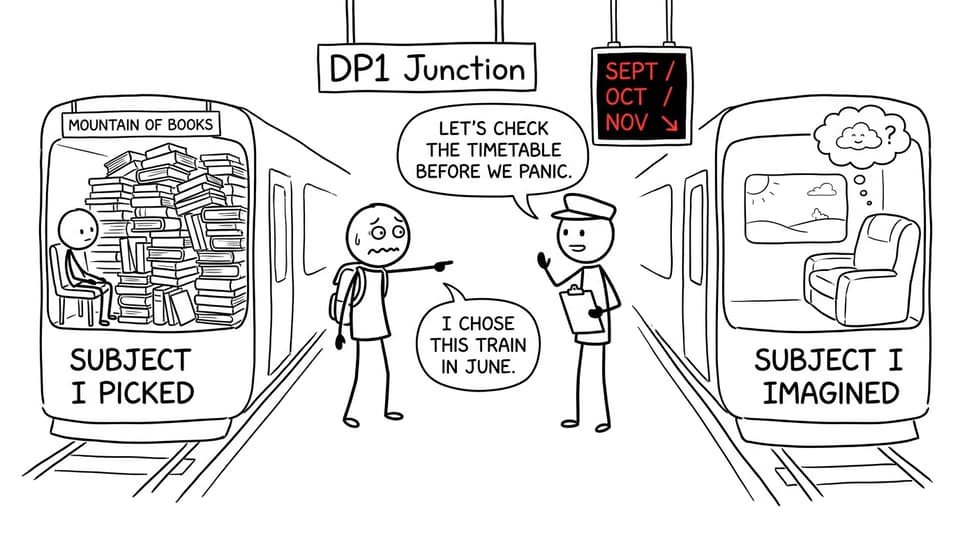
September-to-November is valuable because you have real classroom evidence while retaining more recovery time than you will later. It is not a universal switching window. Schools set their own processes, and feasibility depends on timetables, staffing, class space, missed content, and assessment planning.
Students cannot independently amend their official IB assessment registration. The school's DP coordinator manages that process. Bring your reason for changing, recent assessment evidence, the subject and level you want to enter, relevant university requirements, and a realistic catch-up proposal.
Avoid saying only, "I hate this subject." Explain what you tested, what remained difficult, and why the alternative is a better academic fit. For more detail, read whether you can change subjects during DP1.
Decide whether to switch, change level, or recover
There are usually three routes:
| Route | Best fit | Main risk |
|---|---|---|
| Switch subjects | The course is structurally unsuitable or blocks an important pathway | Missing content and timetable complications |
| Change HL or SL | You value the subject but chose the wrong depth | The revised HL combination may become unbalanced |
| Stay and recover | The issue is early difficulty, weak foundations, or study method | Waiting too long if the mismatch is genuine |
A complete switch is not always necessary. Moving from HL to SL may reduce depth and teaching-hour demands while preserving a subject you enjoy. Another subject would normally need to move to HL so that your diploma still meets the required structure.
If HL intensity is the problem, use the IB HL regret rescue plan to test whether recovery is realistic before changing your programme.
Run a 14-day evidence test
Regret feels permanent when it remains vague. A short experiment turns it into information.
Choose one representative topic from your current subject. Spend 14 days using a controlled learn, test, and review cycle. Read concise Study Notes, use Flashcards for retrieval, and complete targeted Questionbank practice without notes. Ask AI Chat to explain precise points of confusion, then use Grading tools on written responses and record repeated weaknesses. Finish with a timed mini-assessment under realistic conditions.
RevisionDojo brings this cycle together in its complete IB resource hub. The test is not whether the work becomes effortless. Ask whether your understanding, performance, and confidence improve when the study method improves.
At the same time, request sample materials and a catch-up map for the proposed replacement. Complete a small diagnostic task if possible. You are comparing two realities: the course you have experienced and the course you would actually enter. Do not compare a difficult reality with an imagined easy alternative.
Build a catch-up plan before switching
If the school approves a switch, ask what the new class has completed and convert that list into weekly outputs. Begin with missed topics and essential vocabulary, then rebuild foundations, practise standard question types, and finish the month with a timed section and full error review.
Use the RevisionDojo Questionbank and study resources to target gaps instead of revising the entire course indiscriminately. Study Notes and Flashcards support coverage, while AI Chat can unblock specific questions. The Coursework Library clarifies future assessment expectations, and Tutors can provide human diagnosis when the gap is substantial.
Predicted Papers and Mock Exams are more useful once foundations are stable. They test integration and timing; they should not replace learning missed content. Your catch-up plan must also protect sleep, current classes, and core obligations. The guide to managing a full IB timetable can help you create room without causing a second crisis.
If you cannot switch
A school may decline because the timetable does not work, the replacement class is full, or too much essential content has been missed. Ask whether an HL-to-SL adjustment is possible, then request specific support from your teacher.
Break weaknesses into concepts, assessment technique, and time management. Build a weekly loop: understand one area, retrieve it from memory, apply it to questions, review feedback, and try again. RevisionDojo's Questionbank, Study Notes, Flashcards, AI Chat, and Grading tools make that process easier to sustain.
IB subject selection regret is not proof that you failed to plan. You made a decision with limited information, then gained better information by experiencing the course. Act promptly, but not impulsively. Check prerequisites, consult the people who control the timetable, test your current subject with a better method, and calculate the alternative's catch-up cost.
Whether you switch or stay, RevisionDojo gives you one place to rebuild momentum. The final decision belongs to you and your school. The work that makes it succeed can begin today.