



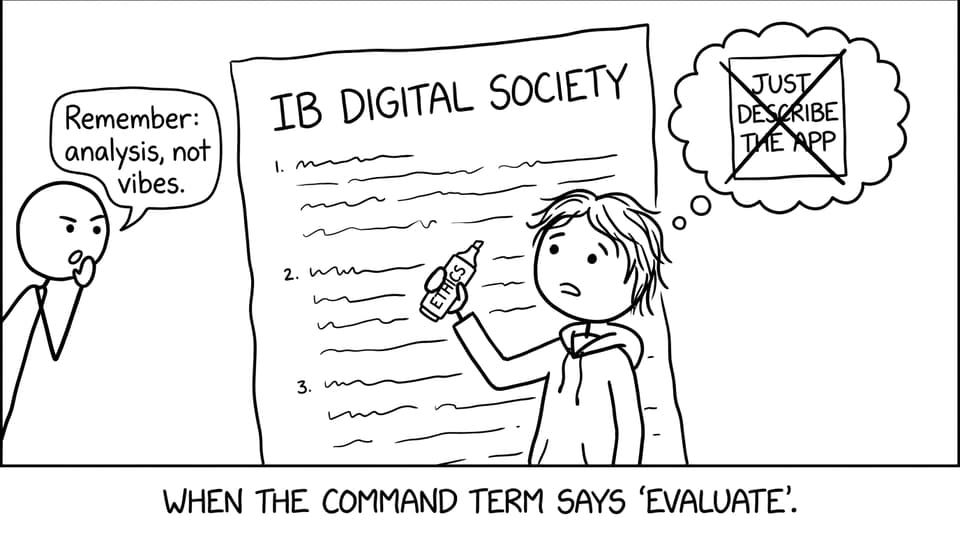
If you’ve ever felt that IB Digital Society is “obvious” because you live online, you’re not alone. Most students start the course thinking familiarity will translate into marks. Then the first timed response happens, and the feedback is blunt: too descriptive, not enough analysis.
That’s the quiet trap of IB Digital Society assessment. It doesn’t reward who knows the most apps. It rewards who can explain how a digital system shapes people and communities, and then evaluate the trade-offs with evidence, ethics, and clarity.
This overview breaks down how IB Digital Society is assessed through exams and the internal assessment (IA), what examiners are actually looking for, and how to train those skills without burning out.
IB Digital Society assessment at a glance
Here’s a simple way to hold IB Digital Society assessment in your head. Every task, whether it’s an exam response or the IA, is checking whether you can do five things consistently:
-
Identify a specific digital system (not a broad topic)
-
Apply course concepts to explain how it works in context
-
Analyze impacts on individuals and communities
-
Evaluate implications, trade-offs, and ethical tension
-
Communicate with structure (so your thinking is visible)
If you want a home base for the full course toolkit, start with IB Digital Society Resources, which connects Study Notes, Flashcards, Questionbank practice, and exam simulation.
How IB Digital Society exams are designed
The exams in IB Digital Society are built around unfamiliar stimuli and real-world style scenarios. That design is intentional: it forces transfer. You’re not meant to repeat memorized paragraphs. You’re meant to show you can think with concepts.
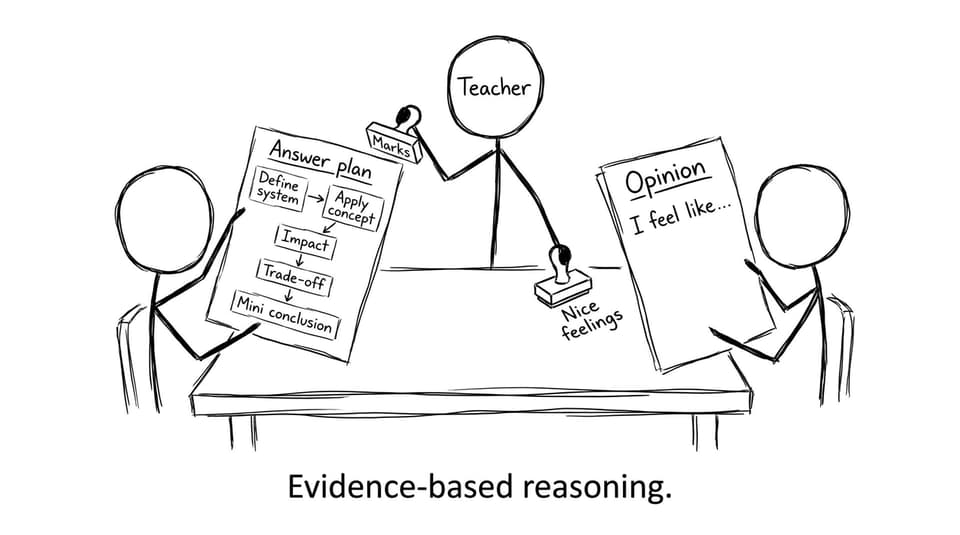
A strong IB Digital Society exam answer typically does four moves, in order:
-
Name the digital system clearly (platform feature, policy, algorithmic tool, database, device, etc.)
-
Select 1-2 relevant concepts and define them in your own words
-
Analyze mechanisms (cause-and-effect, incentives, who gains power, who loses options)
-
Evaluate with justified judgment (trade-offs, ethics, uncertainty, possible responses)
If you keep slipping into storytelling, it helps to study “concept glue”, how ideas connect instead of sitting in separate boxes. RevisionDojo’s guide on how the core concepts fit together is built for that exact problem.
What exam questions really reward
Examiners aren’t grading your tech knowledge. They’re grading the quality of your reasoning. In IB Digital Society, that usually means:
-
Conceptual control: you use terms precisely, not as decoration
-
Stakeholder awareness: you can see more than one perspective
-
Evidence-based claims: you ground points in credible sources or clearly explained examples
-
Command term accuracy: you do what the question asks (analyze vs discuss vs evaluate)
When students drop marks, it’s often because they answer a different question than the one on the page. A fast fix is to practice with unseen prompts using a timer and immediate feedback. RevisionDojo’s Questionbank is designed for exactly that loop: targeted drills, markscheme-style feedback, and rapid repetition. See Questionbank.
Responding to unseen case studies without panicking
The unseen element is where IB Digital Society becomes strangely fair. Everyone meets new material. So performance comes from process.
Try this 90-second planning routine before you write:
-
Underline the digital system and the affected group
-
Circle the command term
-
Write two concepts you can genuinely apply
-
Draft a mini line of argument: “This system shifts power by… which leads to… however…”
If you want a deeper lens set for almost any stimulus, RevisionDojo’s breakdown of key themes in IB Digital Society is a reusable way to organize your thinking under pressure.
SL vs HL: what changes in IB Digital Society assessment
Both SL and HL share the same core logic: concept-driven analysis of digital systems and their impacts. The difference is that HL typically demands more sustained depth.
In practice, HL students usually need to:
-
Build longer chains of reasoning (not just one-step impacts)
-
Make evaluation more explicit (trade-offs, counterarguments, justified conclusion)
-
Integrate multiple perspectives without losing structure
If HL sometimes feels like “just write more,” it helps to reframe it as “justify more.” The number of words matters less than the number of reasoning steps.
The IB Digital Society internal assessment (IA) in plain terms
The IB Digital Society IA is an individual inquiry into a real digital system. It is not a technical report, and it’s not a generic research essay. It’s closer to a disciplined investigation: you choose a system, gather evidence, compare perspectives, and evaluate implications.
Key IA facts to hold onto:
-
The IB recommends approximately 30 hours of class time for the IA process.
-
The inquiry process document has a maximum of 1500 words.
-
The recorded multimedia presentation has a maximum of 10 minutes.
For the most accurate step-by-step guidance, use the examiner-style breakdown in the IB Digital Society IA Guide. And if you want to see what a high-quality project can look like, explore a sample in the IB Digital Society IA Exemplar.
Choosing an IA focus that stays manageable
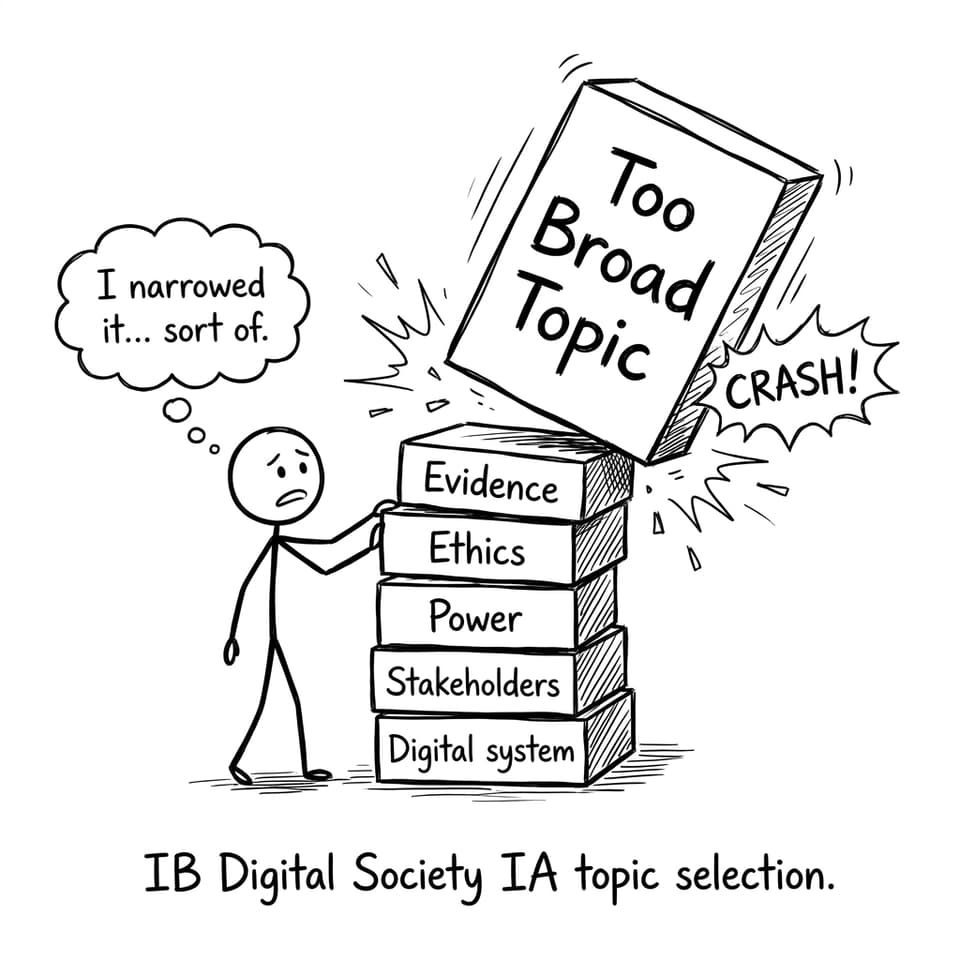
Most IA stress comes from scope. Students pick “social media” or “AI” and then wonder why everything feels shallow.
A better IB Digital Society IA focus is:
-
One identifiable digital system (feature/policy/tool)
-
A defined context (place, community, time)
-
Clear stakeholders (who is affected and how)
-
Built-in ethical tension (privacy, bias, consent, accountability)
RevisionDojo’s guide on writing a strong IA research question is especially helpful when you’re stuck between “too broad” and “too niche.”
A practical prep loop for IB Digital Society (exams + IA)
You don’t need a perfect schedule. You need a repeatable loop.
-
Study Notes to clarify the concept you keep misusing
-
Flashcards to lock in definitions and command term habits
-
Questionbank to practice applying ideas under exam conditions
-
AI Chat when you’re stuck mid-question and need a fast explanation
-
Grading tools to learn how marks are awarded (especially for written evaluation)
-
Mock Exams and Predicted Papers to rehearse timing and decision-making
-
Coursework Library + Tutors when IA planning or feedback becomes the bottleneck
To build your overall approach, the Ultimate Survival Guide for IB Digital Society is a solid map from “I’m revising” to “I’m training.”
FAQ: IB Digital Society assessment
How do I stop being descriptive in IB Digital Society exam answers?
Description isn’t “bad” in IB Digital Society, but it’s only useful when it sets up analysis. The fastest fix is to limit description to one or two sentences, then move immediately into mechanism: how does the system produce that outcome? After that, add stakeholders: who benefits, who is harmed, who has control, and who has limited choices. Then evaluate: what trade-off is being normalized, and is it justified in this context? Finally, write a mini conclusion that answers the command term directly, even if your conclusion is tentative. Practicing this structure repeatedly in the IB Digital Society Resources Questionbank builds the habit faster than re-reading notes.
What makes a strong IB Digital Society IA question?
A strong IB Digital Society IA question names a specific digital system and makes impacts on people unavoidable. It should invite conceptual analysis (power, inequality, culture, ethics, change) rather than technical explanation. It also needs to be researchable with credible sources you can access, not insider data you can’t realistically obtain. The best questions create space for evaluation: you should be able to reach a justified judgment, not just summarize perspectives. Finally, the question should narrow context: a particular country, platform version, policy change, school setting, or community group. If you’re unsure, use RevisionDojo’s breakdown on how to write a strong IA research question and sanity-check your scope before you commit.
How should I use ethics without sounding preachy?
In IB Digital Society, ethics is not a “moral speech” at the end. It’s a method for weighing values when outcomes collide: privacy vs safety, convenience vs autonomy, innovation vs inequality. Start by naming the ethical tension clearly, then show how different stakeholders prioritize different values. Use evidence: policies, documented harms, real examples, and credible reporting, not just “people might feel.” Then make a justified judgment that acknowledges uncertainty and trade-offs, because confident oversimplification usually scores poorly. Ethics works best when it’s integrated through your analysis, not added as a final paragraph. If you want a theme-based way to do this consistently, review IB Digital Society: Key Themes Explained and practice applying one theme per paragraph.
Closing: make IB Digital Society feel predictable
The good news about IB Digital Society assessment is that it’s stable. The surface details change: new apps, new policies, new controversies; but the marking logic stays the same: concept-driven analysis, evidence-based evaluation, ethical reasoning, and clear structure.
If you want that stability to show up in your grades, build your prep around practice loops, not passive revision. Start with IB Digital Society Resources, drill exam skills in the Questionbank, and use the IB Digital Society IA Guide to keep coursework focused and manageable. With the right loop, IB Digital Society stops feeling like a subject about “the internet” and starts feeling like a subject you can train for and win.