

A concrete company finds gold (and you find time)
The weird part of studying for Paper 1 isn't the pressure. It's the timing.
Three months before the exam, the IB Business Management 2026 case study lands in your inbox like a sealed envelope. You get just enough information to feel responsible, and not enough to feel ready. The IB Business Management pre released statement 2026 tells you what's coming, what words matter, and what you're allowed to research (five hours, maximum). It's a small window.
And this year's window opens onto a company that makes the most ordinary thing in the world--concrete--and then, by accident, discovers a way to pull gold out of e-waste.
That's Abraca ABC IB in one sentence: heavy industry meets circular economy.
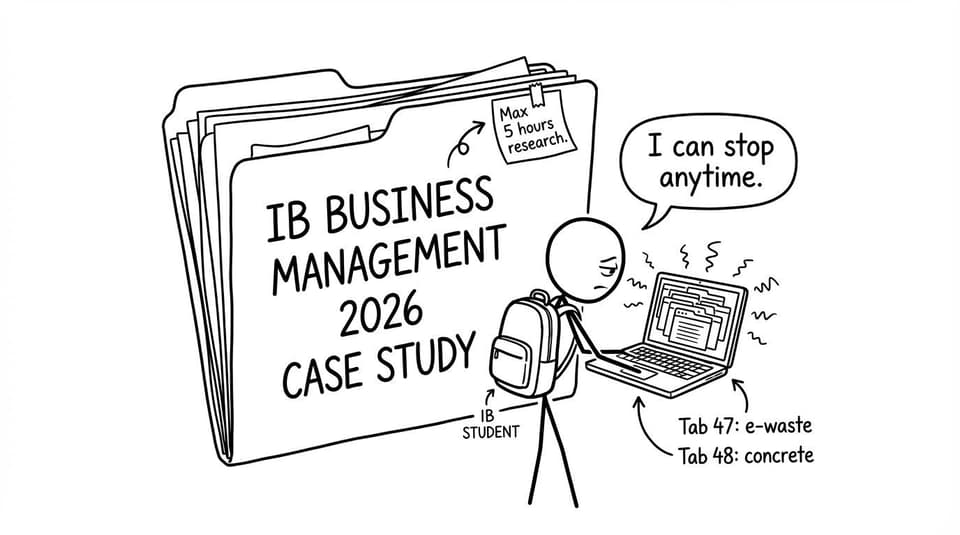
This guide is your calm, complete summary of the IB Business Management 2026 case study, built around what the IB Business Management pre released statement 2026 expects you to know, and how to turn Abraca ABC IB into high-scoring Paper 1 application and evaluation.
Quick checklist: what to do with the pre-released statement
Use this as your five-hour plan for the IB Business Management pre released statement 2026 and the IB Business Management 2026 case study:
- Read the first four paragraphs twice and annotate: products, processes, stakeholders, numbers, and decisions.
- Build a mini glossary of the extra terms (listed below) in your own words.
- Make a "decision map" for ABC's four considerations: efficiency, environment, market orientation, growth.
- Prepare 6-8 reusable paragraphs that link tools to this context (STEEPLE, SWOT, Ansoff, stakeholder conflict).
- Practice exam-style responses under time using RevisionDojo's Questionbank and Predicted Papers.
Helpful RevisionDojo hubs to keep open while you prep for the IB Business Management 2026 case study:
- Business Management subject hub
- IB Business Management Predicted Papers
- How to Maximize Your Score in IB Business Management
Abraca (ABC) case study context: what the four paragraphs really say
Here's the clean summary of the Abraca ABC IB context from the opening extract of the IB Business Management 2026 case study:
- ABC is publicly held and the largest concrete producer in Country Z.
- It buys limestone and clay aggregates to make cement, which becomes concrete.
- Concrete is everywhere (the case states: half the world's buildings are made from concrete), which hints at scale, demand stability, and also environmental scrutiny.
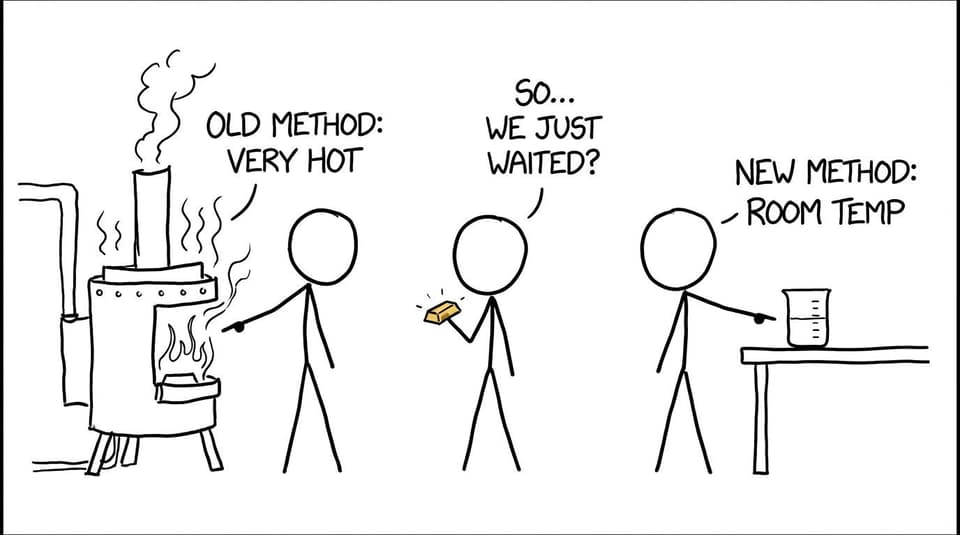
- While researching recycled aggregates for concrete, ABC's scientists accidentally discover a room-temperature process to recover gold and other precious metals from electronic circuit boards (e-waste).
- The older method required burning at extremely high temperatures, described as carbon-intensive.
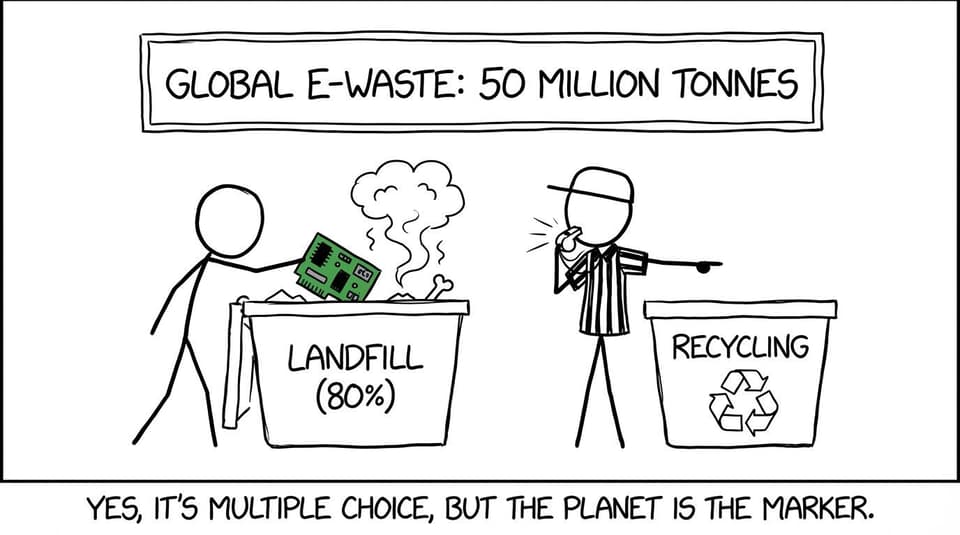
- Global e-waste is 50 million tonnes per year; only 20% is recycled; 80% goes to landfill.
- ABC opened an e-waste processing factory in 2024, processing 100 tonnes per week and recovering hundreds of kilograms of gold per year, sold to jewellery makers.
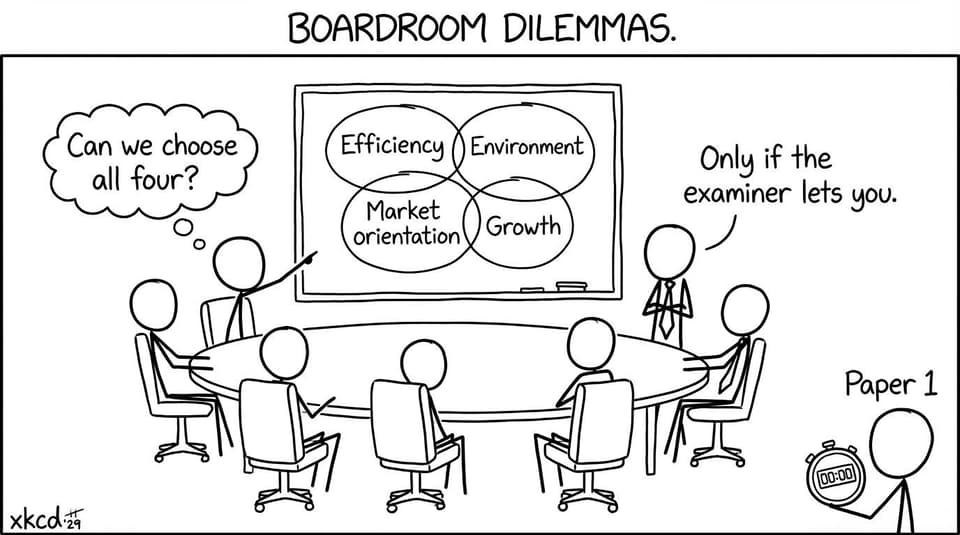
- ABC is considering: improving concrete efficiency, reducing environmental impact, becoming more market-orientated, and growth options.
In Paper 1 terms: ABC is not a start-up story. It's an incumbent with market power in a mature market, suddenly holding a potential new capability in a fast-growing environmental problem.
The terminology list: learn it for application, not definitions
The IB Business Management pre released statement 2026 is explicit: you're expected to have basic familiarity with these terms, not a deep engineering qualification. The trap is writing long explanations that don't earn marks.
Below is the terminology from the statement, framed as "what it helps you do in Paper 1" for the IB Business Management 2026 case study and Abraca ABC IB.
Aggregates (as construction materials)
Aggregates are materials like crushed stone, sand, or recycled material mixed into concrete. For ABC, aggregates become an operations, sustainability, and procurement discussion: cost, quality, supplier relationships, and environmental impact.
Business-to-business (B2B)
ABC's concrete business is likely B2B (selling to construction firms, developers, government contractors). This matters when evaluating market orientation: relationship marketing, tendering, long-term contracts, and price sensitivity.
Carbon-intensive
This is central. The old metal recovery method is carbon-intensive; concrete production is also often associated with significant emissions. ABC's strategic challenge is credibility: can it reduce carbon while expanding?
Circuit boards
Circuit boards are the e-waste input. In Paper 1, treat them like a raw material with supply chain, quality variation, and regulatory constraints.
Clay, limestone, concrete, recycling, landfill
These terms locate ABC in a classic operations environment: raw material sourcing (primary sector links), manufacturing (secondary sector), logistics, compliance, and community impact.
E-waste, toxic metals, solar panels, plastic-shredding machinery
These hint at wider circular economy opportunities and risks. E-waste includes hazardous materials; processing requires health and safety, investment, and potentially reputational risk if mishandled.
If you want a fast way to make terminology stick, build a micro-deck in RevisionDojo Flashcards and quiz yourself for two minutes daily. Pair it with one tool per term (eg "landfill" + stakeholder conflict; "B2B" + market research).
Why this case study is a gift for business tools
The IB Business Management 2026 case study is almost engineered to reward smart tool choice. Every major theme links cleanly to a toolkit model, but you only score if you apply it to Abraca ABC IB with the numbers and the context.
If you need a central place to revise the models you'll actually use in the IB Business Management pre released statement 2026 context, keep this open:
Efficiency in concrete production (operations lens)
"Improving efficiency" is not a vague wish. In a heavy manufacturing firm like ABC, it usually means:
- reducing waste (lean thinking)
- improving quality assurance to cut defects
- investing in R&D and process innovation
- increasing capacity utilization and reducing downtime
In Paper 1, efficiency becomes evaluation: investment cost vs long-term unit cost reduction, impacts on workforce, and whether gains can be sustained.
To practice operations-style application (without drifting into generic writing), use RevisionDojo's Business Management hub plus topic practice:
Environmental impact (ethics and sustainability lens)
ABC sits in an uncomfortable intersection: concrete demand is huge, but environmental pressure is huge too. The e-waste innovation can look like "green progress," but it also raises questions:
- regulatory compliance for hazardous waste
- stakeholder concerns (community, employees, NGOs)
- greenwashing risk if core concrete emissions stay high
- whether e-waste processing scales without causing new harm
This is where you win evaluation marks: show trade-offs, pick criteria, and end with a justified recommendation that fits ABC's resources and reputation.
Becoming more market-orientated (marketing lens)
A market-orientated business listens first, builds second. In Abraca ABC IB, that could mean:
- deeper relationships with construction firms (B2B account management)
- market research into demand for "lower-impact concrete"
- repositioning the brand around sustainability and innovation
- creating new stakeholder messaging about the e-waste operation
If you want exam-style practice for market research application, this RevisionDojo page is useful:
Growth options (strategy lens)
Growth is where Paper 1 often turns: internal vs external, risk appetite, financing, stakeholder objectives. ABC is publicly held, so growth decisions connect to shareholder expectations, dividends, long-term value, and reputational resilience.
For growth framing, Ansoff is usually your cleanest starting point. Don't just name it--attach it:
- market penetration: sell more concrete in Country Z, win more contracts
- product development: develop lower-carbon concrete mixes using recycled aggregates
- market development: export concrete products or license the e-waste process
- diversification: scale the e-waste business into a serious second revenue stream
To sharpen strategy writing, pair model learning with timed practice:
The two-business problem: concrete stability vs e-waste uncertainty
One of the most interesting features of the IB Business Management 2026 case study is that ABC is effectively managing two different business logics.
Concrete is scale, reliability, and cost control. E-waste is innovation, uncertainty, and regulation.
That tension is where many Paper 1 questions will live. If the exam asks you to recommend a strategy, you'll likely need to answer a quiet question underneath:
Is ABC trying to make concrete less harmful, or trying to become something else?
Neither is automatically "better." Your job is to choose based on evidence, and argue like a calm decision-maker.
How to turn the Abraca ABC IB context into Paper 1 marks
Here are four repeatable moves that fit almost any IB Business Management 2026 case study question and keep your writing grounded in Abraca ABC IB.
Anchor every paragraph in a case fact
Use one of these in each body paragraph:
- publicly held company
- largest concrete producer in Country Z
- 50 million tonnes e-waste per year
- 20% recycled, 80% landfill
- 100 tonnes circuit boards per week
- hundreds of kilograms of gold per year
Then analyze the implication. This is how you stop sounding generic.
Define briefly, then apply immediately
Definitions should be one line. Your marks come from application to ABC.
If you need quick, syllabus-aligned refreshers while preparing the IB Business Management pre released statement 2026, RevisionDojo's topic notes keep definitions tight and usable:
Evaluate with a clear criterion
Evaluation is not "on the other hand" forever. Pick criteria such as:
- profitability and cash flow stability
- regulatory risk
- reputational impact
- operational feasibility
- long-term sustainability
Then conclude.
Practice with feedback loops
Do one timed response, get feedback, rewrite once. RevisionDojo's ecosystem is designed for this loop: Questionbank for repetition, AI Chat for clarification, Grading tools for feedback, and Mock Exams for pressure testing.
If you're also doing coursework, the Coursework Library and exemplar bank can sharpen your evaluation tone:
Closing: make the case study small enough to carry
The best way to think about the IB Business Management 2026 case study is as a backpack, not a library.
You're not meant to carry everything. You're meant to carry what the IB Business Management pre released statement 2026 signals, and what Paper 1 can actually reward: terminology you can use correctly, tools you can apply cleanly, and judgments you can justify using the Abraca ABC IB facts.
If you want to turn that into consistent marks, build your routine inside RevisionDojo: drill case-style application in the Questionbank, run timed practice with Predicted Papers and Mock Exams, lock in vocabulary with Flashcards, and use AI Chat and Grading tools to tighten evaluation. When the full case appears in the exam, you'll recognize the story--and you'll already know how to answer.
For the IB Business Management 2026 case study, that's the real magic: not that ABC found gold, but that you walk into Paper 1 with something rarer--clarity.