IB Business Management 2026 case study explained: why Abraca (ABC) feels different
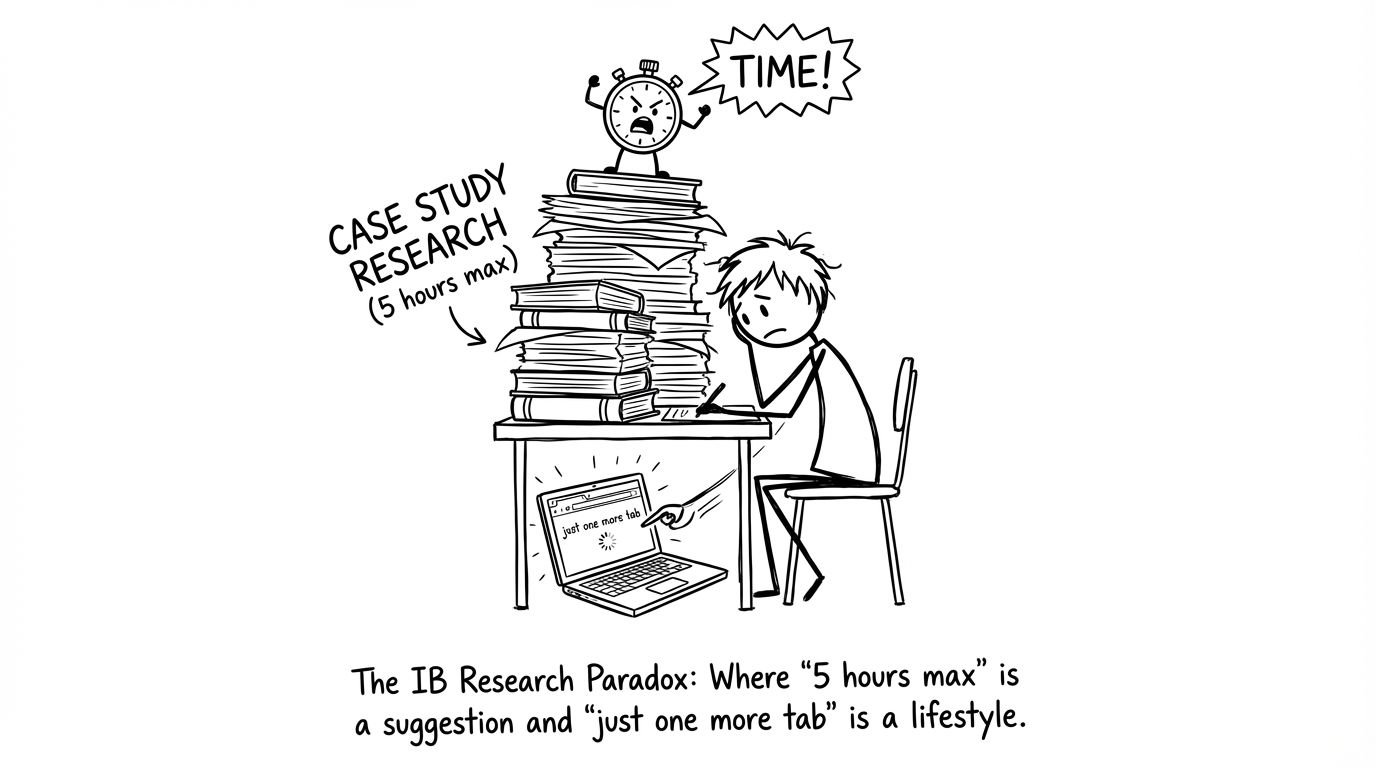
Three months before the exam, the IB Business Management 2026 case study arrives like a polite interruption. You are told, calmly, to do a maximum of five hours of research. Not a weekend. Not a deep dive that ends at 2 a.m. with fourteen tabs open and one suspicious PDF.
But the IB Business Management pre released statement 2026 is not really about research. It is about focus. It is the IB saying: Here are the concepts we could not predict when the guide was written. Learn the language, build familiarity, and be ready to think.
And then there is Abraca.
Abraca ABC IB is Country Z's largest concrete producer. Concrete is ordinary until you remember that "ordinary" things often run the world. Half of the world's buildings are made from it. ABC's story begins in limestone and clay, then suddenly turns into gold, circuit boards, and a room-temperature process for recovering precious metals from e-waste.
This article is a complete overview of the IB Business Management 2026 case study so you can walk into Paper 1 with context, terminology, and analysis pathways already mapped.
Quick checklist for the IB Business Management pre released statement 2026
Use this checklist to keep your prep inside the IB's "five hours max" spirit while still mastering the IB Business Management pre released statement 2026.
- Memorize the unfamiliar terminology (short definitions + one ABC link each).
- Understand ABC's two-core operations: concrete/cement and e-waste processing.
- Prepare 3 toolkit models you can adapt fast (STEEPLE, SWOT, Ansoff).
- Identify stakeholders and likely conflicts (environmental, shareholder, community).
- Build a "decision menu" for ABC's considerations: efficiency, environmental impact, market orientation, growth.
- Practice writing conclusions that balance profit, risk, ethics, and sustainability.
If you want a clean home base for content revision, start with Business Management - IB Resources.
Abraca (ABC) in 60 seconds: the exam context you must know
In the IB Business Management 2026 case study, Abraca (ABC) is:
- A publicly held company (so shareholder expectations matter).
- The largest concrete producer in Country Z (scale and market power).
- A buyer of limestone and clay aggregates to manufacture cement for concrete.
- A firm whose scientists discovered a room-temperature method to recover gold and other precious metals from circuit boards (e-waste).
- A business that opened an e-waste factory in 2024 that processes 100 tonnes of circuit boards weekly, recovering hundreds of kilograms of gold annually.
- A company selling recovered gold to jewellery makers (clear B2B angle).
- A firm considering operations efficiency, environmental impact reduction, becoming more market-orientated, and growth options.
Those bullet points are not "notes." They are the skeleton of most Paper 1 application marks.
Key terminology: what the IB expects you to be familiar with
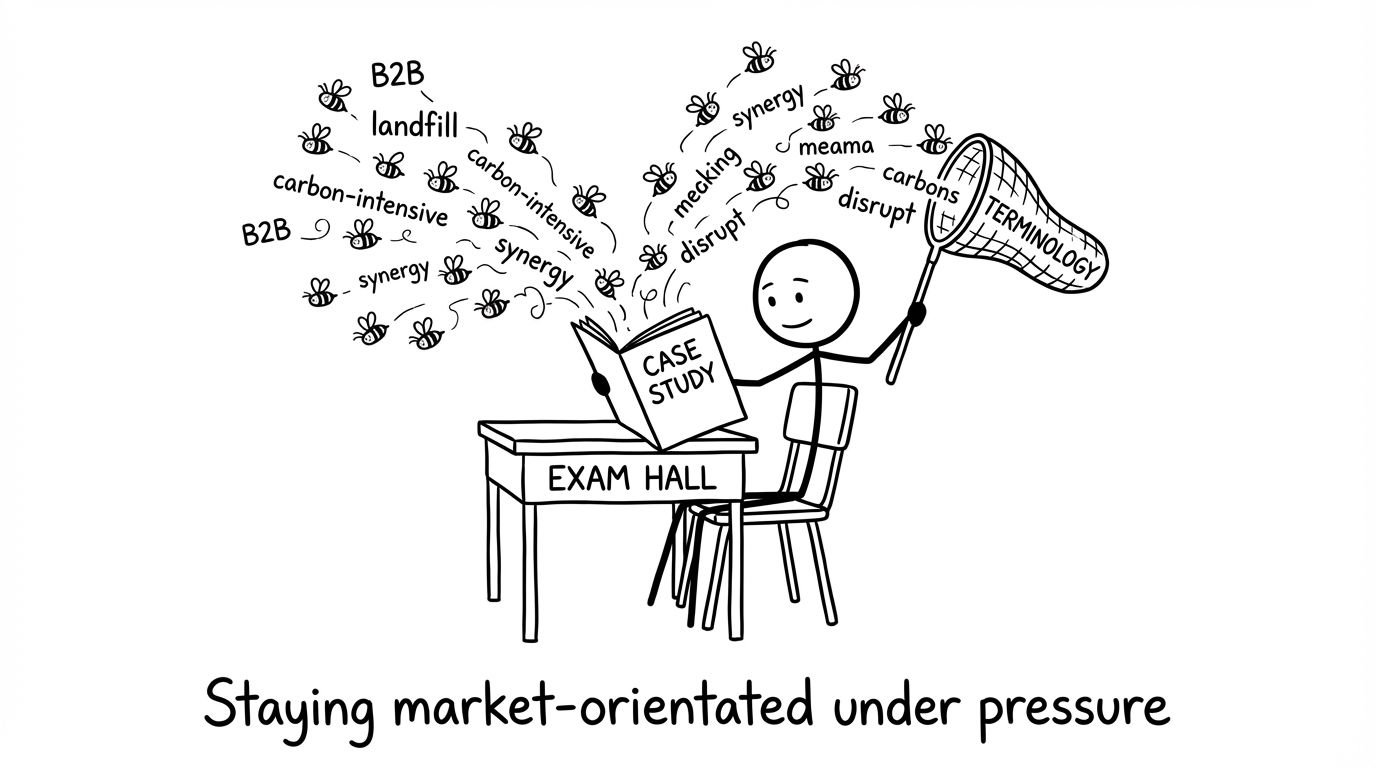
The IB Business Management pre released statement 2026 gives you a vocabulary list because vocabulary controls speed. If you can name the thing, you can analyze the thing.
Here are exam-friendly definitions with ABC context.
Aggregates (construction materials)
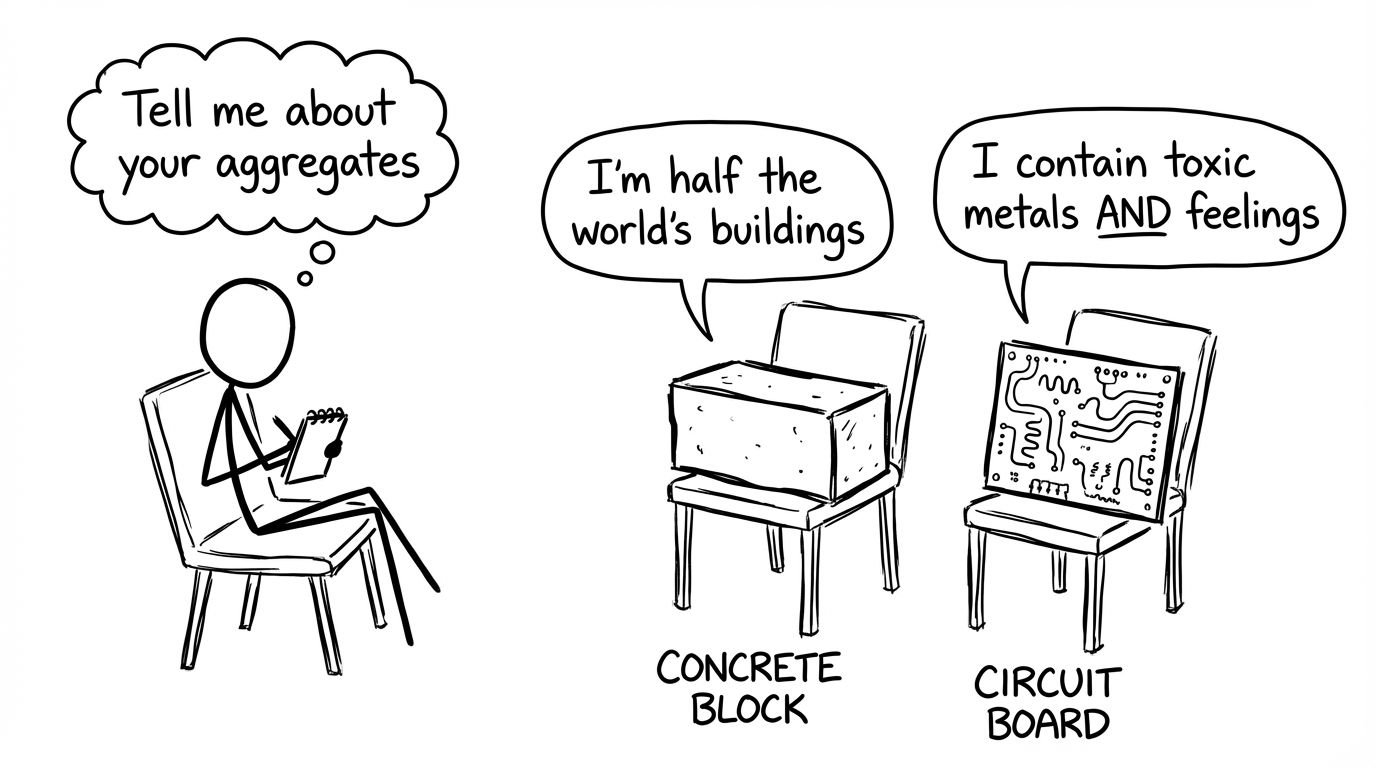
Aggregates are granular materials used in construction, often in concrete (e.g., sand, gravel, crushed stone). For Abraca ABC IB, aggregates matter because ABC buys limestone and clay aggregates to produce cement, and also explores recycled materials as aggregates.
Business-to-business (B2B)
B2B refers to selling products/services to other businesses instead of final consumers. In the IB Business Management 2026 case study, ABC sells recovered gold to jewellery makers (a B2B customer relationship), and its concrete likely supplies construction firms (also B2B).
Carbon-intensive
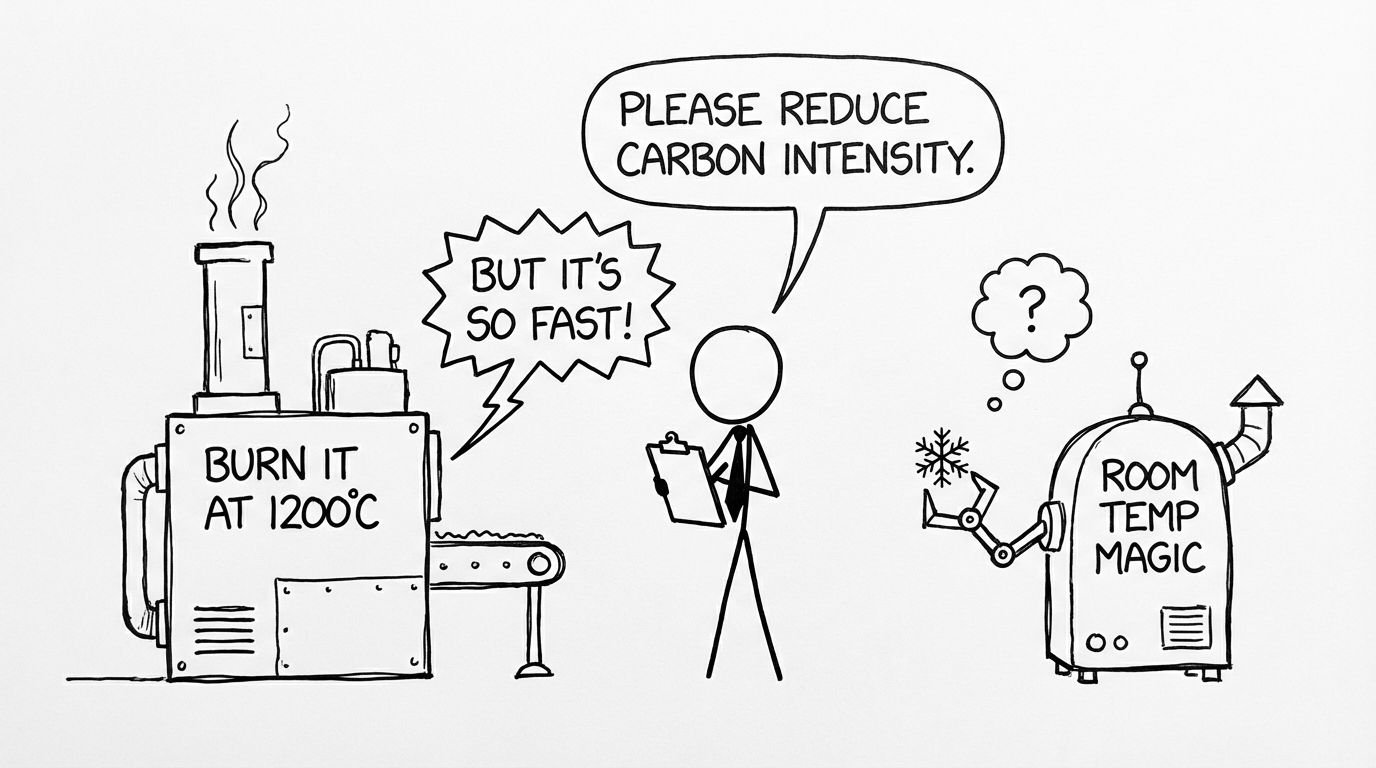
A carbon-intensive process produces high greenhouse gas emissions. Burning circuit boards at extremely high temperatures to recover metals is carbon-intensive; ABC's room-temperature process becomes a competitive and ethical talking point in the IB Business Management 2026 case study.
Circuit boards
Circuit boards are key components inside electronics that contain valuable and hazardous materials. For Abraca ABC IB, circuit boards are the input for e-waste processing.
Clay, limestone, cement, concrete
These terms anchor ABC's original industry. Cement is a binding ingredient; concrete is a composite used in construction. ABC's scale implies large fixed assets, heavy logistics, and high environmental scrutiny.
E-waste, recycling, landfill, toxic metals
E-waste is discarded electronics. Only 20% is recycled and 80% goes to landfill (as the case states). Toxic metals make disposal and processing a major ethical and regulatory issue, which is exactly why the IB Business Management pre released statement 2026 highlights this area.
Solar panels and plastic-shredding machinery
These terms suggest adjacent recycling streams and technologies. The exam may test how ABC evaluates investments or diversification opportunities related to sustainability.
To lock these definitions in quickly, combine reading with active recall using RevisionDojo's Flashcards and Study Notes inside RevisionDojo for IB.
The strategic heart of the IB Business Management 2026 case study: two businesses inside one
A useful way to read the IB Business Management 2026 case study is to notice that ABC is becoming a portfolio business:
- Core business: concrete and cement (high volume, established processes, heavy environmental impact).
- New venture: e-waste processing (innovation-driven, sustainability narrative, potential high margins, reputational upside).
This dual identity creates exam-friendly tensions:
- Efficiency vs. innovation spend (operations vs. R&D priorities).
- Shareholder pressure for returns vs. long-term sustainability investment.
- Market orientation shift (from production-led to customer-led decisions).
- Brand identity conflict: "largest concrete producer" vs. "circular economy materials innovator."
If you want to revise operations language that fits ABC's efficiency theme, see Notes for 5.3.2 Methods of Lean Production.
Operations and efficiency: what "increase efficiencies" might mean for Abraca ABC IB
In the IB Business Management 2026 case study, "increasing efficiencies" in concrete production could include:
- Lean production methods (reducing waste, downtime, defects).
- Quality management to cut rework and returns.
- Better supply chain coordination for limestone and clay aggregates.
- Energy management and process optimization (important in carbon-heavy industries).
The strongest exam responses connect efficiency to outcomes:
- Lower unit costs and potentially higher profit margins.
- Improved capacity utilization and faster delivery times (customer satisfaction).
- Reduced environmental impact per unit (supporting sustainability claims).
For quick toolkit refreshers you can apply to ABC, use BM Toolkit - Core business frameworks and tools Notes.
Environmental impact: why ABC cannot treat sustainability as a side project
Concrete is under global scrutiny for emissions and resource intensity. E-waste is under scrutiny for toxic leakage, landfill overflow, and unsafe informal recycling.
So the IB Business Management pre released statement 2026 is pushing you toward a broader question: What happens when your industry is unavoidable but your impact is unacceptable?
For ABC, the room-temperature precious metal recovery process is a strategic asset because it may:
- Reduce carbon intensity compared to burning.
- Improve compliance with environmental regulations.
- Strengthen corporate social responsibility claims.
- Create differentiation (a sustainability-based USP).
But it also introduces operational risks:
- Health and safety requirements due to toxic metals.
- Supply risk: reliable sourcing of circuit boards.
- Reputation risk if the process is perceived as greenwashing.
When you evaluate, show trade-offs and constraints. That's where top marks live.
Becoming more market-orientated: how ABC might shift from production-led thinking
A market-orientated business designs products and decisions around customer needs and market signals.
In the IB Business Management 2026 case study, ABC's traditional concrete business may be production-led: make, scale, distribute. But the e-waste venture depends on:
- Customer requirements (jewellery makers may demand certified gold origin and purity).
- Market trends (ethical sourcing, recycled materials, green procurement).
- Competitor moves (other recyclers, mining firms, alternative building materials).
Market orientation might look like:
- Developing eco-concrete products using recycled aggregates.
- Transparent sustainability reporting to win B2B contracts.
- Market research into construction clients' willingness to pay for lower-carbon materials.
You can practice market research style responses with 4.4 Market research - IB Questionbank.
Growth options: likely Ansoff pathways for the IB Business Management 2026 case study
Growth is explicitly listed in the IB Business Management 2026 case study, so expect growth strategy questions.
ABC's options map well to Ansoff:
- Market penetration: sell more concrete to existing markets, compete on price, reliability, or sustainability credentials.
- Product development: new concrete mixes using recycled aggregates, or "green concrete" branding.
- Market development: new regions or international markets (depends on transport costs and regulation).
- Diversification: expand e-waste processing capacity, process other components (beyond circuit boards), or enter other recycling tech.
Evaluation points to include:
- Funding requirements and financial risk (publicly held firms face shareholder scrutiny).
- Operational capacity and human resources constraints.
- Regulatory complexity in waste processing.
For investment decision practice, use 3.8 Investment appraisal - IB Questionbank.
Stakeholders and conflicts: easy marks if you name the tension clearly
The IB Business Management 2026 case study has built-in stakeholder conflicts:
- Shareholders: may want short-term profits and dividends; may fear risky diversification.
- Employees: safety concerns in e-waste operations; training needs; job security if efficiency drives automation.
- Government/regulators: environmental compliance, landfill reduction targets, workplace safety.
- Local communities: pollution concerns, but also jobs and local investment.
- B2B customers: construction firms want reliable concrete supply; jewellery makers want ethical, high-quality gold.
- Environmental groups: scrutinize "carbon-intensive" claims and real recycling outcomes.
If conflict appears in questions (often in Paper 1), you can revise conflict resolution language with Notes for 2.7.3 Approaches to Conflict Resolution.
How to study the IB Business Management pre released statement 2026 in five hours (actually)
Here's a realistic plan that fits the IB Business Management pre released statement 2026 intention.
Hour 1: Build a one-page case map
Company facts, key numbers (100 tonnes weekly, 20% recycled globally), and ABC's four considerations.
Hour 2: Terminology flashcard sprint
Make flashcards for every term, each with one ABC example. Use RevisionDojo Flashcards inside Business Management - IB Resources | RevisionDojo.
Hour 3: Toolkit selection
Pick 3 models you can deploy fast: STEEPLE, SWOT, Ansoff. Draft ABC-specific bullets for each.
Hour 4: Practice answers under time pressure
Use topic-based exam practice via the Unit 1: Introduction questionbank and build response structure: definition (short) -> application (ABC) -> analysis -> evaluation.
Hour 5: Get feedback
Use RevisionDojo's AI Chat to challenge your assumptions, then use Grading tools on a timed response. If you want human support, use RevisionDojo Tutors.
FAQ: IB Business Management 2026 case study and Abraca (ABC)
What is the IB Business Management 2026 case study actually testing?
The IB Business Management 2026 case study tests whether you can apply business tools to a real company context with unfamiliar contemporary themes. It's less about memorizing niche recycling chemistry and more about making managerial judgments with limited information. The IB Business Management pre released statement 2026 tells you exactly that: you're expected to have basic familiarity, not exhaustive expertise. That means your marks come from how well you connect terminology like "carbon-intensive," "landfill," and "B2B" to decisions ABC might make. It also means evaluation matters: you must show trade-offs, stakeholder impacts, and long-term implications. If you treat Abraca (ABC) as a story of competing priorities rather than a science lesson, your answers become clearer and more strategic.
How do I write strong evaluation for Abraca ABC IB without extra data?
With Abraca ABC IB, evaluation is less about perfect numbers and more about disciplined reasoning. Start by stating a possible strategy (for example, expand the e-waste factory capacity), then weigh benefits and drawbacks using the case facts you do have. Benefits might include differentiation and lower carbon intensity, while drawbacks might include regulatory risk, training costs, and uncertain supply of circuit boards. Next, bring in stakeholders: shareholders may worry about risk, communities may support job creation, regulators may demand strict compliance. Finally, give a justified judgment based on conditions, such as "recommended if ABC can secure long-term supply contracts and demonstrate safe handling of toxic metals." This kind of conditional conclusion is exactly how high-scoring Paper 1 answers sound.
What should I research from the IB Business Management pre released statement 2026 terms?
Research just enough to define the terms accurately and avoid misunderstanding them in the exam. For example, you should know that aggregates are construction materials used in concrete, and that e-waste contains valuable and hazardous components like circuit boards and toxic metals. You should understand why burning circuit boards is carbon-intensive and why a room-temperature process can be a strategic advantage. You should also be able to explain landfill as a disposal method with environmental externalities, and recycling as a process that can be constrained by technology and economics. The point is not to become an engineer; it is to speak the language of modern sustainability and operations decisions. If you keep your research tied to how it would change ABC's costs, risks, reputation, and stakeholder relationships, you stay within the intended scope of the IB Business Management pre released statement 2026.
Closing: turning the IB Business Management 2026 case study into confidence
The IB Business Management 2026 case study is not asking you to predict the future of concrete or solve global e-waste. It is asking you to read a business like a living system: heavy assets, big impacts, uncertain trade-offs, and a surprising innovation that could reshape strategy.
If you learn the terminology, map the tensions, and practice evaluation, Abraca ABC IB becomes less intimidating and more usable. And when you want all of that in one place -- Questionbank practice, Study Notes, Flashcards, AI Chat, Grading tools, Predicted Papers, Mock Exams, a Coursework Library, and Tutors -- RevisionDojo is built for exactly this moment.
For next steps, revise exam technique with How to Maximize Your Score in IB Business Management, then drill case-style thinking using the RevisionDojo Questionbank inside Business Management - IB Resources.
Near the end, remember what matters: the IB Business Management 2026 case study, the IB Business Management pre released statement 2026, and Abraca ABC IB are not three separate tasks. They are one skill -- thinking clearly when the case gives you complexity on purpose.