


An IB Biology HL day in the life is busy, but it should not mean studying biology from sunrise to midnight. A typical school day may include a content-heavy lesson, practical or data-based work, and a focused review session at home. During scientific investigation weeks, the workload grows because planning, analysis, and evaluation require sustained attention.
The key is rhythm. When lessons, retrieval practice, questions, and coursework happen in small cycles, Biology HL becomes manageable. Leave everything until examination season, and its scale feels overwhelming.
The schedule below is a realistic hypothetical example. School timetables, laboratory access, homework policies, and subject combinations vary, but the routine shows what an ordinary demanding day can look like.
The day at a glance
A balanced Biology HL day might include:
- One Biology lesson or laboratory session
- 10-15 minutes of retrieval practice
- Around 30-45 minutes of focused homework
- A short review of mistakes rather than extensive note rewriting
- Scientific investigation work when relevant
- Protected time for other subjects, activities, meals, and sleep
The IB recommends 240 teaching hours for an HL subject. In Biology HL, this includes 180 hours of syllabus content and a 60-hour experimental programme. The workload is therefore substantial, but much of it occurs during scheduled teaching and practical work. The IB Biology HL and SL syllabus comparison explains the difference in more detail.
6:45 AM: A small review before school
The student eats breakfast and spends ten minutes recalling yesterday's material. This is not a heroic morning study session. It might involve labelling a diagram from memory, explaining a biological process aloud, or answering a few IB Biology flashcards.
Short retrieval sessions matter because Biology contains connected terminology, structures, mechanisms, and examples. Recalling information regularly reduces the amount that must be relearned later. Then Biology closes. Conserving attention is part of using it well.
8:15 AM: The wider IB timetable
Biology HL never exists in isolation. The first lesson could be Mathematics, English, or a language, while Theory of Knowledge and other Diploma Programme commitments occupy their own places in the week.
This is why the IB Biology HL workload cannot be measured only by counting Biology assignments. The deeper challenge is switching between different forms of thinking. Strong schedules reduce that friction: deadlines remain visible, notes are stored consistently, and every study session has one clear purpose.
10:00 AM: Biology lesson and practical work
Today's lesson might explore cell respiration, gene expression, homeostasis, evolution, or another area within the four course themes. The teacher may introduce evidence and ask students to explain how a change in one part of a system affects another.
Biology HL is not simply a longer list of facts. Students must connect levels of organization and apply knowledge to unfamiliar information. Effective notes capture those relationships rather than every sentence the teacher says. After class, unclear points can be checked through the RevisionDojo IB Biology resource hub.
On a laboratory day, the pace changes. Students may calibrate equipment, control variables, record quantitative observations, or decide whether an unusual result reflects biological variation or a methodological weakness. The recommended 60-hour experimental programme includes practical activities, the collaborative sciences project, and the scientific investigation.
A careful student records units, anomalies, uncertainties, and methodological changes during the session. Memory becomes unreliable after several days, while these details may later support analysis and evaluation.
12:45 PM: Lunch remains a break
Demanding programmes create a temptation to turn every pause into study time. That can feel productive before it becomes exhausting.
Lunch is usually better spent eating, walking, and talking to friends. If a deadline is close, the student might identify the next action, such as completing a graph. They do not attempt to draft an entire report beside an unfinished sandwich. Rest supports the concentration needed for unfamiliar biological data.
2:15 PM: Applying knowledge to data
Later, the student receives an unfamiliar graph. Before writing, they inspect the axes, units, overall pattern, and variation. A vague statement such as “the value increases” should become a precise comparison supported by data.
This gap between knowing and applying explains why question practice matters. The IB Biology Questionbank allows students to target one topic without completing an entire examination. Grading tools and AI Chat can then help distinguish missing knowledge from weak interpretation or imprecise expression.
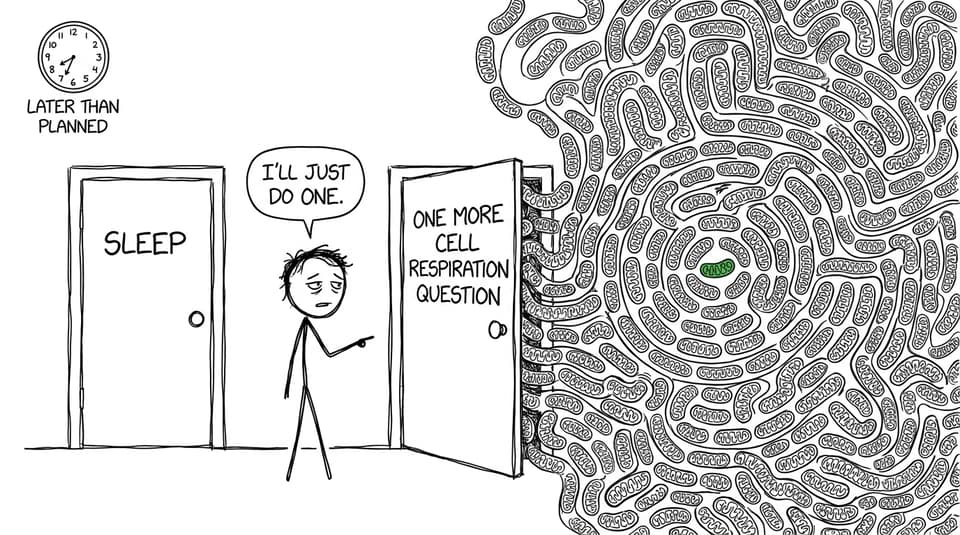
5:00 PM: One focused Biology block
After school and a genuine break, the student asks: “What is today's smallest useful task?”
If the lesson was confusing, they use Study Notes to repair one concept, close the explanation, reconstruct it from memory, and answer several questions. One or two mistakes are recorded for later review. This learn, retrieve, apply, and correct cycle is more useful than copying pages. The guide to independent IB Biology resources develops this workflow further.
On an ordinary evening, 30-45 focused minutes may be enough. Near an assessment, the session could be longer. During quieter weeks, no additional Biology work may be necessary.
6:00 PM: Scientific investigation work
Not every day includes coursework. When the scientific investigation is active, another block may be needed to refine the question, process data, draft a conclusion, or evaluate limitations.
The investigation contributes 20% of the final Biology grade and has a maximum report length of 3,000 words. Students can consult IB Biology internal assessment guidance, the Coursework Library, and the Biology IA Grader. These resources support judgment rather than replacing teacher guidance or the student's scientific decisions.
9:30 PM: Close the loop
Biology eventually closes so another subject, an activity, or rest can take its place. Closer to examinations, some sessions may shift toward timed Mock Exams and Predicted Papers. RevisionDojo Tutors can help when a misconception persists despite independent revision, while the Biology HL and SL difficulty comparison can help prospective students evaluate the commitment.
Before stopping, the student writes one next action for tomorrow. The realistic Biology HL day is neither effortless nor relentless. It becomes sustainable through a repeatable system. RevisionDojo brings that system together through Study Notes, Flashcards, the Questionbank, AI Chat, Grading tools, Predicted Papers, Mock Exams, the Coursework Library, and Tutors, supporting students from their first lesson to final assessment.