
A race can be lost before it starts.
Not because the athlete forgot their shoes, but because they arrived slightly under-hydrated. The kind of small disadvantage you don’t feel at minute five, but you definitely feel at minute forty, when your heart rate creeps up, your pace drops, and your body’s cooling system starts missing steps.
In IB SEHS, hydration and thermoregulation sit together for a reason: water is the quiet partner behind effective heat loss, stable performance, and safety in the heat.
IB SEHS quick checklist: what to mention in exam answers
Use this as a fast IB SEHS plan for 4- to 9-mark questions:
-
Define thermoregulation: maintaining stable core temperature (homeostasis)
-
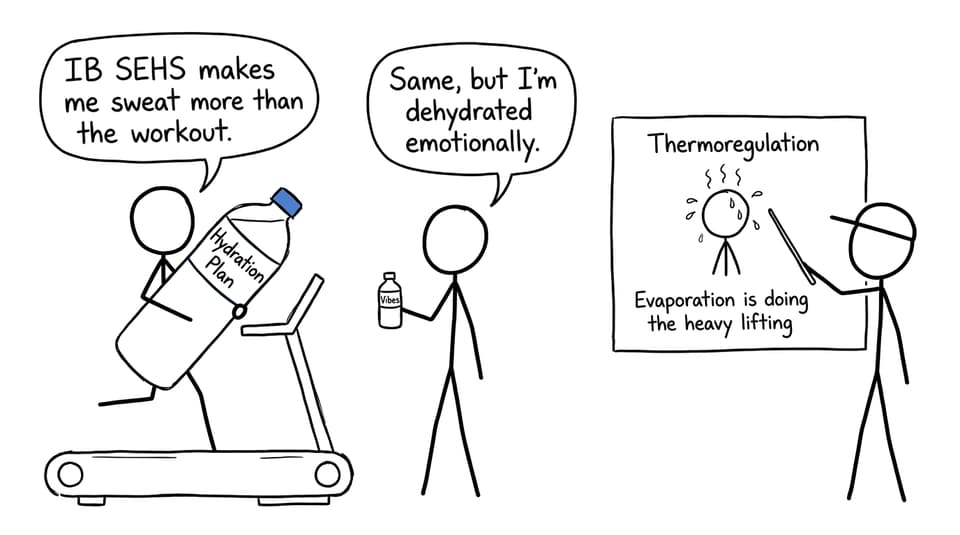
Explain sweating and evaporation as the key heat-loss method during exercise
-
Link hydration to plasma volume, sweat rate, and skin blood flow
-
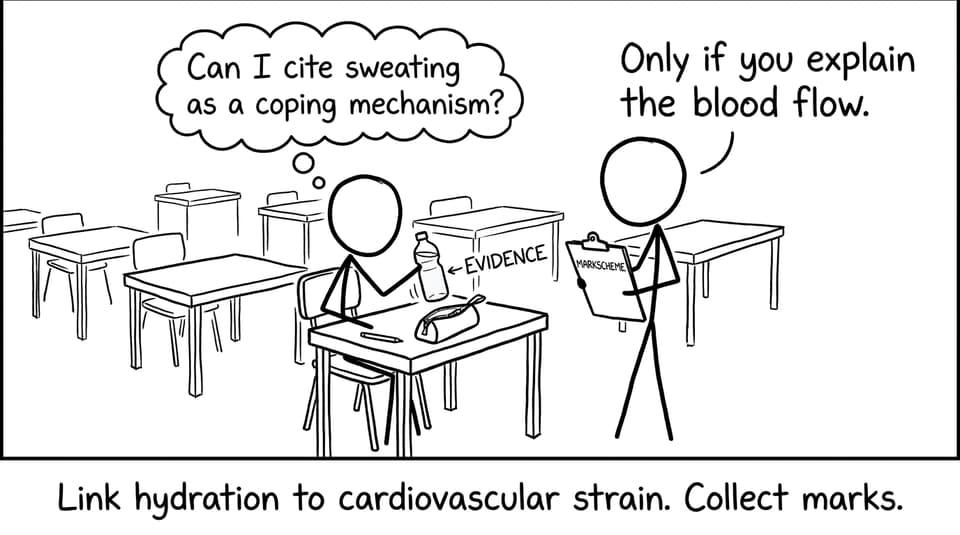
Explain dehydration consequences: reduced sweat, rising core temperature, cardiovascular strain
-
Apply context: hot vs humid vs windy conditions and intensity/duration
For detailed revision, pair this with A.2.1 Water and electrolyte balance Notes and targeted practice from the A.2.1 Water and electrolyte balance Questionbank.
How thermoregulation works during exercise (and where hydration fits)
During exercise, working muscles produce heat as a by-product of cellular metabolism. If heat production outpaces heat loss, core temperature rises, and fatigue accelerates.
In IB SEHS, the headline mechanism for heat loss in the heat is sweating, specifically evaporation of sweat from the skin. But sweating only works when the body can afford to lose water.
Hydration supports thermoregulation in three connected ways:
-
Sweat production: adequate body water helps maintain sweat rate.
-
Skin blood flow: vasodilation sends warm blood to the skin, but this depends on sufficient blood volume.
-
Evaporation efficiency: sweat must evaporate (not just drip) to remove heat.
To lock in the physiology, revise homeostasis foundations in A.1.2 Maintaining homeostasis Notes and the process detail in A.2.5 Sweat formation and sweat response Notes.
Dehydration in IB SEHS: why performance drops before “cramping” shows up
Dehydration is often tested in IB SEHS as a chain reaction. You don’t just say “less water = worse performance.” You show the mechanism.
When fluid loss reduces plasma volume, the body faces a trade-off: send blood to the skin to cool, or to the muscles to sustain work. Either way, strain increases.
Key consequences to explain clearly:
-
Reduced sweat rate (less water available) and less evaporative cooling
-
Rising core temperature (heat storage increases)
-
Greater cardiovascular strain (heart rate increases to maintain cardiac output)
This is the kind of cause-and-effect examiners reward. If you want to practice that structure, use How to Answer SEHS Essay Questions: Command Terms, Content and Clarity and then apply it with A.1.2 Maintaining homeostasis Questionbank.
Environment matters: heat, humidity, and the “sweat that doesn’t work” problem
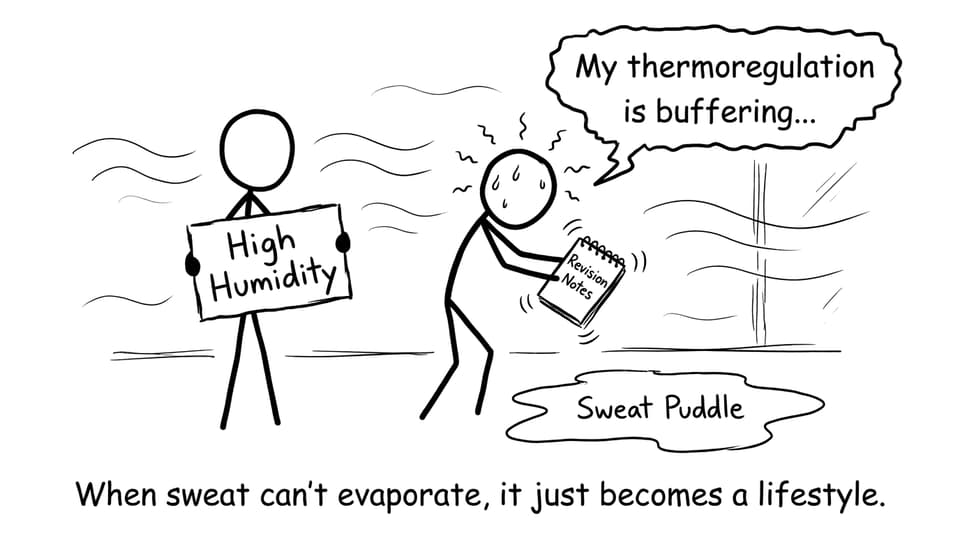
Hot weather usually increases sweat rate, raising dehydration risk. But humidity is sneakier in IB SEHS questions.
In high humidity, the air is already full of water vapour. Sweat struggles to evaporate, so cooling is less effective even if the athlete is sweating a lot. That can drive core temperature higher and push perceived exertion up.
For environmental physiology links, review Acute and Long-Term Responses to the Environment and the focused thermoregulation overview in A.2.3 Outline how the body thermoregulates in hot and cold environments.
RevisionDojo angle: turning physiology into marks
Knowing the story is one thing. Writing it under time pressure is another.
RevisionDojo helps IB SEHS students bridge that gap with Study Notes, Flashcards, and the Questionbank for exam-style application. When you want feedback on whether your explanation actually earns marks, the AI Chat and Grading tools help you tighten links like “dehydration -> plasma volume -> stroke volume -> heart rate -> thermoregulation.” Add Mock Exams and Predicted Papers to rehearse timing, and use the Tutors when you need a human to spot what you’re consistently missing.
If you’re revising broadly, How to Revise Hydration and Nutrition is a strong next step.
Conclusion: the simplest IB SEHS advantage is often a bottle of water
Hydration is not a bonus topic in IB SEHS. It is the foundation that lets thermoregulation do its job: sweating, evaporation, skin blood flow, and stable performance under stress.
If you want to turn that understanding into marks, build your revision plan with RevisionDojo’s Study Notes, Questionbank, Mock Exams, and Grading tools; practise writing the full cause-and-effect chain until it feels automatic.