

Concepts can feel like the “soft” part of IB Digital Society. You know they matter, but when you sit down to write, they sometimes turn into a quick definition at the top of a paragraph and a vague sentence like “this shows power.”
And that’s the trap.
In IB Digital Society, concepts aren’t decoration. They’re the engine of analysis. Real-world examples are the road, but concepts are the steering wheel that keeps your essay pointed toward explanation and evaluation (the marks).
A quick checklist for concept use in IB Digital Society
Use this as a 60-second pre-write routine for IB Digital Society essays:
-
Identify the digital system (platform, policy, feature, algorithm, dataset)
-
Choose one main concept (two max) that fits the question
-
Explain a mechanism (how the system produces an outcome)
-
Link the mechanism to impacts on individuals and communities
-
Add evaluation: trade-offs, responsibility, and what could be improved
If you need a bigger-picture map first, skim Key Themes in IB Digital Society Explained and then return to your essay plan.
Why concepts matter in IB Digital Society essays
The course rewards a specific kind of thinking: moving from “what is happening” to “why it’s happening” to “why it matters.” Concepts are what make that movement possible.
When you use concepts well in IB Digital Society, you show the examiner you can:
-
Build a coherent line of argument
-
Explain cause-and-effect inside digital systems
-
Make judgments that are reasoned, not just opinion
-
Handle complexity without losing the question
When you use concepts badly, your essay often becomes a summary of a case study with a few concept words sprinkled on top.
If you want a clear model for exam-style structure, pair this article with How to Write Strong Essays in IB Digital Society.
Choosing the right IB Digital Society concept (and avoiding the “concept buffet”)
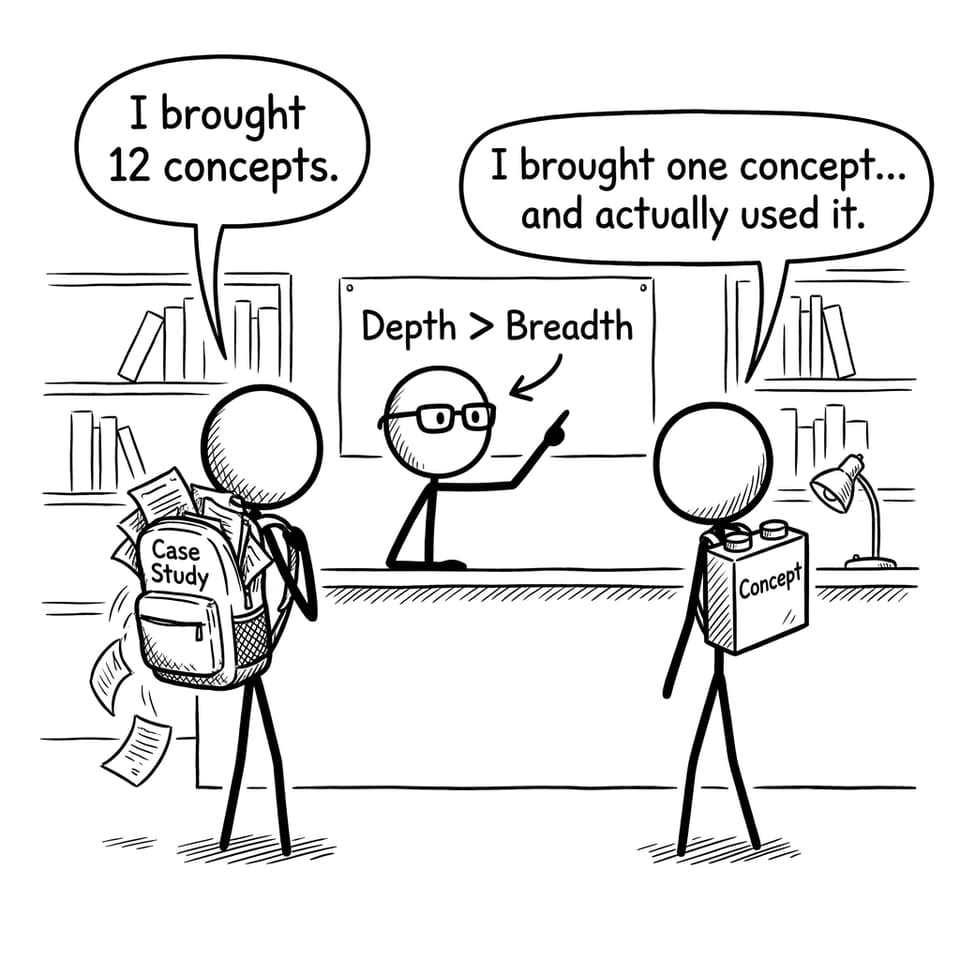
Most students don’t lose marks because they chose the “wrong” concept. They lose marks because they chose too many concepts and developed none.
A better approach is to treat concept choice like choosing a camera lens. One lens makes the clearest picture. Two lenses can create depth. Ten lenses just fog the frame.
Before you commit, ask:
-
What is the question really asking me to judge?
-
Which concept helps me explain the mechanism behind the issue?
-
Which concept naturally leads to evaluation (trade-offs, ethics, responsibility)?
You can practice this quickly using the concept lists in Topic 2: Concepts and then testing yourself with timed prompts from the IB Digital Society Resources hub.
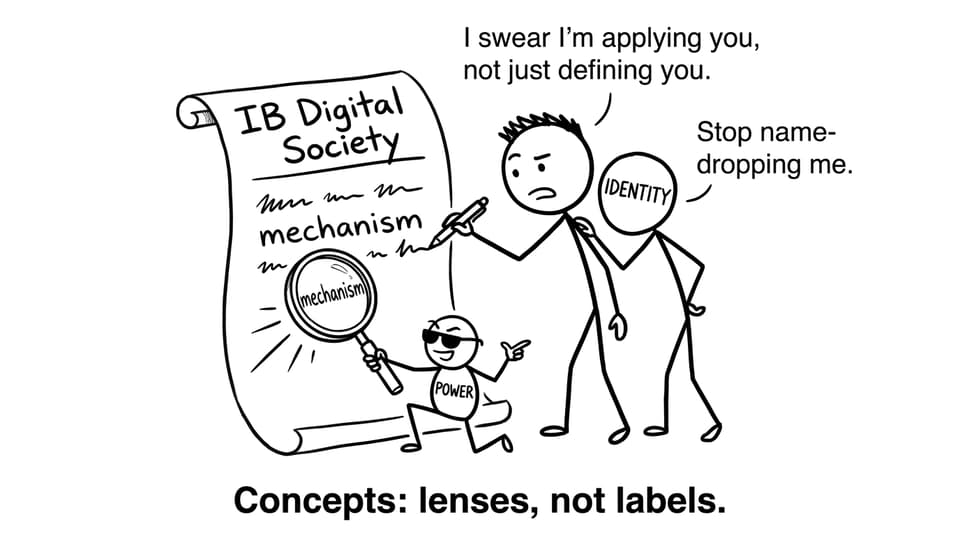
Use concepts as lenses, not labels, in IB Digital Society
A concept is not something you “mention.” It’s something you do.
Here’s the difference.
Weak conceptual use (labeling):
- “This shows power because the company is powerful.”
Stronger conceptual use (lens):
- “The company exercises power by shaping visibility through ranking systems, which limits user agency and concentrates influence among actors who can pay or optimize for the system.”
Notice what changed:
-
The concept is tied to a specific mechanism
-
The mechanism connects to impact
-
The language is analytical, not circular
If you want more practice with this “mechanism first” style, the drills in Topic 3: Content are ideal because they push you to explain how systems work, not just what they are.
Blending concepts with real-world examples (the exam-friendly way)
In IB Digital Society, you earn marks when your example and concept cooperate.
A reliable paragraph pattern is:
-
System setup: name the digital system and the relevant feature
-
Concept lens: introduce your concept in one sentence, as an analytical tool
-
Mechanism: explain how the feature produces outcomes
-
Impact: individuals AND communities
-
Evaluation: trade-offs, limitations, or possible interventions
To build example flexibility, keep a small bank of 3-5 adaptable case studies and rotate them through different concepts. RevisionDojo’s Questionbank makes this easier because you can practise unseen prompts and get feedback, instead of memorizing fixed “perfect examples.”
How to get conceptual depth (the part examiners actually reward)
Depth usually comes from answering “how” and “why” twice.
Try a simple ladder:
-
How does the system feature work?
-
Why does that mechanism lead to this outcome?
-
How does it affect different groups differently?
-
Why are the trade-offs difficult to resolve?
For instance, if you’re using the concept of change, don’t stop at “technology changed society.” Focus on pace, direction, uneven impact, and who benefits. This is exactly what’s modelled in Understanding Change in Digital Society: IB Concept Explained.

Revision practice that makes IB Digital Society concepts automatic
Concept skill is built the same way as any other skill: short feedback loops.
A strong routine is:
-
Learn the concept quickly using RevisionDojo Study Notes and Key Definitions
-
Lock it in with Flashcards (spaced repetition works especially well for concept language)
-
Apply it under time pressure with the Questionbank
-
Use AI Chat to test counterclaims and alternative interpretations
-
Submit a paragraph to the Grading tools or essay marker to see if your concept is doing real analytical work
You can also pull targeted content knowledge from pages like Topic 4: Contexts and, for quick recall sessions, the Digital Society Flashcards.
Closing: turn IB Digital Society concepts into your advantage
The best IB Digital Society essays don’t sound like students trying to impress an examiner. They sound like students who can see the invisible rules of a digital system, explain how those rules shape people, and then judge what should happen next.
That’s what concepts are for.
If you want to practise this consistently, use RevisionDojo as your loop: learn with Study Notes, reinforce with Flashcards, apply with the Questionbank, refine with AI Chat and Grading tools, then build confidence with Mock Exams and Predicted Papers. Concepts stop feeling “theoretical” the moment you start using them to control your argument under exam pressure in IB Digital Society.

