


If you’ve ever stared at a CAS screen and felt that quiet panic, the kind that says, I know the math… but do I know the buttons?, you’re not alone.
In IB Math, CAS can feel like a superpower you’re not fully trained to use. One day it saves you from a 12-line algebra mess. The next, it gives an answer that’s technically correct and completely wrong for the question you were asked.
This guide is about using CAS the way top scorers do in IB Math: as a thinking partner, not a crutch. You’ll learn when CAS is allowed, which features matter most, how to practise without becoming dependent, and how to turn CAS output into examiner-friendly working.
A quick CAS checklist for IB Math students
Keep this short list next to your calculator for the next two weeks. In IB Math, consistency beats intensity.
-
Confirm radian vs degree before any trig.
-
Write the equation you typed, not just the CAS answer.
-
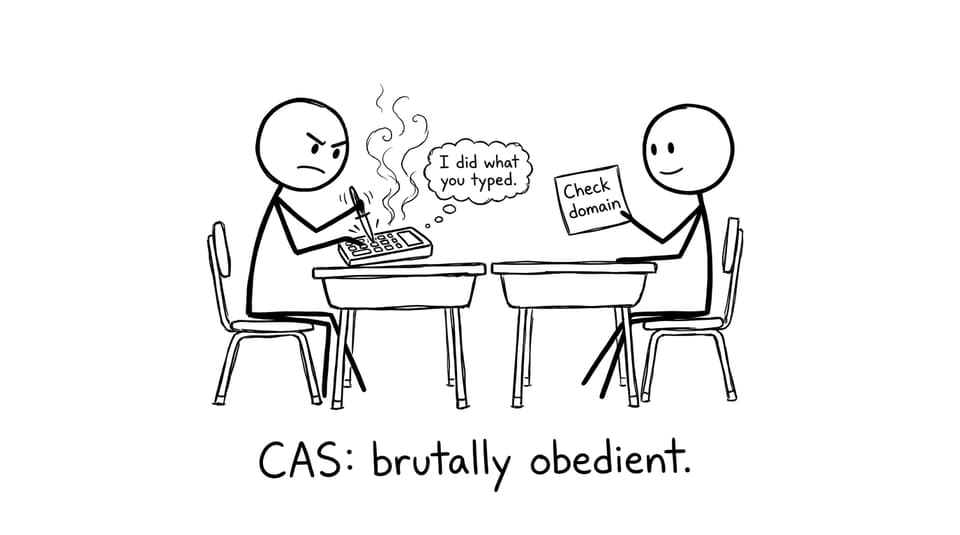
Check domain restrictions (especially logs, square roots, trig inverses).
-
Use exact forms when the question expects them.
-
Graph to sanity-check: intercepts, asymptotes, turning points.
-
After every session, log 1 mistake you made and how you’ll prevent it.
For targeted practice that mirrors exam style, build short sets from RevisionDojo’s Questionbank workflow in How to Use the Questionbank for Targeted Math Revision.
What CAS actually is (and why it matters in IB Math)
CAS stands for Computer Algebra System. Unlike basic calculators that mostly compute numerical values, CAS can manipulate expressions symbolically: factorise, solve equations exactly, differentiate and integrate in algebraic form, and handle systems and matrices without immediately approximating.
That symbolic power is exactly why CAS changes the experience of IB Math.
It helps you:
-
Reduce avoidable arithmetic slip-ups in long algebra.
-
See structure faster (factor forms, exact roots, parameter relationships).
-
Visualise functions and transformations with quick graphs.
-
Move quicker on calculator-allowed papers, without sacrificing clarity.
If you’re choosing or refining your tech setup, pair this with How to Use Graphing Calculators During IB Math Exams to align your habits with exam-day expectations.
When CAS is allowed in IB Math papers
The rule is simple, but the implications matter.
Paper 1
-
Calculator-free
-
CAS not allowed
Paper 2
-
Calculator allowed
-
CAS permitted and often expected for efficiency
Paper 3 (HL only)
-
Calculator allowed
-
CAS is especially useful for modelling and extended problem solving
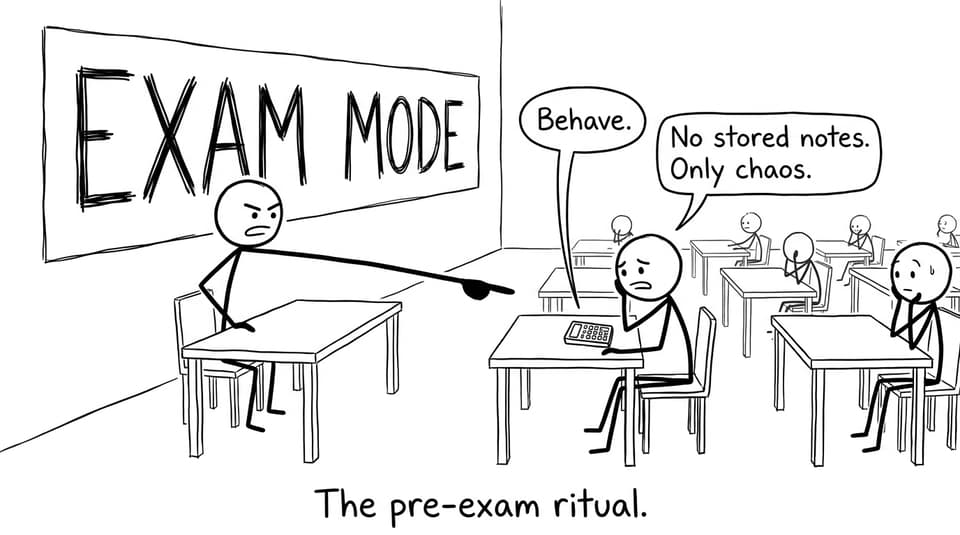
Before your exam, your device should be in Exam Mode (or your school’s required equivalent). Don’t treat that as admin. Treat it as a rehearsal step that reduces stress.
If Paper 2 is your main battleground, use How to Prepare for IB Math Paper 2 (Calculator Allowed) to structure your revision blocks.
The CAS features you should master for IB Math
In IB Math, “knowing CAS” doesn’t mean knowing every menu. It means mastering the few actions that show up everywhere.
Solving equations (and interpreting solutions)
CAS can solve linear, quadratic, exponential, logarithmic, and trig equations quickly. But the exam still rewards judgement.
What to do every time:
-
State the equation clearly.
-
Use CAS to solve.
-
Check whether all solutions make sense in context (domain, interval, worded constraints).
-
Present the final answer in the requested form (exact vs decimal, radians vs degrees).
A good habit is to confirm with a graph when the equation is tricky. In IB Math, a 10-second graph can prevent a 10-mark mistake.
Graphing for behaviour (not decoration)
Graphing is where CAS stops being a calculator and becomes a tutor.
Use graphs to:
-
Find intersections and approximate roots.
-
Check turning points and asymptotes.
-
Compare a function and its derivative.
-
Test parameter changes quickly (especially HL investigations).
If you’re in AA, revisit core function behaviour alongside the AA hub: IB Mathematics Analysis and Approaches Resources.
Differentiation and integration (with method marks in mind)
CAS can compute derivatives and integrals instantly. The exam, however, still cares about setup.
Train yourself to always write:
-
The expression you differentiated/integrated.
-
Any bounds for definite integrals.
-
The interpretation step: area, accumulation, rate of change.
For calculus drilling, you can focus your practice using IB Mathematics Analysis and Approaches Topic Calculus Questionbank.
Matrices and vectors (clean, fast, error-resistant)
CAS is great for matrix multiplication, inverses, solving linear systems, and vector operations like dot products and magnitudes.
In IB Math, this is where CAS saves time and reduces careless errors, but only if you label what you’re doing:
-
Define matrices/vectors.
-
Show the operation (e.g., (A^{-1}b)).
-
Interpret the result if it represents a solution, transformation, or model.
How to practise CAS without becoming dependent
The paradox of IB Math is that CAS is most useful when you don’t need it.
Here’s a simple training loop that keeps you in control.
The 3-pass method (15-30 minutes)
Pass 1: By hand (6-10 minutes)
Attempt the question without CAS first. Even if you fail, you learn where you fail.
Pass 2: With CAS (6-10 minutes)
Use CAS to compute, graph, or solve. Compare the CAS pathway to your attempt.
Pass 3: Explain (3-5 minutes)
Write two sentences:
-
What CAS did.
-
Why that result makes sense.
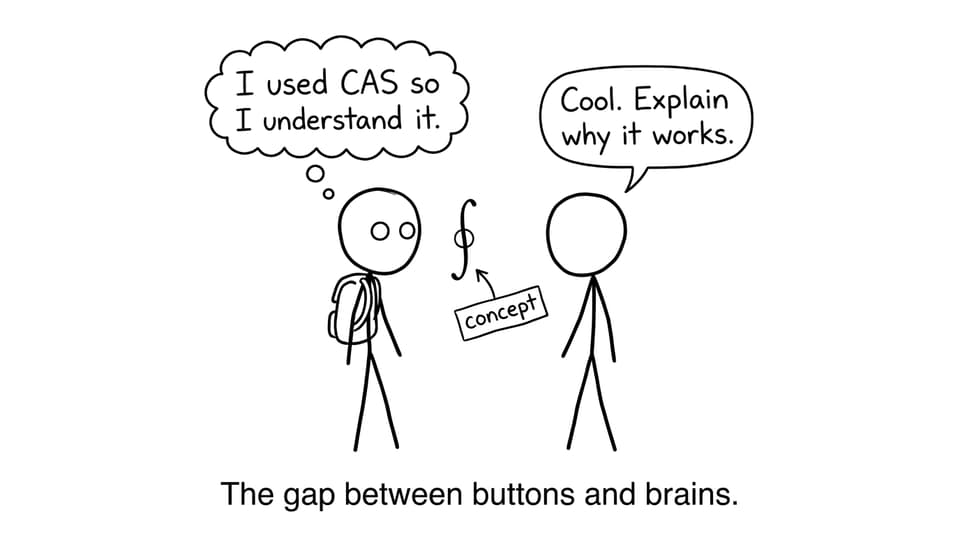
That last step is where marks are born. And it’s where most students in IB Math quietly lose them.
To make this repeatable, build short sessions using RevisionDojo’s exam-simulation tools. The workflow in How to Use the Exam Builder for Efficient Math Revision is built for exactly this kind of loop.
Common CAS mistakes that cost IB Math marks
Most CAS mistakes are not “calculator mistakes.” They’re thinking mistakes that CAS reveals.
Ignoring domains and restrictions
CAS will happily give solutions that don’t belong (extraneous roots, forbidden log inputs, negative values under square roots, wrong intervals).
Fix: after every solve, ask: what values are allowed here?
Rounding too early
A rounded value can destroy later accuracy in multi-step questions.
Fix: keep exact values until the final step unless the question explicitly wants decimals.
Wrong mode for trig
Degrees vs radians is the classic.
Fix: check before you start every trig problem. Make it a ritual.
Treating CAS output as “working”
In IB Math, an answer without communication is often an expensive sentence.
Fix: write the expression, the command result, and the interpretation. CAS supports your working, it doesn’t replace it.
CAS for IB Math IA: how to use it like an analyst
For your exploration, CAS can be a quiet multiplier:
-
Model data with regression and compare models quickly.
-
Test parameters and sensitivity without redoing tedious algebra.
-
Produce clean graphs and tables you can interpret.
-
Validate calculus steps for optimisation and change.
But the IA isn’t impressed by screenshots. It’s impressed by choices.
If you’re building an AA exploration, browse high-quality examples in the IB Mathematics Analysis and Approaches (AA) Exemplars and notice how strong students use technology to justify decisions, not to fill space.
How RevisionDojo helps you train CAS skills for IB Math exams
CAS fluency comes from repetition with feedback, not from memorising menus.
RevisionDojo supports that in a way that matches how IB Math is assessed:
-
Questionbank for topic-filtered practice that forces you to use CAS strategically.
-
Study Notes and Flashcards to lock down the concepts CAS outputs are based on.
-
AI Chat to ask “why did CAS give this form?” and get an explanation you can write in your solution.
-
Grading tools to spot where your communication is losing method marks.
-
Mock Exams and Predicted Papers to rehearse timing and decision-making under pressure.
-
Coursework Library and Tutors when your IA needs expert direction.
To simulate real exam pacing, pair How to Use RevisionDojo to Prepare for IB Math Mock Exams with the free IB Predicted Papers by IB Examiners (Free).
Conclusion: make CAS your partner, not your substitute
Used well, CAS makes IB Math feel calmer. Not easier, calmer. It reduces noise, catches silly errors, and gives you fast feedback when your algebra starts to drift.
Your goal isn’t to become a button-pressing machine. It’s to become a student who can decide: Do I solve this by hand? Do I verify with CAS? Do I graph to check? That decision-making is what exam papers reward.
If you want a complete system for that kind of practice, build your routine around RevisionDojo: start with Study Notes, drill with the Questionbank, review with Flashcards, ask “why” with AI Chat, then pressure-test your skills with Mock Exams and Predicted Papers. In IB Math, that loop is how confidence becomes a score.