If you’ve ever opened your IB Math notes and felt your brain go quiet, you’re not alone. It’s not that you “can’t do IB.” It’s that formulas create a special kind of pressure: they look like facts you’re supposed to carry around perfectly, forever.
The trouble is, most students try to solve the pressure with force. More pages. Longer sessions. Another rewrite of the same list. And then, on exam day, the formula you swore you knew evaporates.
This post is a calmer approach to IB Math formulas: a system that reduces overwhelm by making recall automatic. Not by doing more, but by doing the right small things, in the right order.
A quick IB formula revision checklist (save this)
Use this as your default loop for IB formula revision:
-
Pick one formula family (not the entire syllabus).
-
Learn the “meaning” using topic Study Notes.
-
Test yourself with Flashcards (active recall, not rereading).
-
Apply immediately with 5-10 questions in a Questionbank.
-
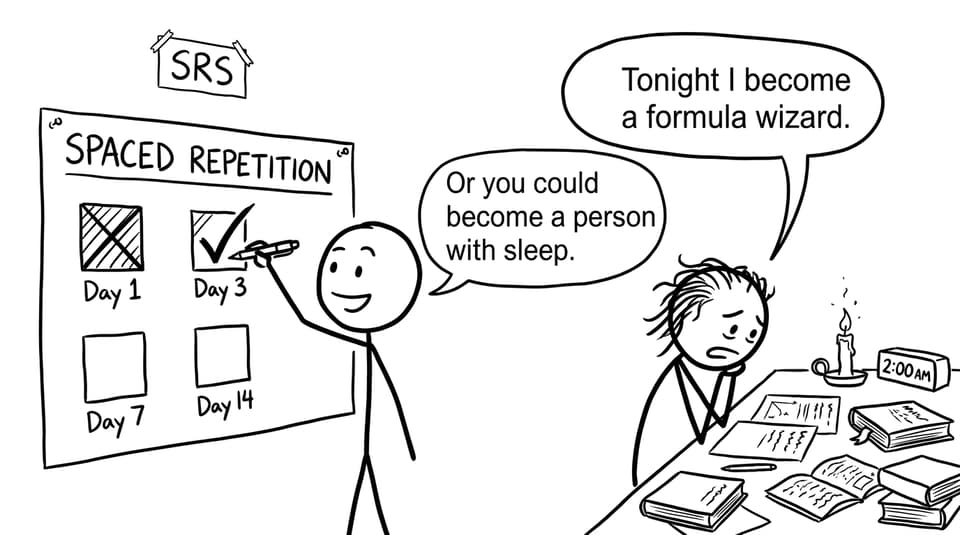
Revisit on a spaced schedule (Day 1, 3, 7, 14).
-
Track confidence levels so you revisit what’s actually fragile.
If you want a structured ecosystem for this, start with IB Mathematics Analysis and Approaches Resources and build outward from there.
Why IB Math formulas feel overwhelming (and why that’s normal)
Formulas are compact. That’s their beauty and their threat.
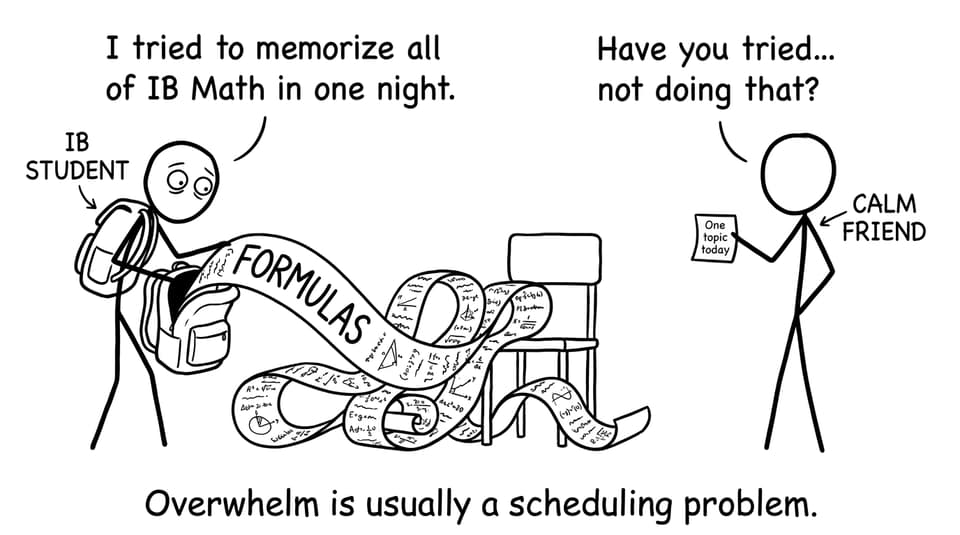
A single line like a differentiation rule isn’t just a line. It represents conditions (when it works), patterns (what it looks like in messy questions), and habits (how you write it under time pressure). When students say “I forgot the formula,” they often mean: “I didn’t build enough routes to the formula.”
In IB, you don’t only need recognition. You need retrieval. And retrieval is trained best through short, repeated effort.
That’s also why a platform workflow helps: when RevisionDojo keeps your Flashcards, Study Notes, and Questionbank in one place, you spend less energy organizing and more energy remembering. If you’re building a bigger routine around that, borrow the structure from The Ultimate IB Math Study Routine for Busy Students.
Start with understanding, not memorizing
A formula you understand has handles. A formula you memorise raw is slippery.
So before you try to “commit” a formula to memory, ask:
-
What is it doing? (Rate of change? Area? Counting? Standardising?)
-
What are the conditions? (Right triangle? Independent events? Differentiable?)
-
What does each symbol represent in a real question?
This is where RevisionDojo Study Notes help you slow down in the right way. Instead of rereading a textbook chapter, you can review a focused explanation, then immediately convert it into recall practice.
If you’re trying to improve the quality of your written explanations alongside formulas, keep Effective Note-Taking Strategies for IB Math Students open while you revise.
Break formulas into “families,” not a single giant list
One of the simplest anti-overwhelm moves in IB Math is grouping.
Instead of “all formulas,” organise by families you can finish in one session:
-
Algebra and functions (log laws, sequences, transformations)
-
Trigonometry (identities, sine/cosine rules)
-
Calculus (derivatives, integrals, differential equations where relevant)
-
Statistics and probability (variance, distributions, counting)
Your brain remembers better when it can attach new information to a category. It also reduces decision fatigue: you sit down already knowing what “counts” as done.
For targeted syllabus-level coverage, explore the hubs for your course. For example, many students start with IB Mathematics Analysis and Approaches Resources, then jump into the exact strand they need next.
Use Flashcards the right way: recall first, polish second
In IB, flashcards only work if they force retrieval.
A good formula flashcard is not “Here’s the formula, stare at it.” It’s:
-
Prompt: “Area of triangle using two sides and included angle”
-
Your job: write it from memory, then check.
-
Bonus: say what each variable means out loud.
This is why IB Flashcards with Spaced Repetition (SRS) | RevisionDojo is such a leverage tool: spaced repetition keeps difficult formulas coming back before you forget them, without you needing to micromanage a schedule.
And if you want a guide specifically about turning formulas into a system, use How to Use RevisionDojo Flashcards for Formula Mastery.
Apply immediately with a Questionbank (this is where memory “sticks”)
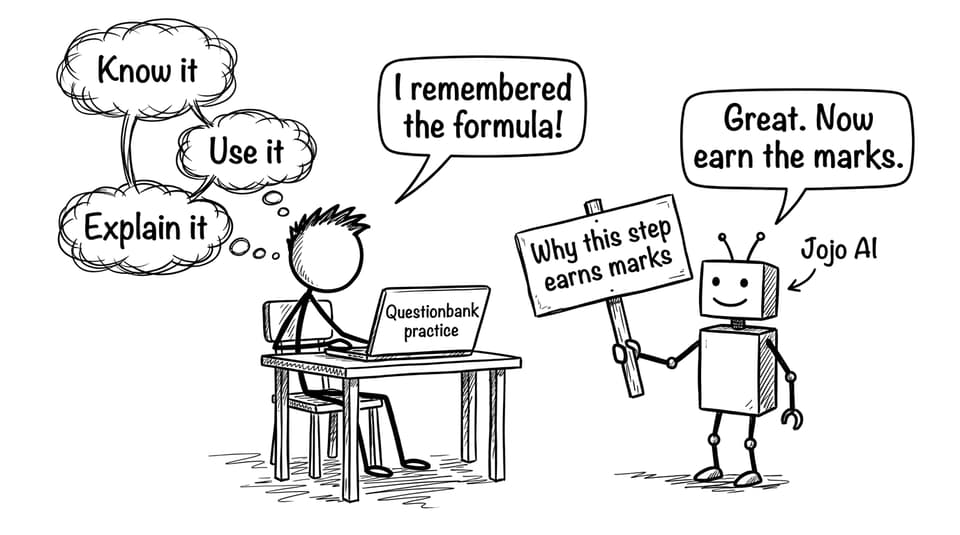
A formula becomes reliable when you use it in context.
After a short Flashcards session, do a tiny set of questions that force the formula to appear in different disguises. In IB, exam questions rarely announce themselves. They hint.
RevisionDojo makes this loop fast:
-
Read the explanation in notes.
-
Recall with flashcards.
-
Apply with the Questionbank.
-
Get feedback while the mistake is still fresh.
A strong place to begin (AA) is IB Mathematics Analysis and Approaches Topic Calculus Questionbank. If you need a broader strategy for drilling weaknesses without spiraling, use How to Use the Questionbank for Targeted Math Revision.
Build a gentle spacing schedule (and stop “starting over”)
Most IB students don’t actually fail to memorise. They fail to revisit.
Try this simple spacing rhythm for formula families:
-
Day 1: learn + flashcards + 5 questions
-
Day 3: flashcards + 5 harder questions
-
Day 7: mixed review set
-
Day 14: mini-timed set
Notice what’s missing: the dramatic “rewrite everything” restart. Spacing creates continuity. Continuity creates calm.
If you’re trying to fit this into a realistic week, adapt a schedule from Best Study Schedule For IB Math Exams.
Track confidence, not completion
Completion is seductive. Confidence is honest.
After you revise a formula family, rate each formula:
-
Green: I can recall and apply it quickly.
-
Yellow: I recall it, but hesitate in messy questions.
-
Red: I’m guessing.
Then use the ratings to decide what comes back into your Flashcards rotation. This is how you prevent the classic IB cycle: “I revised everything” followed by “I don’t remember anything.”
Use timed practice sparingly, but consistently
Overwhelm spikes when timing and formulas collide.
You don’t need to do long sessions daily, but you do need regular contact with pressure. Once a week is enough to start. Pair it with feedback.
RevisionDojo supports this progression naturally: use Mock Exams and Predicted Papers to simulate the pacing, then use the Questionbank to repair specific weaknesses. If you want a wider framework for exam prep tools, see RevisionDojo App: The Smarter Way to Prep for IB Exams and browse IB Predicted Papers by IB Examiners (Free).
A calmer ending: make IB formula revision boring (in a good way)
The students who look “naturally good” at IB Math formulas usually aren’t carrying a bigger brain. They’re carrying a smaller daily habit. Ten minutes of recall. A short Questionbank set. A spaced schedule that means they never truly start from zero.
If you want that kind of calm, build your loop inside RevisionDojo: use Study Notes to understand, Flashcards to retain, the Questionbank to apply, AI Chat to get unstuck quickly, and Grading tools to learn what earns marks. Then, when you’re ready, pressure-test it with Mock Exams and Predicted Papers. That’s how IB formulas stop feeling like a flood and start feeling like familiar tools.
Your next step: pick one formula family today, open your notes, and make the first recall session small enough to finish. Consistency is the real flex in IB.