


The first time you flip through the AA HL formula booklet, it feels comforting, like someone left you a ladder in the exam room.
But comfort is not the same as control.
In IB Math, the students who look calm aren’t calmer people. They’ve just trained one small skill that compounds: they know exactly what the formula booklet can do, where things live, and when not to touch it.
The smart role of the IB Math formula booklet
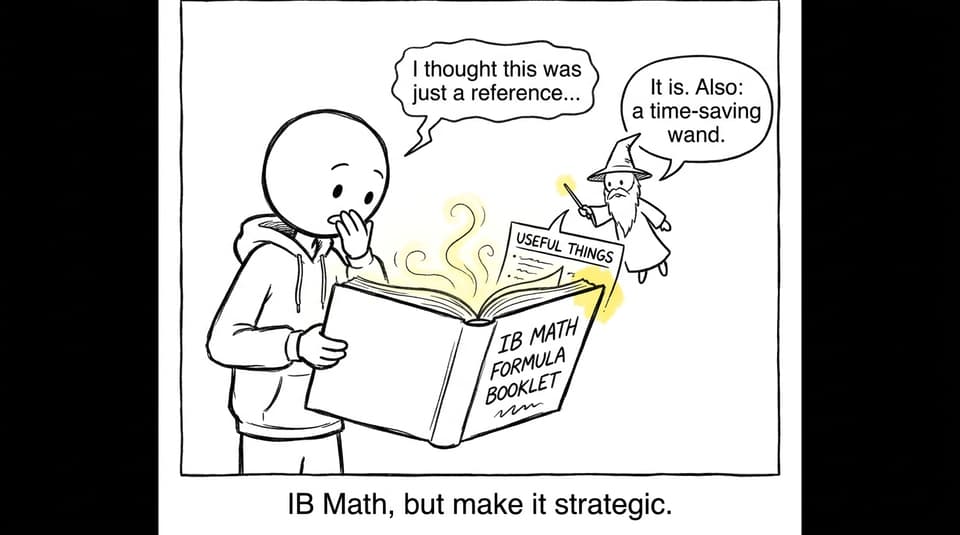
Treat the booklet less like a safety net and more like a navigation tool. In IB Math, marks often come from structure: defining variables, choosing an approach, and showing the chain of reasoning.
A smart approach means you can:
-
Recognize the “trigger” that tells you a certain formula is relevant
-
Link formulas across topics (functions + calculus + probability shows up more than you think)
-
Use the booklet to check a method, not to replace understanding
If you haven’t already, bookmark the official-style layout using RevisionDojo’s AA resource hub: IB Mathematics Analysis and Approaches Resources and its aligned reference: IB Mathematics Analysis and Approaches Data Booklet.
A quick “formula booklet mastery” checklist
Use this before every focused session of IB Math practice:
-
Open the booklet before you open your calculator
-
Make a one-page “page map” (topic -> section -> what it’s for)
-
Memorize only the high-frequency formulas that save real time
-
Practice with timed questions so the booklet becomes muscle memory
-
After marking, note: “Was my mistake conceptual, or booklet navigation?”
Build speed: train navigation, not flipping
The biggest booklet mistake in IB Math AA HL is turning page-flipping into a habit. Every frantic search quietly steals minutes.
Do this instead:
-
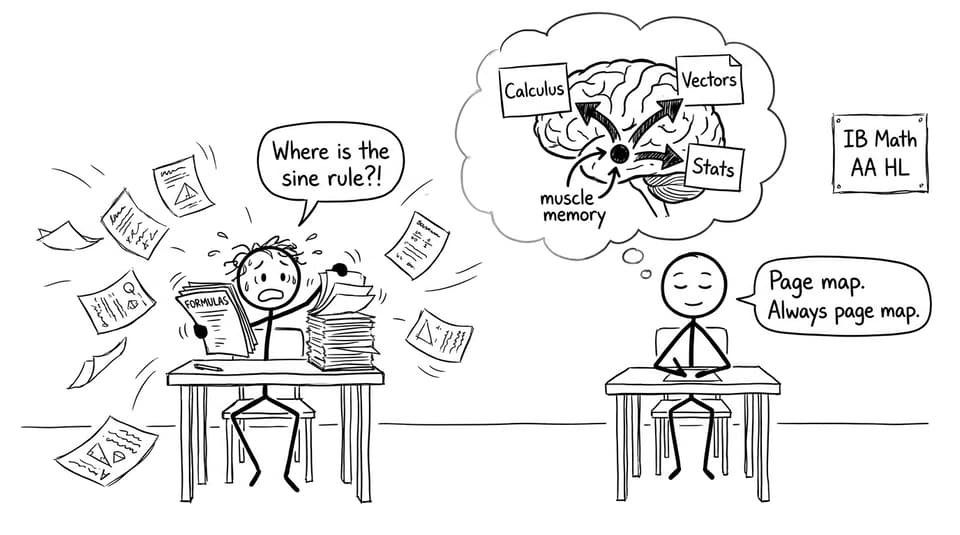
Create a page map: calculus, vectors, stats/probability, trig identities, distributions. Your goal is to know where a formula usually is before you look.
-
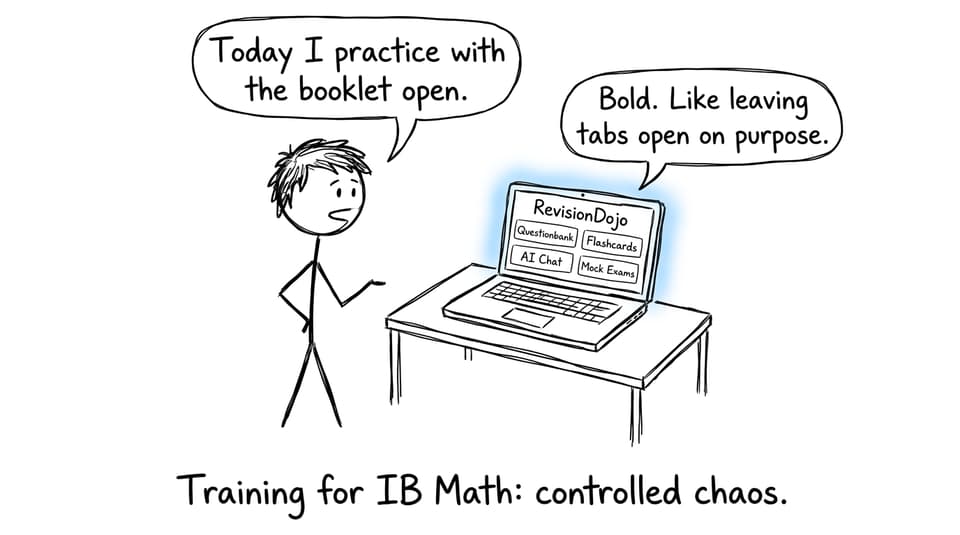
Use timed drills: even 10 minutes matters. Run short sets from the IB Mathematics Analysis and Approaches Calculus Questionbank with the booklet open, like it’s exam day.
-
Keep a “why this formula” note: one sentence. Not the derivation: just the situation it solves.
Build fluency: connect formulas to question language
In IB Math, questions often signal formulas indirectly. Words like “show that,” “hence,” “estimate,” and “model” are often invitations to choose a clean formula-based route.
A strong habit is to work backward:
-
What is the final form they want? (a value, a proof line, an equation)
-
Which formula delivers that form most directly?
-
What conditions must be true for the formula to apply?
Then practice that habit on real exam-style items. RevisionDojo’s How to Use the Questionbank for Targeted Math Revision is built for exactly this kind of deliberate practice.
Use RevisionDojo to make the booklet feel “native”
The formula booklet becomes powerful when it’s paired with feedback. That’s where RevisionDojo fits naturally into IB Math revision:
-
Questionbank for exam-style drills and pattern recognition
-
Study Notes to understand what a formula is saying, not just how to plug values
-
Flashcards for high-frequency identities and conditions (the time-savers)
-
AI Chat to ask “Why this formula here?” and get an explanation in examiner-friendly language
-
Mock Exams and Predicted Papers to pressure-test navigation under time
-
Grading tools to see where method marks were lost
-
Coursework Library and Tutors when your gaps are bigger than one worksheet
If you want a simple routine that keeps this consistent, borrow the structure from The Ultimate IB Math Study Routine for Busy Students.
Conclusion: make the booklet your advantage
The AA HL formula booklet isn’t there to rescue you. It’s there to reward the student who prepared with it.
In IB Math, the smartest approach is simple: learn the layout, train the triggers, and use the booklet to support clear reasoning under time pressure. Then scale that skill with RevisionDojo’s Questionbank, Study Notes, Flashcards, AI Chat, Mock Exams, Predicted Papers, and Grading tools.
When you’re ready, start by opening the booklet and doing one focused set with it today, today, inside RevisionDojo’s IB Mathematics Analysis and Approaches Resources.