
For IB students sitting exams in May 2028, earning a 7 in IB Math AA requires reliable mathematical understanding, accurate written reasoning, and enough timed practice to perform across every assessment component. You will follow the current Math AA course and assessment model, not the revised course first assessed in May 2029.
A top grade rarely comes from one spectacular trick. It is built from smaller decisions: writing the missing algebraic step, recognizing when technology helps, checking whether an answer fits its context, and repairing weak topics before they become permanent gaps.
This guide explains how to get a 7 in IB Math AA 2028 at SL or HL, including how to approach each paper, the internal assessment, and the two years leading to the examination.
The 7-level checklist
- Learn the complete SL or HL syllabus, not only comfortable topics.
- Develop fluent algebra and exact-value work for Paper 1.
- Use graphing technology strategically without replacing explanation.
- Show complete methods, correct notation, and relevant conclusions.
- Practise unfamiliar multi-step problems, especially at HL.
- Record mistakes and revisit them through spaced practice.
- Treat the mathematical exploration as a sustained investigation.
- Complete timed papers and full mock exams before May 2028.
- Track progress by skill and topic, not only by total score.
The RevisionDojo IB Math AA resource hub brings Questionbank practice, Study Notes, videos, and Flashcards into one syllabus-organized place. Preparation becomes easier when learning, feedback, and review belong to the same routine.
Which syllabus applies to May 2028?
The IB's current public curriculum information states that the existing Mathematics: Analysis and Approaches course has its final assessment in November 2028. The revised course begins assessment in May 2029. Students taking examinations in May 2028 should therefore follow the current guide, first assessed in 2021.
This matters because information about the 2029 course is already available. Its paper marks and internal assessment criteria do not govern the May 2028 cohort.
As of October 2026, the detailed May 2028 examination timetable has not been published publicly. Confirm future dates and session times with your IB coordinator rather than relying on unofficial schedules.
Grade boundaries are not published in advance either. They may vary by session and level, so no responsible plan can promise that a particular raw percentage will produce a 7. Aim for consistently strong performance across the course instead of planning around an invented cutoff.
Understand how Math AA is assessed
External examinations contribute 80% and the mathematical exploration contributes 20% at both SL and HL.
| Component | SL | HL | Main demand |
|---|---|---|---|
| Paper 1 | 1 hour 30 minutes, 40% | 2 hours, 30% | Non-calculator reasoning and technique |
| Paper 2 | 1 hour 30 minutes, 40% | 2 hours, 30% | Technology-supported problem solving |
| Paper 3 | Not applicable | 1 hour, 20% | Two extended, unfamiliar problems |
| Mathematical exploration | 20% | 20% | Independent mathematical investigation |
The syllabus covers number and algebra, functions, geometry and trigonometry, statistics and probability, and calculus. HL adds greater depth, but the difference is not merely the amount of content. HL students must connect ideas and sustain reasoning through more demanding problems.
A 7 is therefore not simply a reward for speed on routine exercises. It reflects breadth, precision, and the ability to transfer mathematics into unfamiliar settings.
What 7-level performance looks like on Paper 1
Paper 1 tests mathematics without calculator support. Success depends on exact manipulation, recognizable structures, and solutions another mathematician can follow.
Suppose you must find and classify the stationary point of
A complete response shows
Because , the stationary point occurs when , giving and
The sign of (f'(x)) changes from positive to negative at , so is a local maximum.
This solution exposes the structure through factorization, acknowledges that the exponential is non-zero, retains the exact value, and answers the classification instruction. It is not long for appearance's sake. It includes every logically necessary step.
To develop this skill, follow effective IB Math AA revision methods and alternate between short fluency drills and multi-step questions. Study Notes can repair understanding, while Questionbank practice reveals whether you can apply the idea independently.
What 7-level performance looks like on Paper 2
Paper 2 permits the required technology, but calculator access does not remove the need for judgment. A displayed value becomes useful evidence only when you explain what it means.
Suppose
and you must find when . An analytical route is
If counts completed years, the contextual answer is 9 years. The calculator evaluates the logarithms, but it does not decide how to rearrange the model, round the result, or interpret .
Ask three questions when using technology:
- What mathematical operation produced this value?
- Does it require rounding, and in which direction?
- What does it mean in the original context?
Technology should accelerate valid thinking, not conceal missing reasoning.
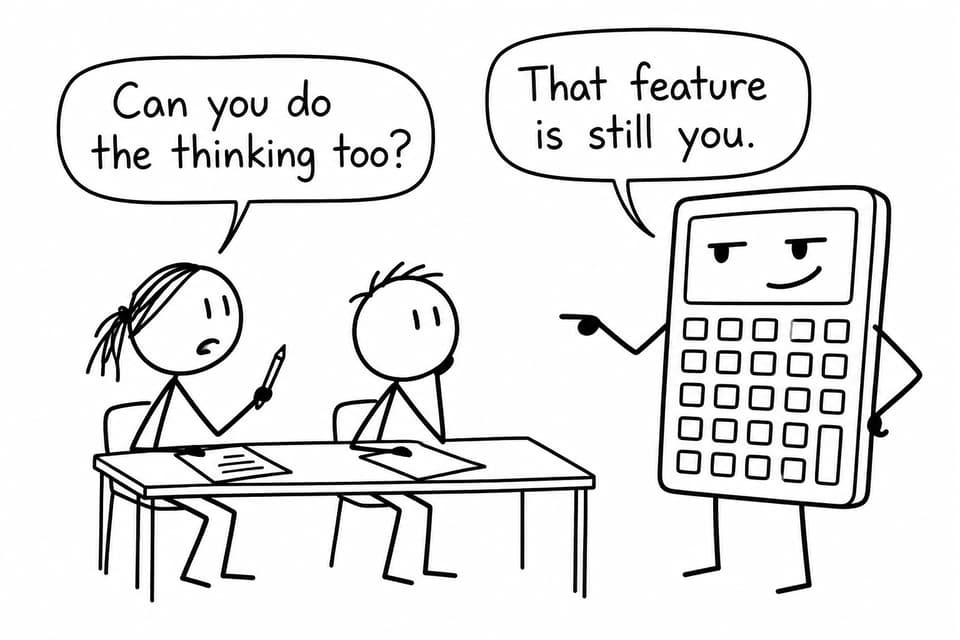
Two students discover that a calculator can perform commands but cannot take responsibility for the reasoning.
Learn your required calculator workflows during DP1. By DP2, they should be automatic enough that you can concentrate on choosing methods, checking outputs, and communicating conclusions.
What a top HL Paper 3 response requires
HL Paper 3 contains two compulsory extended-response problems. Questions may start with accessible observations before developing into unfamiliar investigations. The challenge is continuing when the complete route is not immediately visible.
An illustrative problem might define
Simplifying gives
The transferable process is more important than the example:
- Compute a simple case.
- Look for a pattern or useful representation.
- State a conjecture clearly.
- Justify it using valid mathematics.
- Apply the result to the next part.
If stuck, record what you know and test a special case. Paper 3 can reward connected progress, and one correct observation may unlock later reasoning.
RevisionDojo's practical Math AA HL study plan helps students balance content coverage with inquiry practice. Predicted Papers and Mock Exams can later develop sustained, timed performance.
Build an IA that demonstrates real mathematics
For the May 2028 cohort, the mathematical exploration is marked out of 20 using five criteria:
| Criterion | Maximum marks |
|---|---|
| Presentation | 4 |
| Mathematical communication | 4 |
| Personal engagement | 3 |
| Reflection | 3 |
| Use of mathematics | 6 |
Do not plan with the revised May 2029 criteria. Your teacher should provide the current guide and explain how each criterion applies at your level.
A strong exploration begins with a focused mathematical purpose. Compare “The mathematics of football” with “How can a projectile model be used to investigate the launch conditions of a free kick?” The second question creates room to define assumptions, construct a model, test parameters, discuss limitations, and refine the approach.
Reflection should occur throughout the investigation. It might explain why you rejected a method, whether an output is reasonable, how two models differ, or how an assumption affects the conclusion.
Use mathematics you genuinely understand. Complexity without control can weaken an exploration, while appropriately challenging mathematics that is explained and evaluated can produce coherent work. The guide to preparing for the Math IA exploration and summer Math IA planning advice can help you shape a viable question before DP2 becomes crowded.
RevisionDojo's Coursework Library demonstrates useful structures, while Grading tools and Tutors can support feedback. AI Chat can help you question a method or identify a gap, but the investigation, calculations, decisions, and writing must remain your own and follow school academic integrity rules.
A two-year plan for the May 2028 cohort
A two-year plan works because each stage has a different job. Trying to revise everything simultaneously often creates activity without direction.
August-December 2026: establish clean foundations
Follow your school's sequence and solve questions every week. Prioritize algebraic manipulation, functions, notation, and prerequisite skills identified by your teacher.
After each topic, complete a mixed set and classify errors as concept, method, accuracy, or interpretation. Every lost mark then becomes a specific repair task.
January-June 2027: connect topics
Mix earlier content with current lessons. Calculus may depend on functions, logarithms, trigonometry, or algebra, so prolonged topic isolation eventually becomes a weakness.
Every 2-3 weeks, complete a timed section and review it carefully. Improvement comes from diagnosing decisions, not merely collecting scores.
June-August 2027: consolidate and shape the IA
Close DP1 gaps and develop an approved exploration direction. Do not produce an enormous draft before confirming that the question is focused and mathematically viable.
The best May 2028 IB resources can help you combine Study Notes, Flashcards, Questionbank sets, and feedback tools instead of switching randomly between materials.
September-December 2027: strengthen transfer
Complete the remaining syllabus and increase mixed practice. HL students need regular unfamiliar problems, while SL students should also practise multi-step reasoning rather than expecting every task to resemble a textbook exercise.
Finish the IA according to your school's deadlines, but protect weekly time for examination preparation.
January-March 2028: practise timed performance
Complete full papers under authentic conditions. Alternate Paper 1 and Paper 2, adding Paper 3 at HL. Use Mock Exams for endurance and Predicted Papers as extra exam-style practice, never as a claim about what will appear.
After marking, rebuild weak skills in the Questionbank. A full paper reveals what failed; targeted questions help you repair it.
April-May 2028: refine rather than panic
Review recurring errors, calculator commands, exact values, proof structures, and interpretation mistakes. Make practice increasingly similar to examination conditions.
Avoid rebuilding your entire system in the final weeks. A calm routine is valuable because it removes unnecessary decisions when pressure rises.
Turn the ambition into a repeatable system
Learning how to get a 7 in IB Math AA 2028 is less about discovering a secret resource than using good resources in the right sequence. Learn the idea, attempt it without support, inspect the error, repair the weakness, and revisit it later under time pressure.
RevisionDojo is built as the ultimate IB resource for that cycle. Study Notes and Flashcards support understanding, the Questionbank develops application, and AI Chat and Grading tools strengthen feedback. Predicted Papers and Mock Exams build timed readiness, while the Coursework Library and Tutors provide structured support for the exploration.
Your next step is simple: open the RevisionDojo Math AA Questionbank, choose the topic most recently taught in class, complete 10 questions without notes, and classify every error as concept, method, accuracy, or interpretation.