


If you have ever watched a classmate “get it” in ten minutes while you’re still untangling step one, you’ve felt the quiet unfairness of math. Not because you’re less capable, but because you’re studying in a way that fights your brain instead of working with it.
In IB Math, that mismatch is expensive. It costs time, confidence, and energy you need for everything else. The good news is you don’t need a personality makeover. You need a better fit: your personal learning style for math, translated into actions you can repeat.
This guide shows you how to find your personal learning style for math (without turning it into a label) and how to use it to revise more efficiently using RevisionDojo.
A quick checklist to find your personal learning style for math
Use this as a simple starting loop. It’s designed for IB students who want results, not theory.
-
Notice what reduces friction when you study (what feels clearer, faster, calmer).
-
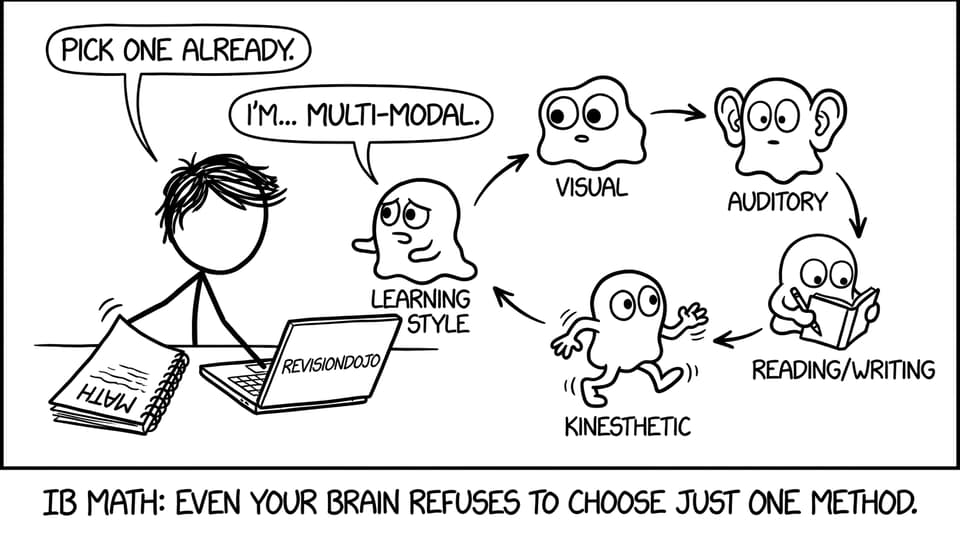
Identify your top 1-2 learning preferences (you’re probably multi-modal).
-
Match each preference to a specific technique: notes, flashcards, explanation, practice.
-
Run one week of experiments and track which method improves accuracy and speed.
-
Lock it into a routine with RevisionDojo tools (Questionbank, Study Notes, Flashcards, AI Chat, Grading tools).
If you want a broader view of how styles shape revision across subjects, pair this with Ways to Optimize IB Revision for Different Learning Styles.
The learning-style trap (and how IB students avoid it)
A learning style is not a box. It’s a bias: what helps you understand sooner.
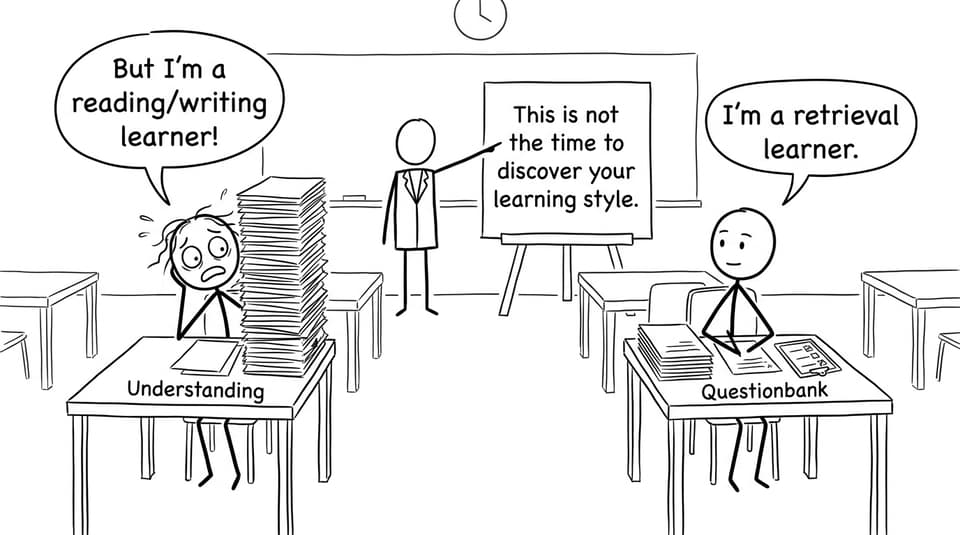
The trap is thinking, “I’m visual, so I only watch videos,” or “I’m reading/writing, so I only rewrite notes.” In IB Math, understanding is only half the game. Marks come from retrieval, method choice, and clean communication under time.
So your real target is this:
-
Understanding mode (how you grasp a new idea)
-
Retention mode (how you remember it later)
-
Performance mode (how you execute under exam constraints)
RevisionDojo is built for that three-part reality: Study Notes for understanding, Flashcards for retention, and the Questionbank + Mock Exams for performance.
For a big-picture routine that ties these together, see RevisionDojo App: The Smarter Way to Prep for IB Exams.
Step back: how you learn math is not how you learn everything
Math has a special kind of honesty. You can feel like you understood a topic at 9pm and still blank at 9am. That’s not weakness; it’s the gap between recognition and recall.
To find your personal learning style for math, you need to watch what happens at three moments:
-
When you meet a new concept (first exposure)
-
When you attempt a question (application)
-
When you correct a mistake (feedback)
Your learning style shows up most clearly in the correction phase because that’s where your brain decides what pattern to store.
Visual learning style for math (IB): “Show me the structure”
If you’re visual-leaning, you often understand faster when you can see relationships: graphs, diagrams, transformations, and “shape” in algebra.
What works well in IB Math:
-
Turn every new method into a mini flowchart (When do I use it? What triggers it?).
-
Use color for meaning, not decoration (e.g., domain restrictions, sign changes, key steps).
-
Sketch graphs even when not asked. Visual learners get marks because the sketch prevents dumb errors.
How to use RevisionDojo with a visual learning style:
-
Start with topic-aligned explanations in the IB Mathematics Analysis and Approaches Resources hub.
-
Then jump to the Questionbank and filter by the exact subskill you just studied (so the picture becomes a method).
-
When stuck, ask Jojo AI Chat to explain the shape of the solution: “What does this function do as x increases?”
If you’re in Math AI and rely on interpretation, this style is even more valuable. You can also borrow strategies from How to Improve Your Scores in IB Math AI: 11 Proven Tips.
Auditory learning style for math (IB): “Let me hear the logic”
Auditory-leaning students don’t just like sound. They like sequence. A spoken explanation forces steps to line up, and that’s exactly what examiners reward.
What works well in IB Math:
-
Explain a solution aloud as if you’re teaching it to a younger student.
-
Record a 60-second “method memo” after each session (trigger, steps, common pitfall).
-
Study with a partner, but only if you both speak in full reasoning, not fragments.
How to use RevisionDojo with an auditory learning style:
-
After reading notes, open the Questionbank and narrate your working line by line.
-
Use AI Chat as a patient listener: paste your attempt and ask, “Where does my reasoning jump?”
-
After you finish, summarize the method as a short script, then convert that into flashcards.
A solid companion read is How to Use the Questionbank for Targeted Math Revision, because auditory learners improve fast when practice is structured.
Kinesthetic learning style for math (IB): “I learn by doing”
Kinesthetic learners often feel behind at first because they want to touch the problem before the theory feels real. But once they commit to deliberate practice, they can become frighteningly consistent.
What works well in IB Math:
-
Short, frequent question sets (20-30 minutes) beat long study sessions.
-
Whiteboard work: larger writing helps you see structure and reduces careless errors.
-
Immediate feedback: do not “practice wrong” for 45 minutes.
How to use RevisionDojo with a kinesthetic learning style:
-
Use the Questionbank as your main textbook: attempt first, then read the explanation.
-
Switch to timed sessions earlier than you think. Kinesthetic learners gain confidence through pressure training.
-
Use Mock Exams and Predicted Papers to build stamina, then review errors like a coach.
For a routine that fits busy schedules, see The Ultimate IB Math Study Routine for Busy Students.
Reading/writing learning style for math (IB): “Let me rewrite it cleanly”
Reading/writing learners build clarity through language. In IB Math, that can be a superpower, because clear structure earns method marks even when the final answer slips.
What works well in IB Math:
-
Rewrite messy solutions into “exam-quality solutions” after marking.
-
Keep a living formula-and-triggers sheet: not just the formula, but when to use it.
-
Convert explanations into questions (active recall), not paragraphs.
How to use RevisionDojo with a reading/writing learning style:
-
Use Study Notes to get the clean version of the concept, then write your own compressed version.
-
Build daily recall with IB Flashcards with Spaced Repetition (SRS) so your writing becomes memory, not rewriting.
-
Strengthen definitions and precision with How to Use Flashcards to Learn IB Math Definitions.
The “mix and match” method most IB students actually need
Most IB students aren’t one style. They’re a combination that changes by topic.
Here’s a reliable multi-modal pattern you can repeat:
-
See it (visual): quick diagram, graph, or flowchart from notes.
-
Say it (auditory): explain the method in plain English.
-
Do it (kinesthetic): 8-12 targeted questions.
-
Write it (reading/writing): rewrite one solution to full-mark standard.
The power is not the individual steps. It’s the sequence. Every cycle ends with a product: corrected work, a flashcard, or an error-log rule.
If you want a short, high-impact way to run cycles, use How to Review Each IB Math Topic in 15 Minutes.
Track your learning style the way IB rewards you: with evidence
If you only “feel” like something works, you’ll eventually stop trusting yourself. So measure.
A simple weekly tracker:
-
Accuracy in targeted sets (Questionbank)
-
Time per question (especially for Paper-style tasks)
-
Error types (algebra slip, method choice, interpretation)
-
Confidence rating after marking (not before)
RevisionDojo’s ecosystem makes this easier because you can practice, get feedback, and tighten weak areas without guessing. Use AI Chat for explanations, Flashcards for retention, and Grading tools to understand how your working aligns with marks.

Closing: your learning style is a strategy, not an identity
The most effective IB Math students don’t find a perfect method. They find a repeatable one. They stop trying to study like the smartest person in the room and start studying like themselves, with a system.
Use RevisionDojo to turn your personal learning style for math into a weekly loop: learn with Study Notes, retain with Flashcards, apply with the Questionbank, stress-test with Mock Exams and Predicted Papers, and sharpen your thinking with AI Chat and Grading tools. When your process fits you, the syllabus stops feeling endless. It starts feeling doable.
If you want to begin immediately, start in the IB Mathematics Analysis and Approaches Resources hub, then build your first targeted practice set from there.