


Choosing an IB Math IA topic feels like standing in front of a fridge at midnight: you know you need something, but everything looks either too ambitious or weirdly empty.
And the uncomfortable truth is this: in IB, the topic you choose quietly determines almost everything that follows. Your motivation. Your math depth. Your ability to reflect. Even how smoothly your draft comes together when deadlines start colliding.
The goal isn’t to pick the flashiest idea. It’s to pick the idea that lets you do real mathematics, stay focused, and still have enough room to think out loud about what your results mean.
The IB Math IA topic checklist (save this)
Before you commit, run your topic through this fast filter. A strong IB Math IA topic should:
-
Be mathematically driven (not just “a real-world story”).
-
Use at least two IB-level concepts (or one concept with genuine depth).
-
Be feasible with data, time, and your tools.
-
Create space for interpretation, limitations, and reflection.
-
Be narrow enough to finish, but wide enough to evaluate.
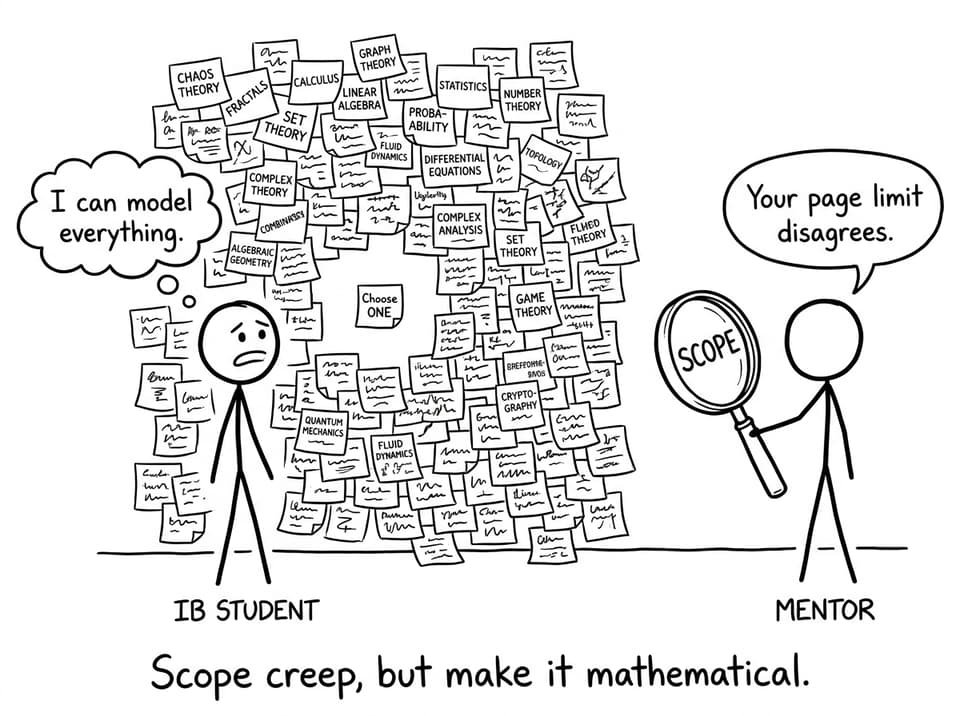
If you need inspiration first, scan a few curated ideas and categories in The Best IB Math IA Topics for 2025 and then come back to the filter.
Start with curiosity, not “what sounds smart”
Most IB students don’t choose a topic, they choose an identity: “I’m the person doing a hard calculus IA.” That’s a fragile strategy. It breaks the first time the math gets messy.
Instead, start with something you’d still want to explore even if nobody graded it.
Good sources of genuine curiosity:
-
A sport you watch obsessively (angles, trajectories, optimization).
-
Your music habits (growth models, signal patterns).
-
A game you play (probability, strategy, expected value).
-
Something you can measure in your daily life (time series, regression, error).
Then translate that curiosity into a mathematical question. If you want more examples of what “curiosity turned into math” looks like, read Examples of Successful IB Math IA Topics.
Identify the mathematical core early (this is the IB trick)
Here’s the mistake that quietly sinks many IB Math IAs: the topic is interesting, but the mathematics is an afterthought.
Ask yourself this blunt question:
“If I delete the real-world context, what mathematics is still left?”
If the answer is “mostly graphing” or “mostly calculator regression,” you’re not doomed, but you need more depth: derivations, parameter interpretation, model comparison, error analysis, or a second technique.
A few strong math cores that work well in IB:
-
Calculus (optimization, rates of change, area/accumulation)
-
Functions and modeling (comparing models, transformations, parameter meaning)
-
Statistics (correlation vs causation, residuals, confidence, distributions)
-
Geometry/trig (structure, symmetry, measurement, transformations)
To check what content you actually need to know for your stream, keep the syllabus hub open while you brainstorm: IB Math AA Resources.
Choose the right depth: “challenging” beats “impossible”
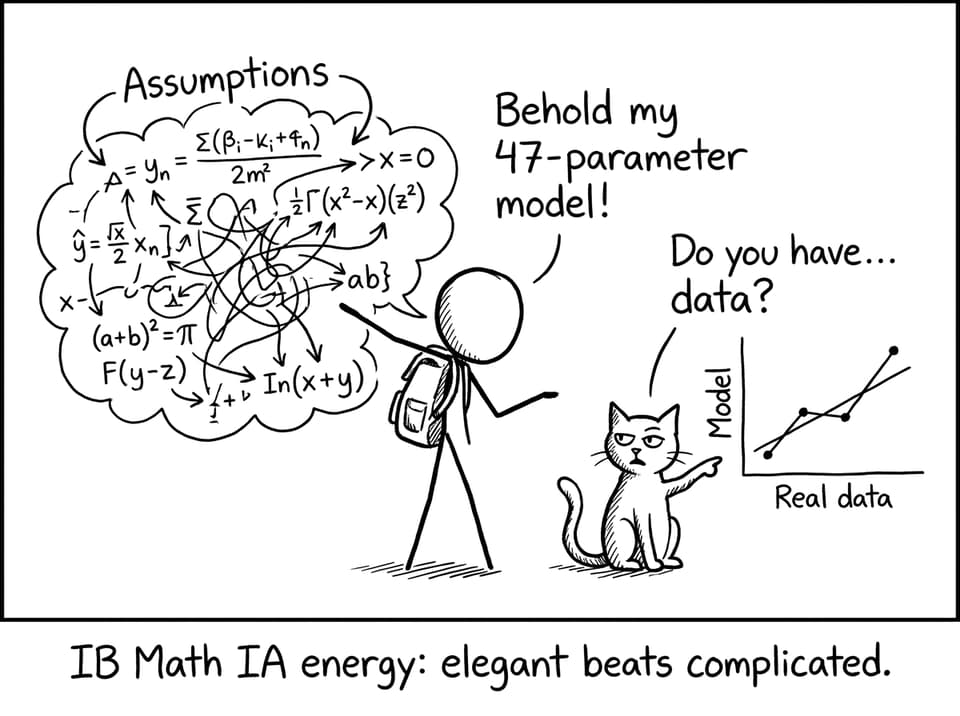
IB math rewards clarity and reasoning, not suffering.
A topic is usually too simple if:
-
It can be completed using one formula with no decisions.
-
It becomes a list of calculations with no interpretation.
-
You can’t explain why a method was chosen over another.
A topic is usually too advanced if:
-
You can’t explain the method in your own words.
-
You rely on copying a process without understanding assumptions.
-
The math requires tools you can’t realistically learn in time.
A practical sweet spot: choose something where you can do a “mini version” in one evening. If you can’t test-drive the idea quickly, it’s often not ready.
If you want a safety net for depth, RevisionDojo helps here in a very IB-specific way: you can learn the method in Notes/Study Notes, drill it in the Questionbank, and then check your accuracy under pressure with Mock Exams and Predicted Papers.
For targeted skill-building while you’re selecting methods, these pages are useful:
Narrow your idea into a research question you can actually finish
The best IB Math IA topics are often boring in one specific way: they are precise.
Compare:
-
Weak: “To study probability in card games.”
-
Strong: “To compare two probability models for winning outcomes in [specific scenario], then evaluate which assumptions distort results most.”
Precision creates room for reflection. Vague aims kill it.
If you’re stuck turning an idea into a question, use a general framework like the one in How to Write a Strong IA Research Question, then adapt it to mathematics.
Make reflection inevitable (not optional)
In IB, reflection isn’t an extra paragraph at the end. It’s what happens when your topic is designed to create decisions.
Build reflection into your topic by planning moments where you must:
-
Compare two models and justify the better fit.
-
Discuss limitations in data quality.
-
Interpret parameter meaning in context.
-
Test sensitivity: “If this assumption changes, what happens?”
A useful habit: write down three “future reflection questions” before you start.
Examples:
-
What assumptions are doing the most work in my model?
-
Where does my method stop being reliable?
-
What would I do differently with better data?
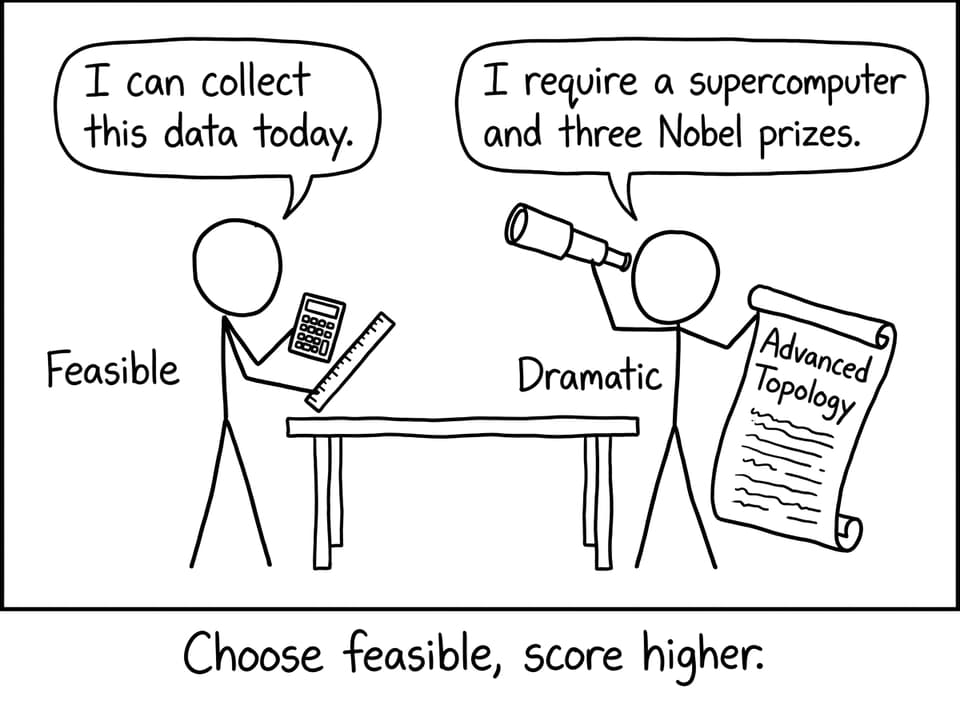
Feasibility: the most underrated IB advantage
A topic that is feasible gives you time to polish, and polish is where IB marks quietly appear.
Feasibility means:
-
You can access data (or collect it safely and ethically).
-
You can repeat measurements.
-
You can explain your process.
-
You can finish analysis without needing miracles.
If you’re unsure, browse examples for structure and realism in RevisionDojo’s Coursework Library: IB Math AA Coursework Exemplars.
A simple IB workflow to lock your topic in (without regret)
Here’s a calm way to decide in 48 hours:
-
Day 1: brainstorm 3 ideas, then write one research question for each.
-
Day 1: do a tiny test calculation or graph for each idea.
-
Day 2: pick the one with the best mix of math depth + feasibility + personal interest.
-
Day 2: outline your method and list the assumptions you’ll discuss.
Then build the skill loop: learn the technique using RevisionDojo Study Notes, test it in the Questionbank, ask AI Chat to clarify your weak steps, and use the Grading tools to check whether your draft is actually meeting the rubric.
If you want broader IA support across subjects (structure, rubric expectations, drafting), start here: IB IA Guides.
Closing: choose the IB topic that lets you finish well
The best IB Math IA topic isn’t the one that looks impressive in a sentence. It’s the one that gives you a clean path: real mathematics, manageable data, and enough space to reflect like a thoughtful investigator.
If you want that path to feel simpler, use RevisionDojo as your home base: explore exemplar structure in the Coursework Library, build understanding with Study Notes and Flashcards, practice the exact methods in the Questionbank, get clarity from AI Chat, and use the Grading tools to turn your draft into a mark-focused final.
Pick a topic you can carry. Then practice like an IB student who plans to finish strong.