If you have ever stared at a list of TOK prescribed titles and felt your brain do that quiet, slow reboot, you are not alone.
The strange part is that nothing is wrong. The titles are supposed to feel open. That is the point of TOK: you are being asked to make choices, set boundaries, and then defend them with careful thinking. But that freedom is also the trap. Pick the wrong question for you, and you spend weeks fighting your own essay.
This guide helps you choose the best TOK May 2026 title for your essay, not by guessing what the examiner “likes,” but by matching a title to your strengths, your examples, and the way the TOK rubric rewards depth.
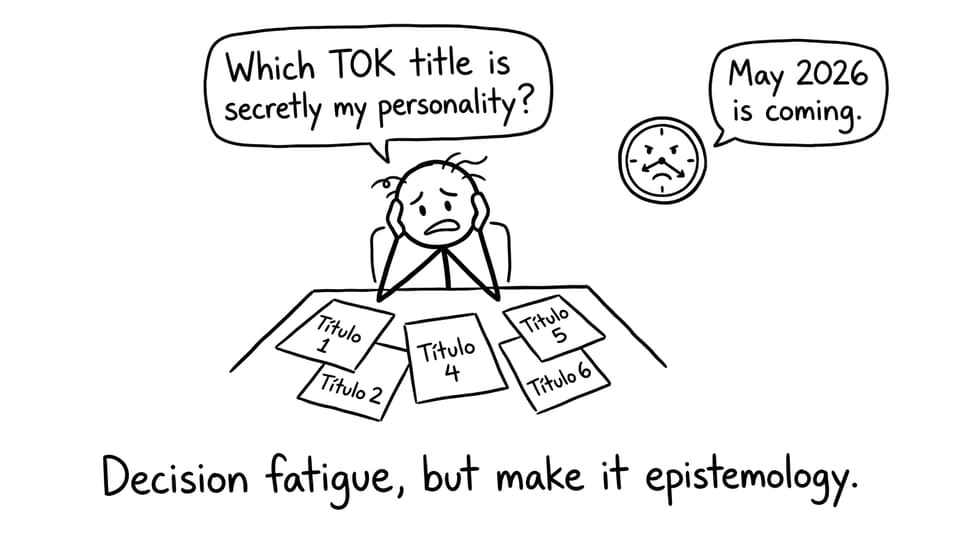
A quick TOK checklist before you commit
Before you “fall in love” with a title, run this fast TOK check. A good choice usually scores well on at least four.
-
AOK fit: Can you see two Areas of Knowledge that create a real comparison (not two versions of the same argument)?
-
Example readiness: Do you already have 3-5 real-life examples you can explain confidently?
-
Counterclaim comfort: Can you imagine credible pushback without turning the essay into a debate club script?
-
Definition clarity: Can you define the key terms in a way that is arguable and not just dictionary-level?
-
Rubric alignment: Can you sustain analysis and evaluation, not just description?
If you want a wider view of what strong TOK work includes, keep Mastering the TOK Essay and Exhibition open while you decide.
The May 2026 TOK titles: what each one “wants” from you
There are six TOK prescribed titles for May 2026. All can score highly. The difference is whether the title naturally pulls you toward sharp claims, rich examples, and real evaluation.
For the official set and a bigger overview, see the TOK May 2026 Essay Prescribed Titles: Complete Guide and the May 2026 (M26) IB TOK Essay Prompts Explained.
Title 1: observation matters, even when it fails
Prompt: “In the production of knowledge, does it matter that observation is an essential but flawed tool?”
This is a TOK title for students who like the tension between “we need this” and “we cannot fully trust this.” It is naturally strong in Natural Sciences and the Arts, but it also plays well with History if you want to talk about eyewitness accounts and recording practices.
-
Best for: students with science experiments, perception bias, measurement limits, or art interpretation examples.
-
Watch out for: treating “flawed” as a simple weakness. The best TOK essays show how flaws can be corrected, reduced, or even made productive.
If you want a direct breakdown, use TOK May 2026 Title 1 guide.
Title 2: doubt as a feature, not a bug
Prompt: “To what extent do you agree that doubt is central to the pursuit of knowledge?”
This TOK title works if you enjoy writing about how knowledge grows through criticism. It can be powerful in Natural Sciences (method, replication, revision) and Human Sciences (interpretations, contested theories). It also lets you discuss when doubt becomes performative or destructive.
-
Best for: students who can separate productive doubt from endless skepticism.
-
Watch out for: writing as if doubt is always good. TOK rewards nuance: doubt can sharpen inquiry, but it can also block action.
Deep dive: TOK May 2026 Title 2 guide.
Title 3: knowledge is powerful when it travels well
Prompt: “Is the power of knowledge determined by the way in which the knowledge is conveyed?”
This TOK title often leads to great essays because it forces you to define “power.” Is it persuasion? usefulness? authority? accessibility? Then it asks what happens when the same content is expressed differently: proof vs. rhetoric, data vs. story, diagram vs. speech.
-
Best for: students who like History, politics, media, Mathematics notation, or communication theory.
-
Watch out for: vague talk about “how we communicate” without tying it back to what counts as knowledge and why it matters.
Guide: TOK May 2026 Title 3 guide.
Title 4: context is either the key or the distraction
Prompt: “In the acquisition of knowledge, can we only understand something to the extent that we understand its context?”
This TOK title shines when you can show two different meanings of “context” (historical, cultural, linguistic, methodological) and then test whether knowledge ever escapes it. Literature and the Human Sciences are natural fits, but Mathematics can work as a contrast if handled carefully.
-
Best for: students who can define context clearly and apply it in two AOKs.
-
Watch out for: circular reasoning ("context matters because context matters"). Strong TOK writing distinguishes what context changes: meaning, validity, interpretation, or ethical impact.
Guide: TOK May 2026 Title 4 guide.
Title 5: “all things are numbers” and the temptation of elegance
Prompt: “To what extent do you agree with the claim that ‘all things are numbers’ (Pythagoras)?”
This TOK title is for students who enjoy abstraction. It lets you explore reductionism, modeling, and the dream that reality becomes understandable when it becomes measurable. It can be beautiful in Mathematics, and surprisingly interesting in the Arts (music, architecture, proportion).
-
Best for: students who can handle metaphor as well as literal claims.
-
Watch out for: taking the quote too literally and getting stuck in “but love is not a number.” Better TOK essays explore where quantification explains, where it distorts, and why we crave numerical certainty.
Guide: TOK May 2026 Title 5 guide.
Title 6: interpretation is unavoidable, but is it reliable?
Prompt: “To what extent is interpretation a reliable tool in the production of knowledge?”
This TOK title rewards mature essays because it pushes you beyond “interpretation is subjective.” You can argue that interpretation is a disciplined tool (methods, peer review, triangulation) while still admitting that perspective and context shape outcomes.
-
Best for: students who like History, Natural Sciences (data interpretation), and debates about objectivity.
-
Watch out for: failing to define “reliable.” In TOK, reliability can mean consistency, accuracy, predictive power, or intersubjective agreement.
Guide: TOK May 2026 Title 6 guide.
How to decide: a simple TOK scoring method
When students ask for the “best TOK title,” what they usually mean is: Which one gives me the best chance to write a focused, evaluative essay with strong examples?
Try this:
Build a two-title mini-plan
Pick your top two titles and write a rough plan for each:
-
2 AOKs you will use
-
2 claims (one per AOK)
-
2 counterclaims (one per AOK)
-
4 real-life examples (2 per AOK)
-
1 sentence defining the key term (observation, doubt, power, context, numbers, interpretation)
If one plan feels like it is pulling you forward, and the other feels like you are forcing it, you have your answer.
To speed this up, borrow a framework from TOK Essay Planning Templates for May 2026 Titles.
Check whether you can create a real knowledge question
A good TOK essay does not just respond to the prompt; it turns it into a focused knowledge question you can actually evaluate.
If you struggle to do that, the title may be too broad for your current examples.
Use Breaking Down TOK Essay Titles: What Are Knowledge Questions? as your guide for turning a TOK prompt into something you can argue.
Stress-test your counterclaims early
Counterclaims are not a “paragraph you add.” They are the proof that you understand the complexity of knowledge.
If you want ready-to-adapt angles, see Best Counterclaims for the May 2026 TOK Essay Titles.
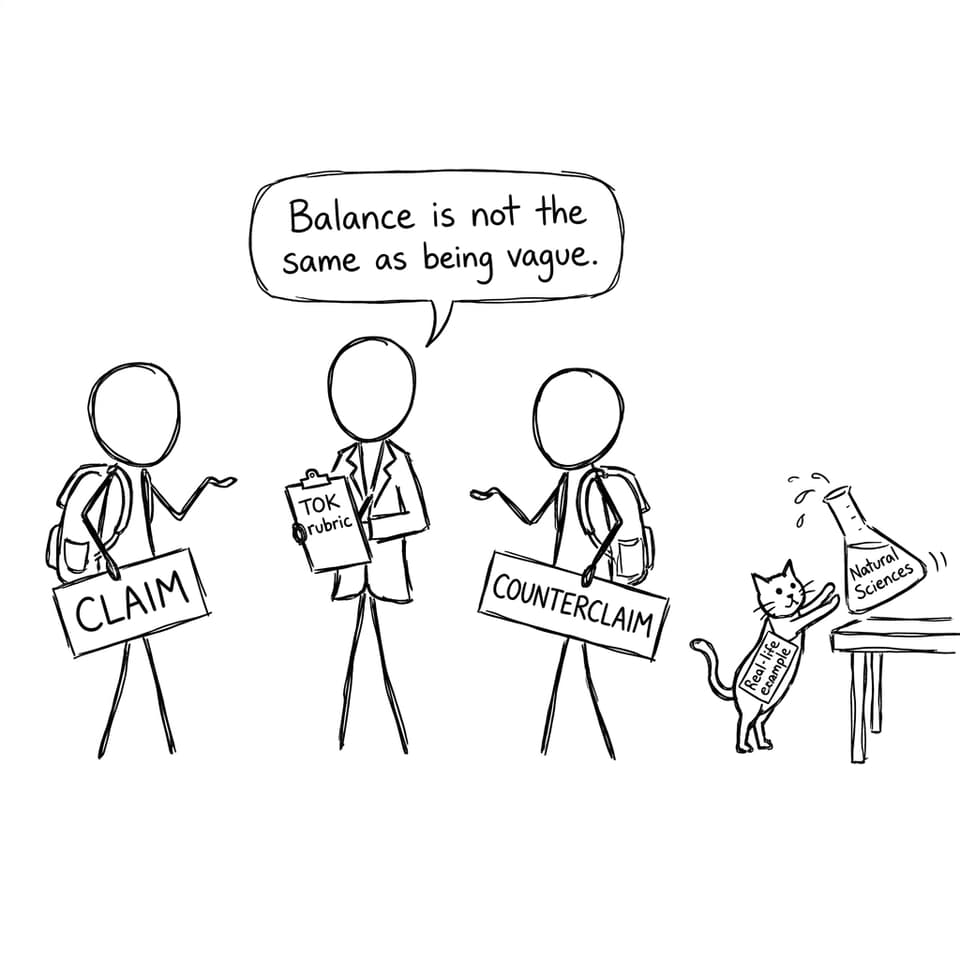
The TOK rubric reality: depth wins
A quiet truth about TOK is that examiners do not reward you for sounding philosophical. They reward you for being precise.
Two practical consequences:
-
Two AOKs done well beats four AOKs done quickly. TOK grades rise when your examples are explained and evaluated, not listed.
-
Definitions are strategic. If you define “power” as “ability to persuade,” Title 3 becomes a different essay than if you define it as “ability to generate action.” Pick definitions that you can defend.
If you want to sanity-check your structure before you draft, compare your outline to the Comprehensive Guide to IB TOK Essay Structure.
And when you have a draft, use RevisionDojo’s rubric grader: IB TOK Essay Grader. It is the fastest way to see whether your TOK evaluation is landing the way the markbands expect.
Where RevisionDojo fits into your TOK decision
Choosing a TOK title is not only about picking a prompt. It is about building a small system that makes your thinking easier to repeat.
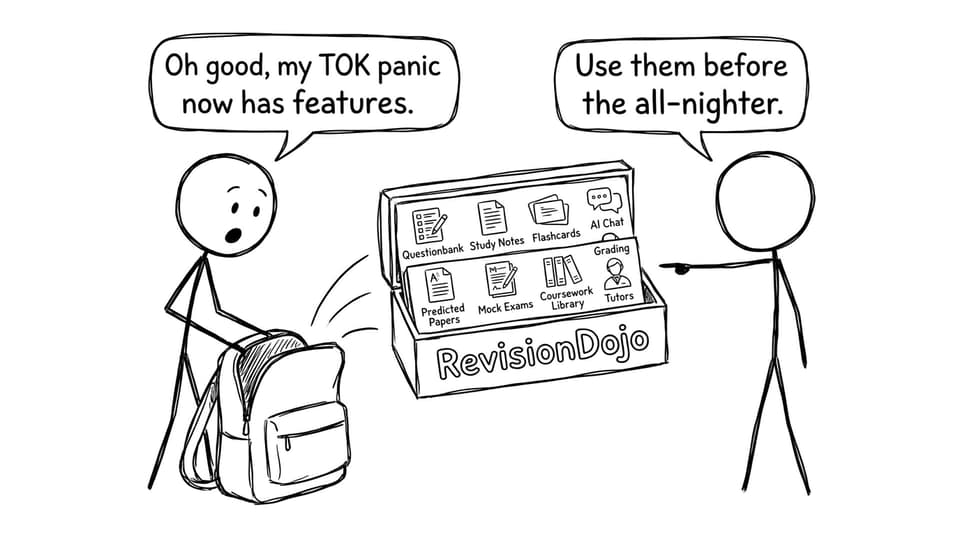
RevisionDojo is built for that kind of work:
-
Use Study Notes to clarify AOK differences and define key terms.
-
Use Flashcards to lock in your core vocabulary (reliability, justification, perspective).
-
Use AI Chat to test counterclaims and spot hidden assumptions.
-
Use Grading tools to keep your draft aligned with the TOK rubric.
-
Use the Coursework Library to see how real high-quality TOK writing sounds.
-
Use Tutors when your ideas are good but your structure keeps slipping.
For TOK-specific exemplars, browse IB Theory of Knowledge (TOK) Examples.
Choosing your TOK May 2026 title: the final test
The best TOK May 2026 title is the one that lets you write with momentum. You should feel the essay tightening as you plan, not expanding into chaos.
Pick the prompt where you can do three things at once: define the terms in a defensible way, compare two AOKs with real contrast, and evaluate claims with counterclaims that genuinely challenge you.
When you are ready, open your chosen title guide, build your plan with RevisionDojo templates, and run your draft through the IB TOK Essay Grader. TOK rewards calm, sustained thinking, and RevisionDojo is built to make that kind of thinking easier to do on purpose.

