


If you’ve ever reread 30 pages of notes and still felt unsure, you’ve met the quiet problem of the IB: the content isn’t just big, it’s connected. Biology links to Chemistry. History arguments depend on evidence. TOK lives on relationships.
A mind map is the simplest way to see those connections. Not to make something pretty, but to make something you can use under exam pressure. In this guide, you’ll learn how to build a mind map for any IB subject, then turn it into active revision with RevisionDojo.
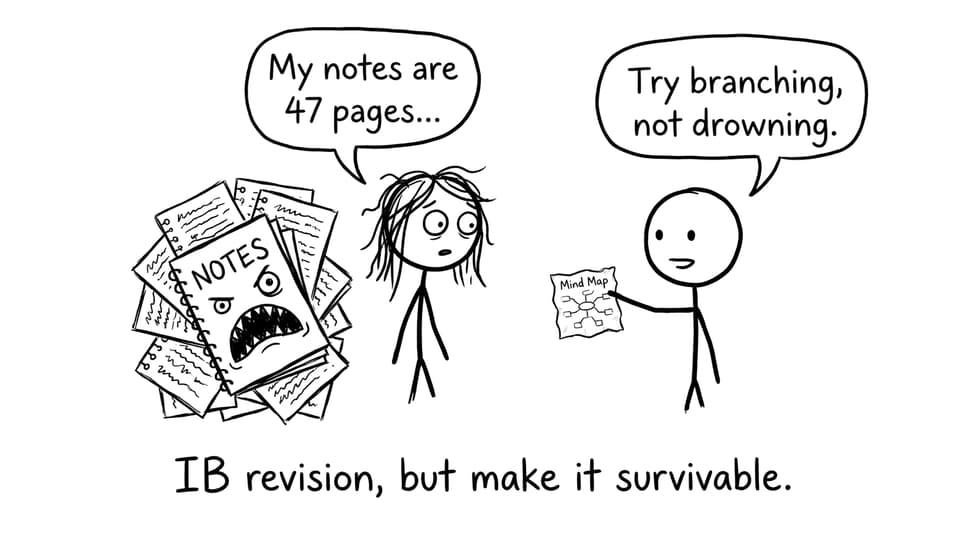
The IB Mind Map Checklist (5 minutes to start)
-
Pick one IB topic (not a whole unit)
-
Write a central prompt you could be examined on
-
Add 4--6 main branches (themes, steps, perspectives)
-
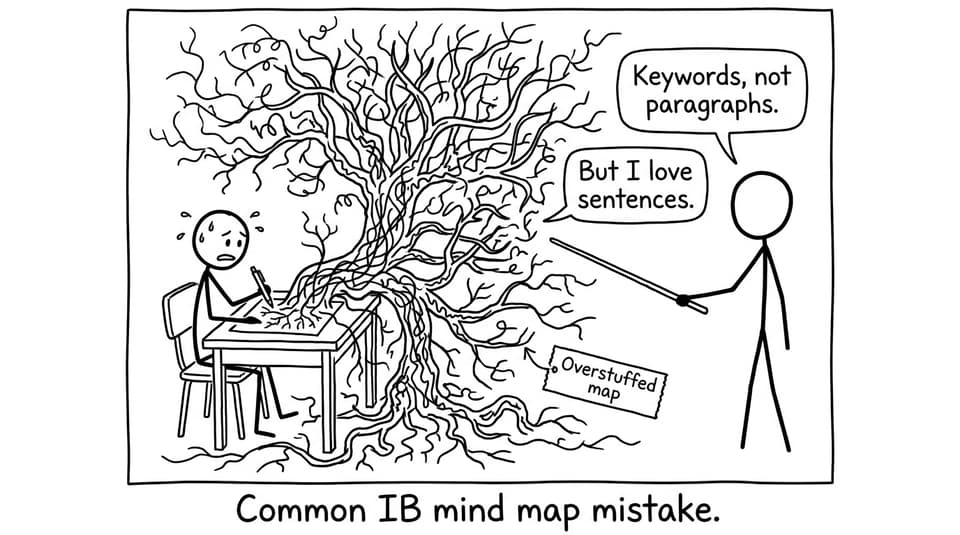
Use keywords and command terms, not paragraphs
-
Finish by testing yourself (cover branches, recall aloud)
For more visual methods that fit IB revision, skim Visual Note-Taking for IB Subjects and IB Revision for Visual Learners.
How to Build a Mind Map for Any IB Subject
Start with a center that sounds like an exam question
Instead of writing “Photosynthesis,” write something the IB could actually ask, like: “How does photosynthesis convert light energy to chemical energy?” This tiny shift forces clarity. It also makes your mind map naturally aligned with application, not just definitions.
If you’re unsure what exam-style wording feels like, the fastest shortcut is to pair your map with targeted practice from the RevisionDojo Questionbank. One good question can define the whole structure of your mind map.
Add main branches that match how marks are earned
A reliable IB pattern is that marks come from categories (steps, causes, perspectives, evaluation). So build branches like:
-
Process/Steps (great for sciences)
-
Key concepts + definitions
-
Evidence/examples/case studies
-
Common mistakes/misconceptions
-
Links to other topics
That last one matters more than students think. IB exams reward transfer: using one idea in a new setting.
Expand using “one layer deeper” rules
For each branch, go one layer deeper with small sub-branches:
-
One equation or key relationship
-
One example you can actually explain
-
One why or so what
This keeps the mind map light but powerful. If you write full sentences, you’ll stop seeing structure and start copying notes.
Make your IB mind map testable (the step most people skip)
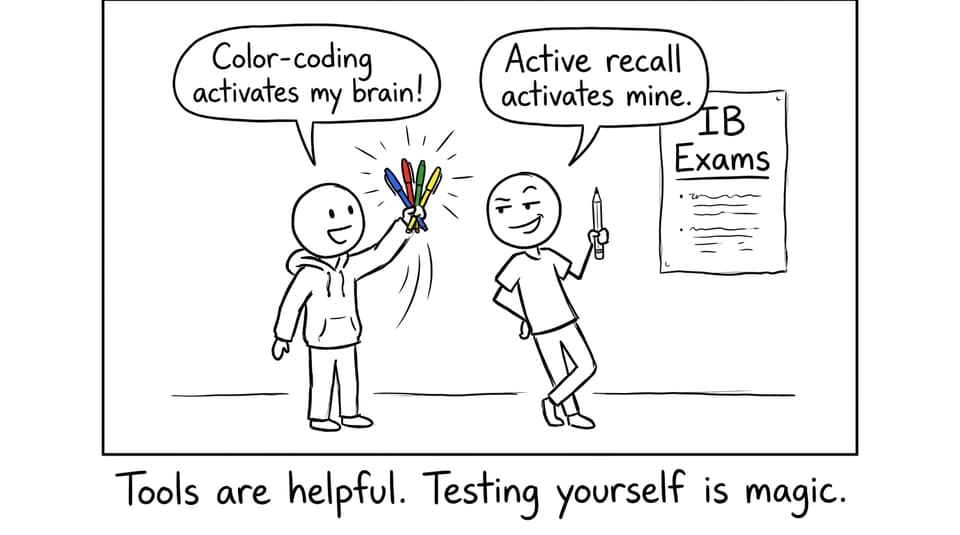
A mind map becomes revision only when you can use it for active recall:
-
Cover 2 branches and explain them from memory
-
Redraw the map in 3 minutes from a blank page
-
Turn each branch into quick questions
This is where RevisionDojo helps. You can convert key points into daily recall using IB Flashcards with Spaced Repetition or the Flashcards feature. And when a branch feels fuzzy, you can ask Jojo in RevisionDojo AI Chat to clarify the missing step before it becomes a recurring error.
Mind Map Templates for Common IB Subjects
IB Sciences (Biology, Chemistry, Physics)
Use branches like: process, variables, graph shapes, definitions, applications, errors. After building the map, drill the same topic in the Comprehensive IB Question Bank guide so your mind map matches what you’re actually being assessed on.
IB Humanities (History, Psychology, Global Politics)
Try: causes, events, consequences, perspectives, historiography/theories, case evidence. Mind maps are especially useful for organizing arguments before you write.
IB Math
Use: concept, method, common question types, pitfalls, worked example, connections. Keep it brutally simple.
Conclusion: Use Mind Maps to Make IB Revision Feel Smaller
The IB gets easier when topics stop being separate piles and start becoming one connected system you can navigate. A mind map is how you build that system: center prompt, smart branches, one layer deeper, then active recall.
If you want your mind maps to turn into marks, build the loop on RevisionDojo: learn with Study Notes, drill with the Questionbank, lock it in with Flashcards, and pressure-test with IB Predicted Papers. Your IB revision becomes simpler because it becomes structured.