Practical labs feel like the part of IB SEHS where your brain finally gets to breathe. You move, you measure, you collect numbers that look like they belong to real life. Then you sit down to revise and the comfort disappears: command terms, definitions, evaluation paragraphs, and theory that suddenly feels heavier than the equipment cupboard.
The trick is noticing what the best athletes already know: training is not one thing. It’s a blend. IB SEHS works the same way. The theory gives you the model; the practical labs prove it (or show you where it breaks). If you revise them separately, you end up with two half-skills. If you fuse them, exam questions start to feel familiar.
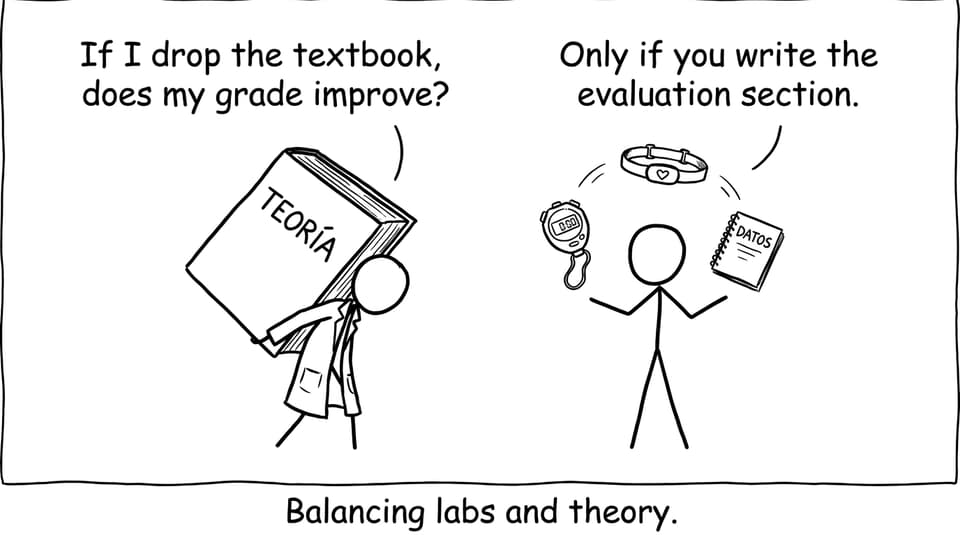
Balancing labs and theory comic
A quick balance checklist (use this after every practical)
Here’s a simple routine that keeps IB SEHS labs and theory pulling in the same direction:
Write the topic link (one syllabus subtopic the lab belongs to).
Capture one key result and what it suggests.
Add two theory terms you could use in an exam answer.
Write one limitation and one improvement (future-you will thank you).
Convert the lab into one exam-style paragraph (40--80 words).
In IB SEHS, the exam paper rewards clarity: accurate definitions, correct processes, and the ability to explain cause and effect. Labs help you understand, but theory is what you’re assessed on most directly.
So the goal isn’t “more theory” in a vague way. It’s targeted theory that you can actually use under pressure:
Build your understanding with syllabus-aligned notes (then compress them).
Train recall with short prompts (definitions and processes).
Practise applying the idea in exam wording.
A good example is energy systems: it’s easy to “get” in class but messy in writing. RevisionDojo’s A.2.3 Energy Systems page makes it easier to move from concept to exam performance because you can shift between notes, flashcards, and practice questions.
Why practical labs are not a side quest
Practical labs are where IB SEHS becomes memorable. A heart-rate recovery test, a VO₂ discussion, a movement analysis video -- these are the moments your brain stores as stories, not just facts.
Labs also quietly teach the skills that lift your marks in longer responses:
describing method (clear, replicable steps)
analysing data (patterns, anomalies)
evaluating limitations (validity, reliability)
proposing realistic improvements
And if you’re building confidence for data-heavy topics, it helps to revise the underlying content alongside your experiments. For physiology, pairing your lab work with RevisionDojo notes like A.1.3.1 The cardiovascular system and bodily functions keeps practical observations anchored to correct terminology.
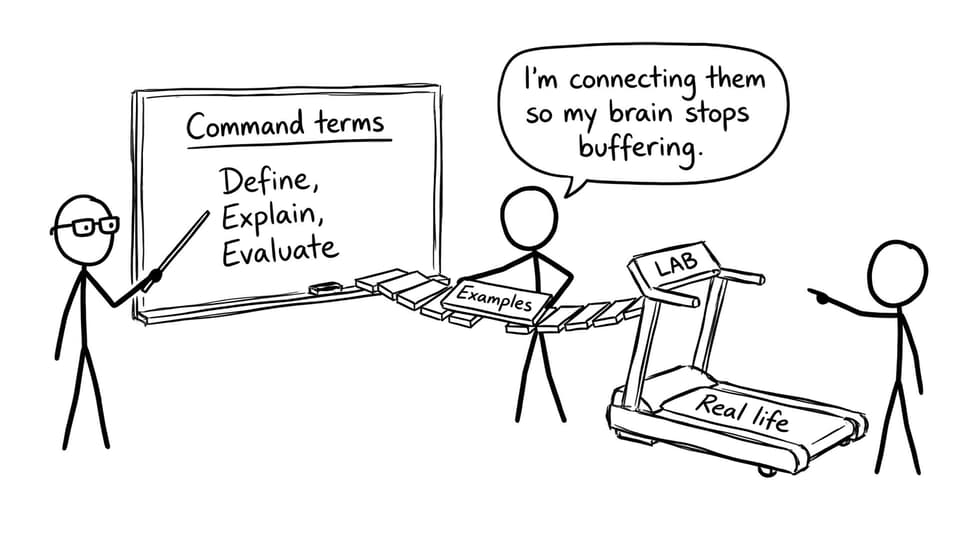
Connecting command terms and lab reality comic
The bridge: turn every lab into an exam-ready example
Most students either write lab notes like a diary (“we did a test…”) or like a science paper they never read again. Try a third option: write lab notes like an examiner is about to ask you about them.
After each practical, create a “bridge paragraph” you can reuse in exams:
Claim: What did the data show?
Concept: Which theory explains it?
Because: Why does that mechanism matter for performance/health?
Limit: What could have distorted the result?
This is where RevisionDojo’s tools fit naturally into IB SEHS revision:
Use Study Notes to check wording and definitions.
Use Flashcards to lock in key terms.
Use AI Chat when your explanation feels fuzzy.
Use the Questionbank to practise writing the same concept in different question styles.
For targeted practice, dip into an exam-style set like A.3--Response Questionbank and force yourself to include one lab-based example in longer answers.
A weekly split that actually holds
Balancing IB SEHS is mostly a scheduling problem disguised as a motivation problem. If you don’t decide where labs belong in your timetable, they float.
Try this split for a normal week:
60% theory: notes, definitions, processes, short-answer practice
30% applied practice: questionbank sets, structured responses, mini timed sections
10% lab review: rewrite one lab as an exam example + evaluation points
Your lab review time looks small because it’s high leverage: you’re not “revising the lab,” you’re extracting marks from it.
If you want one place to run the practice loop, RevisionDojo’s Questionbank is built for quick topic drills with feedback, so you can turn theory into exam behavior.
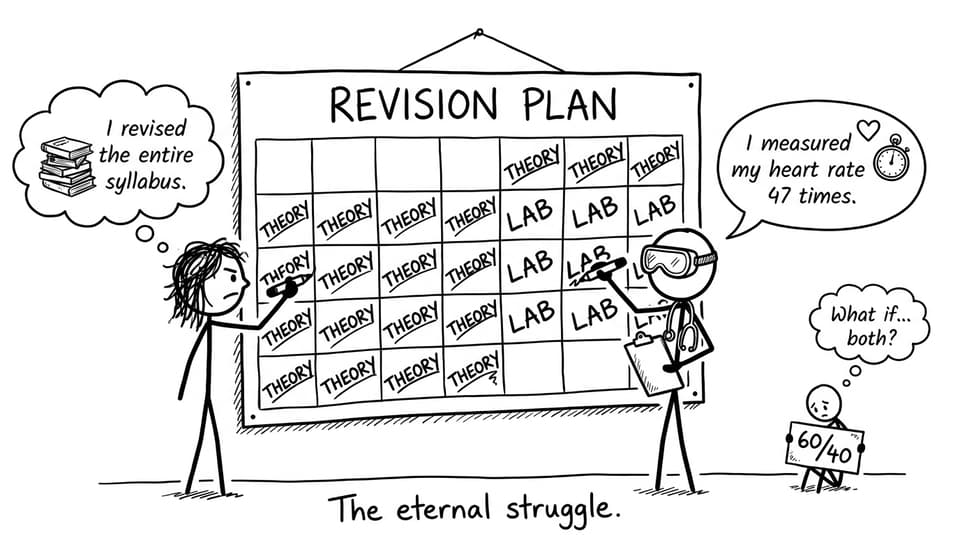
Revision plan 60/40 comic
How to use labs inside exam answers (without rambling)
Examiners don’t award marks for having done a practical. They award marks for accurate concepts, applied appropriately. A lab reference works best when it’s short and purposeful.
Use this sentence frame:
“In a class investigation measuring __, we observed __, which supports __ because __.”
That’s it. One sentence. Then return to theory.
To build exam stamina closer to the real thing, add timed practice using IB Predicted Papers by IB Examiners (Free) and treat each paper as a check: can you explain what you measured in class using the correct IB SEHS language?
Closing: make IB SEHS feel like one subject
The students who do best in IB SEHS aren’t the ones who pick a side. They don’t become “lab people” or “theory people.” They become translators: they can move from data to definition, from movement to mechanism, from results to evaluation.
If you want that to feel simpler, build your loop on RevisionDojo: learn with Study Notes, retain with Flashcards, apply with the Questionbank, get unstuck with AI Chat, and pressure-test yourself with Mock Exams and Predicted Papers. Balance stops being a struggle when your tools make labs and theory speak the same language -- the language your IB SEHS exam will reward.
IB SEHS goal setting in sport made simple: goal types, SMART targets, common mistakes, and exam-ready tips using RevisionDojo practice tools.