




If you have ever written an IB Global Politics paragraph that felt “smart” but still scored like a summary, you have met the most common exam trap: treating theory like a definition to recite, and case studies like stories to retell. Examiners are not allergic to knowledge. They are allergic to knowledge that does not do anything.
In IB Global Politics, political theory is supposed to function like a lens: it helps you explain why actors behave the way they do, what counts as power, and what outcomes were likely in the first place. Your case study is the evidence. Your job is to connect them so tightly that the paragraph can only make sense as analysis.
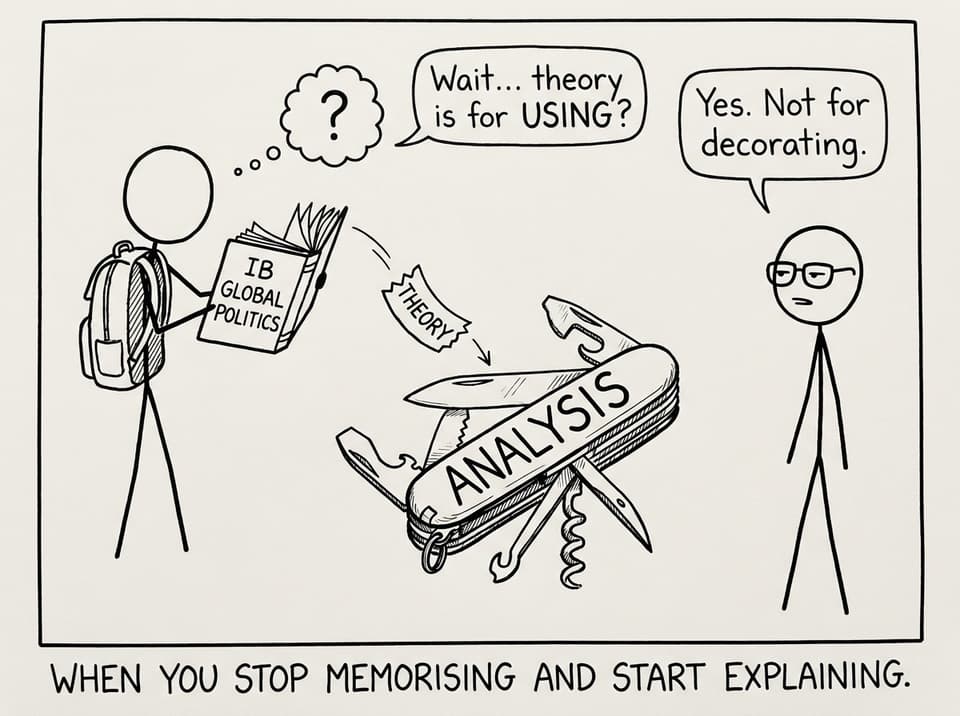
A quick checklist for IB Global Politics theory application
Use this mini-routine before you write:
-
Name the theory and its core assumption (one or two lines)
-
Choose a case study detail that clearly fits the assumption
-
Use theory vocabulary to explain the actor’s choice (the “because”)
-
Add one limitation (what the theory misses)
-
Link back to the question’s command term and judgement
If your paragraph hits all five, you are doing IB Global Politics the way the markbands reward.
Step one: Define the theory like you are already answering
The trick is not to “teach” realism or liberalism. It is to define the theory in a way that sets up your argument.
Example: instead of writing “Realism is about power,” write something like: “From a realist view, states prioritise security and relative power in an anarchic system, so cooperation is fragile when interests clash.” Now your definition already points toward explanation.
If you need a clean refresher, RevisionDojo’s breakdown of theoretical foundations in IB Global Politics helps you keep theory concise and exam-ready.
Step two: Pick case study evidence that is “theory-shaped”
A high-scoring IB Global Politics case study is selective. You are not proving you know everything. You are proving you can choose what matters.
Ask: Which two or three facts best demonstrate the theory’s mechanism? For realism, you might focus on military build-up, alliance behaviour, deterrence statements, or security dilemmas. For liberalism, you might focus on institutions, treaties, interdependence, or domestic constraints. For constructivism, you might focus on identity narratives, norms, legitimacy language, or reframing.
RevisionDojo’s guide on how to use case studies in IB Global Politics is a good reminder that “more detail” often means “less analysis.”
Step three: Make the link explicit (say the quiet part out loud)
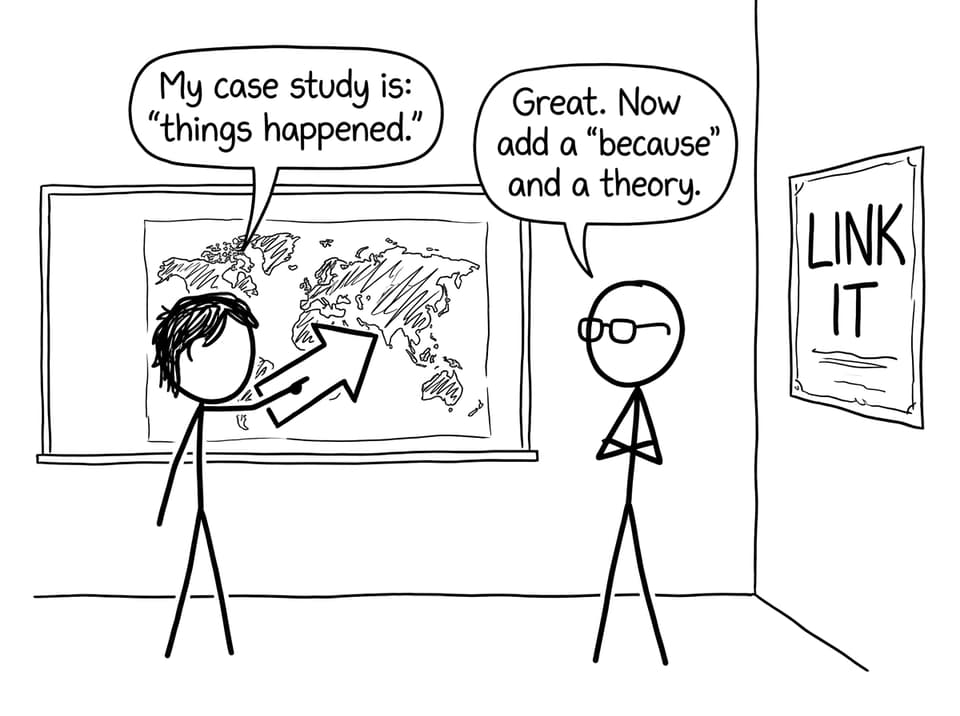
Most students imply the link. Top responses state it.
Use a sentence stem that forces explanation:
-
“This supports a realist interpretation because…”
-
“A liberal reading explains this outcome through…”
-
“A constructivist lens highlights how norms/identity shaped…”
If you want a deeper theory-specific push, RevisionDojo’s What is constructivism in global politics? is excellent for turning “ideas and norms” into concrete analytical language.
Step four: Evaluate the theory, not your case study
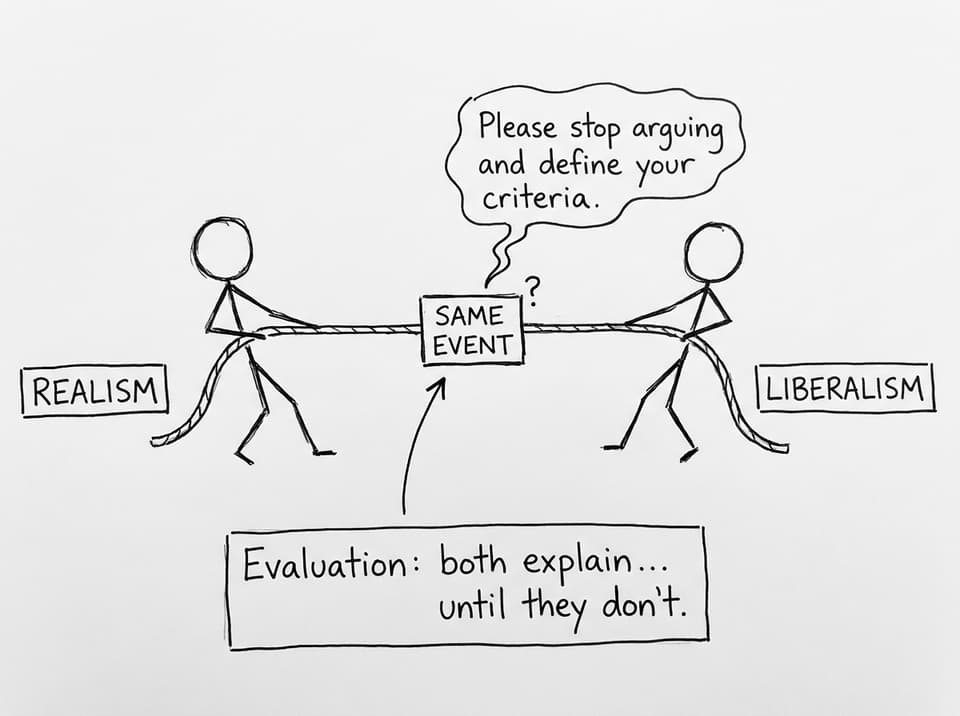
Evaluation in IB Global Politics is not saying “the theory is good/bad.” It is showing conditions.
Try this pattern:
-
What the theory explains well in this case
-
What it cannot explain (or explains weakly)
-
What would strengthen the theory’s explanatory power (context, additional variables, another theory)
To compare lenses cleanly, RevisionDojo’s Realism vs Liberalism in Global Politics and Which theory best explains modern conflicts? both model the “yes, but” tone examiners love.
Step five: Let the command term control your paragraph
A theory-case link that ignores the command term still leaks marks. “Evaluate” demands judgement. “To what extent” demands conditions. “Discuss” demands balance.
Use these RevisionDojo resources to keep your structure aligned:
Conclusion: Turn IB Global Politics theory into a scoring habit
The goal in IB Global Politics is not to “include theory.” It is to use theory to produce explanation, then use case study evidence to prove it, then evaluate how far that explanation holds.
If you want this to become automatic, RevisionDojo makes it easier to practise under exam conditions: build targeted drills with the Questionbank, tighten your definitions with Study Notes and Flashcards, test your links using AI Chat, and rehearse pressure with Mock Exams and Predicted Papers. When you treat theory as a tool you pick up on purpose, your case studies stop being stories, and your essays start sounding like IB Global Politics at the top markband.