

Drama doesn’t give you a narrator to lean on. It gives you people talking, moving, stopping mid-sentence, and pretending they’re fine. Then it asks you, especially in IB English, to explain why the silence felt louder than the line.
That’s the secret (and the stress) of plays: meaning lives in what’s said and what’s staged. If you can analyze dialogue and stage directions with control, your IB English essays stop sounding like plot summaries and start sounding like interpretation.
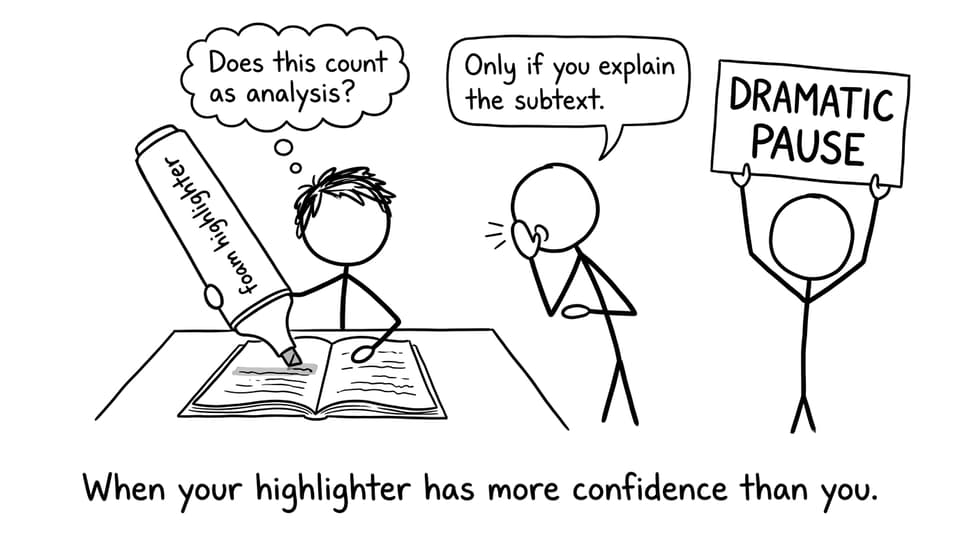
A fast checklist for IB English drama analysis
Use this quick scan before you write anything. It keeps your IB English response focused on technique.
-
What does the dialogue reveal about motive, conflict, and relationships?
-
What does the dialogue hide (subtext, evasion, denial)?
-
Who controls the exchange: interruptions, questions, topic shifts?
-
What do stage directions add: pace, gesture, space, tone, symbolism?
-
Where do dialogue and stage directions contradict each other?
For exam-style practice, use the Drama Questionbank and train yourself to spot these patterns under time pressure.
Dialogue: the character’s self-portrait (and their cover story)
In IB English, dialogue is never “just information.” It’s a character performing a version of themselves. Your job is to notice what that performance costs.
Diction and register
Ask what a character’s word choice suggests about status, education, intimacy, or insecurity. Formal language can be armor. Casual language can be a power move. A sudden change in register often signals a crack in control.
Rhythm, pace, and fragmentation
Plays have musicality. Short, clipped lines can create threat or urgency. Long sentences can become dominance, denial, or desperation. Fragments and unfinished thoughts can expose fear or restraint.
A useful habit: in your annotation, label the shape of the exchange (rapid-fire, pause-heavy, monologue, overlap). That shape is meaning.
If you want a broader technique toolkit that transfers across text types, keep Mastering Literary Devices in IB English Exams open while you practice.
Power dynamics: who gets to speak, who has to react?
A reliable IB English move is to analyze conversation like a tug-of-war.
Look for:
-
Interruptions: dominance, impatience, refusal to listen
-
Questions: control, interrogation, manipulation, testing loyalty
-
Imperatives: authority, panic, entitlement
-
Silence: resistance, shame, fear, calculation
Then connect the power pattern to a theme (control, gender, class, secrecy, violence, loyalty). When you do that, you stop describing and start arguing.
To sharpen your exam writing structure, the Step-by-Step Guide to Revising IB English Paper 1 is a strong reminder of what top-band analysis actually looks like: technique first, effect second, meaning last.
Stage directions: the invisible narrator in IB English drama
Stage directions are where playwrights plant the “truth” characters refuse to say out loud. In IB English, quoting or referencing stage directions shows you understand drama as performance, not just text.
What stage directions typically control
-
Movement and gesture (approaches, recoils, avoids eye contact)
-
Space and positioning (distance, blocking, who is centered)
-
Tempo (pauses, silence, overlapping speech)
-
Atmosphere (lighting, sound cues, props)
-
Tone (quietly, sharply, with hesitation)
When you analyze them, avoid treating them like stage manager logistics. Treat them like authorial choices that shape audience response.
If you want direct practice on this skill, the Stage Directions Notes are surprisingly useful even for IB English because the fundamentals (movement, pause, tension) don’t change.
The most valuable moments are contradictions
One of the best IB English drama insights is simple: meaning often appears when words and actions disagree.
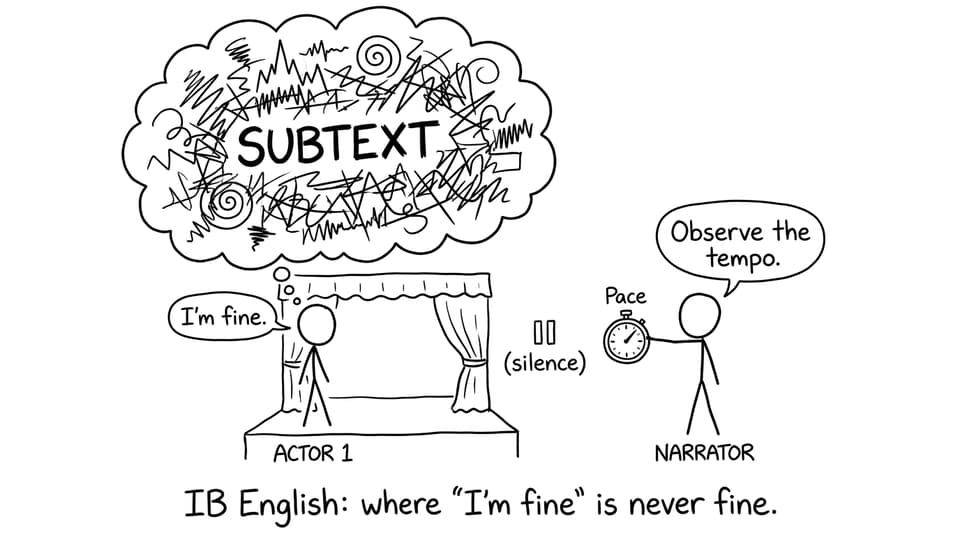
A character says, “I’m calm,” but the stage directions show pacing. Someone offers kindness, but “turns away.” A confession lands, and then the character crosses the room as if retreating from their own honesty.
That gap is subtext.
When you write, make the contradiction explicit:
-
Surface meaning (dialogue)
-
Undercut meaning (stage direction)
-
Resulting implication (theme, relationship, conflict)
For students who like examples of how this looks in assessment-style writing, browse an IB English Lang & Lit IA exemplar and notice how often the best paragraphs hinge on a small staged action.
A simple paragraph frame you can reuse in IB English
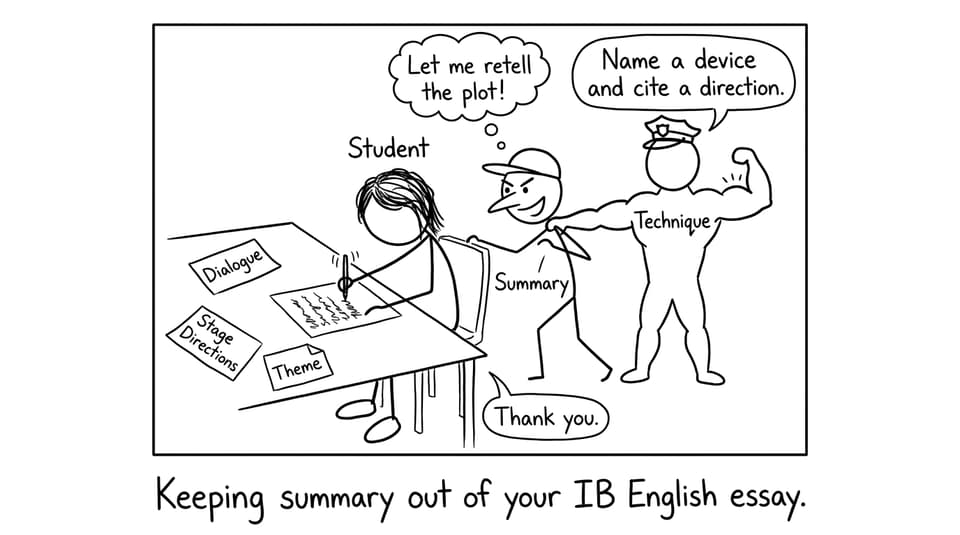
When time is tight, use this structure:
-
Claim: What the moment reveals (power shift, tension, repression)
-
Dialogue evidence: A short embedded quote and a technique label
-
Stage direction evidence: Brief reference/quote and what it cues visually
-
Effect: What the audience learns/feels
-
Meaning: Link to theme or wider conflict
Then check yourself: if your paragraph could fit any play, it’s too generic. Make it specific to this moment, these bodies, this pause.
For more exam strategy, the Best Ways to Prepare for IB English Paper 1 pairs well with drama work because it reinforces the same discipline: patterns, technique, precision.
Conclusion: turn plays into proof
Plays reward the students who pay attention to the smallest things: a repeated word, a cut-off sentence, a character who moves away while promising closeness. That’s why analyzing dialogue and stage directions is a high-leverage skill for IB English. It turns drama from “what happened” into “how meaning was staged.”
If you want this to feel easier, build a routine: drill extracts in the Drama Questionbank, tighten technique with English A Lang & Lit Cheatsheets, and use RevisionDojo’s Flashcards, Study Notes, AI Chat, and Grading tools to convert every mistake into a system. Add Mock Exams and Predicted Papers when you’re close to exam season, and lean on the Coursework Library and Tutors when you need targeted feedback.
In IB English, the best analysis is calm, specific, and evidence-led. Let the dialogue speak. Let the stage directions interrupt. Then show what that interruption means.