
If you have ever left butter on the counter, you already know more IB Biology than you think. Some fats stay solid. Others stay soft. The same quiet idea shows up inside every cell: the structure of fatty acids changes how tightly membranes pack, and that packing changes membrane fluidity. In exams, this is rarely asked as “tell me a story.” It is asked as: explain, compare, predict.
The quick exam checklist (IB Biology)
When a question mentions fatty acids and fluidity, hit these points:
-
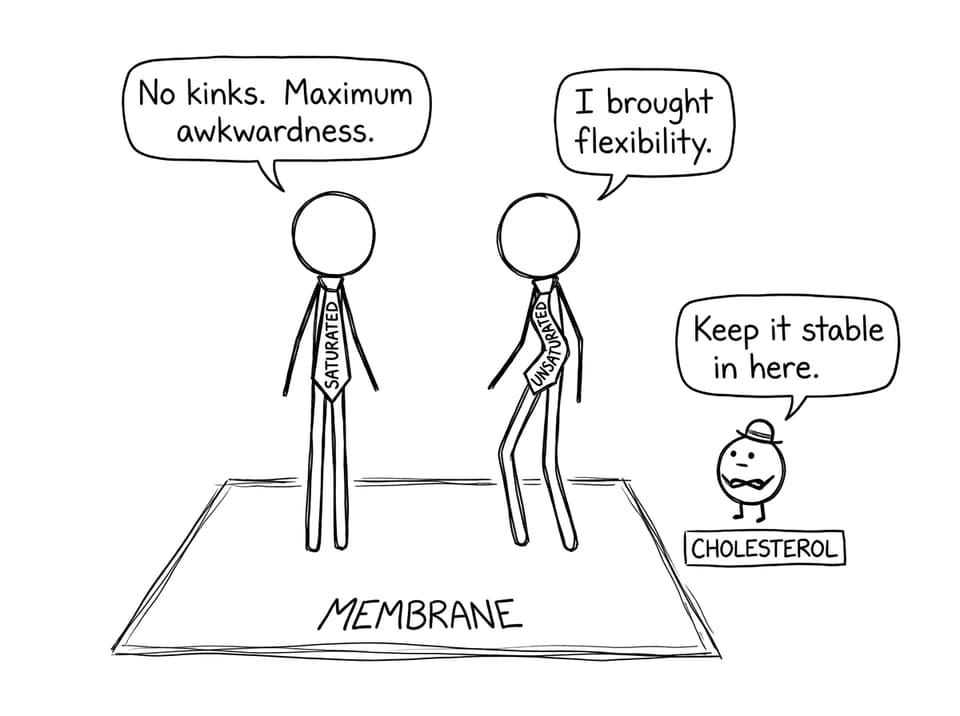
Saturated fatty acids have no double bonds (straight tails); pack tightly; lower fluidity.
-
Unsaturated fatty acids have one or more double bonds (kinked tails); pack loosely; higher fluidity.
-
Temperature shifts fluidity; organisms can adjust lipid composition (homeoviscous adaptation).
-
Cholesterol buffers fluidity: prevents membranes becoming too rigid in cold and too fluid in heat.
-
Fluidity changes protein mobility, diffusion rates, and vesicle fusion.
For the syllabus framing, start with the bilayer basics in Formation of phospholipid bilayers (notes) and the barrier idea in Lipid bilayers as barriers (notes).
Saturated vs unsaturated tails: why tiny bonds change everything
In IB Biology, “structure determines function” is not a slogan; it is the marking scheme.
Saturated fatty acids: straight tails, tighter packing, lower fluidity
Saturated fatty acids contain no C=C double bonds, so their hydrocarbon chains are relatively straight. Straight chains sit close together like uncooked spaghetti in a box. That increases van der Waals interactions and makes the bilayer more rigid. At lower temperatures, this tight packing can become a problem: the membrane’s lateral movement drops, and embedded proteins have less room to shift.
This connects directly to the fluid mosaic model: proteins are not glued in place; they float within the lipid sea. If the sea stiffens, the “mosaic” behaves differently. Link your understanding here: Fluid mosaic model of membrane structure.
Unsaturated fatty acids: kinks, looser packing, higher fluidity
Unsaturated fatty acids have one or more double bonds that introduce kinks in the tail. Kinked tails cannot line up neatly, so phospholipids pack less closely. More gaps mean more motion; higher membrane fluidity.
When you need a functional consequence, point to transport and movement across membranes: higher fluidity generally supports faster lateral diffusion of lipids and can help membrane processes that depend on flexibility.
To anchor this in transport language, revise Simple diffusion across membranes (notes).

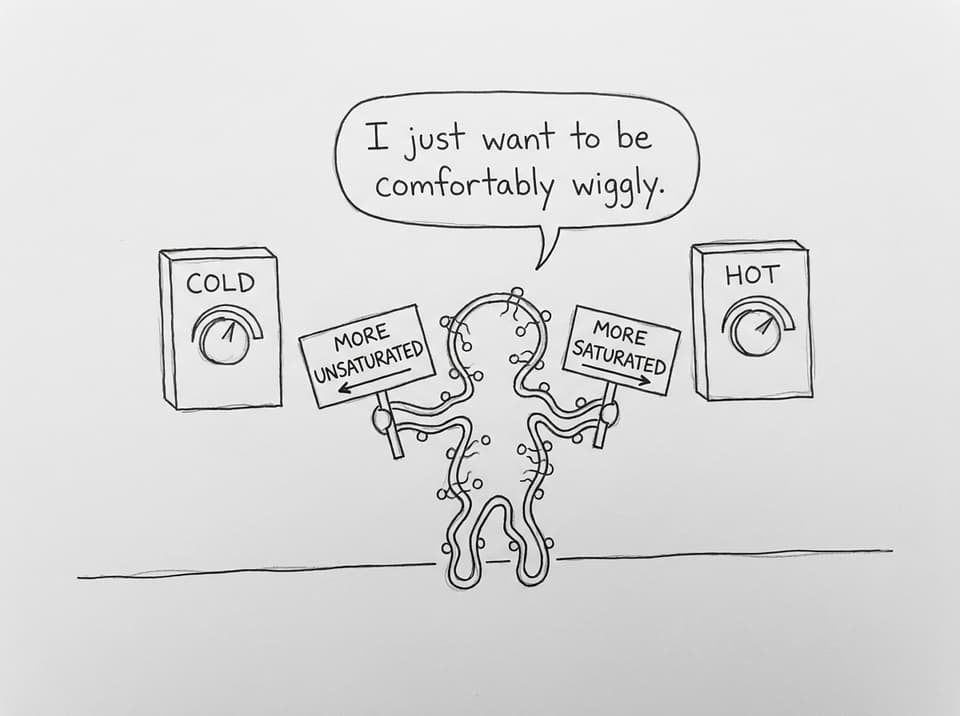
Membrane fluidity as an adaptation: staying “comfortably wiggly”
Cells experience changing conditions, especially temperature. In cold environments, membranes risk becoming too rigid. Many organisms respond by increasing the proportion of unsaturated fatty acids to keep fluidity high enough for function. In warmer conditions, too much fluidity can destabilize interactions, so a higher proportion of saturated fatty acids can help.
This temperature-composition balancing act is often described as homeoviscous adaptation. You do not need long essays in exams; you need the chain: temperature change to packing change to fluidity change to cell adjusts fatty acid composition.
To connect fluidity to membrane behavior (a favorite HL angle), see Membrane fluidity and the fusion and formation of vesicles (HL) and the matching notes.
Cholesterol: the membrane’s “thermostat” (IB Biology HL)
Cholesterol sits between phospholipid tails and acts as a fluidity buffer.
-
At low temperatures, it disrupts tight packing, helping prevent the membrane from becoming too rigid.
-
At high temperatures, it restrains phospholipid movement, helping prevent the membrane from becoming too fluid.
That two-way effect is the key phrase examiners want. Build it with RevisionDojo’s targeted resources: Cholesterol and membrane fluidity in animal cells (HL) notes and practice with the cholesterol fluidity Questionbank.
Why fluidity matters for membrane proteins
Fluidity is not just “how runny the membrane is.” It affects whether proteins can move laterally, cluster, and change conformation. Transport proteins and receptors often depend on the local lipid environment.
When membranes are too rigid, proteins can lose mobility and processes like vesicle budding/fusion can slow. When membranes are too fluid, interactions can become unstable. Tie this back to the protein categories in Integral and peripheral proteins (notes).
Bring it home with RevisionDojo
Membrane questions often look simple, then demand precision: double bonds, kinks, packing, temperature, cholesterol, protein function. If you want that precision to feel automatic, use RevisionDojo’s Study Notes for clean explanations, the Questionbank for exam-style application, and Flashcards for definitions that must be exact. When you get stuck, AI Chat can walk you through your own wording, and the Grading tools can help you see what examiners reward. Add Mock Exams, Predicted Papers, the Coursework Library, and Tutors, and your IB Biology revision stops being a pile of facts and becomes a system.
For a focused pathway, start with the B2.1 Membranes and membrane transport lessons and keep your membrane fluidity practice tight until it feels inevitable, the way good biology should.