Introduction: the kind of stress that sneaks up on you
A lot of IB stress isn’t the dramatic, movie-version panic. It’s quieter. It’s the feeling that every subject is asking for your attention at the same time, and you’re never quite sure which one deserves it most.
That’s why students keep asking the same question: how stressful is IB SEHS compared to other IB subjects?
IB SEHS (Sports, Exercise and Health Science) has a reputation for being more “human” and applied than the traditional sciences. But applied doesn’t mean easy. It just means the stress comes from different places: steady coursework habits, lab write-ups, and learning how to answer questions that want you to think like a scientist--not just recite notes.
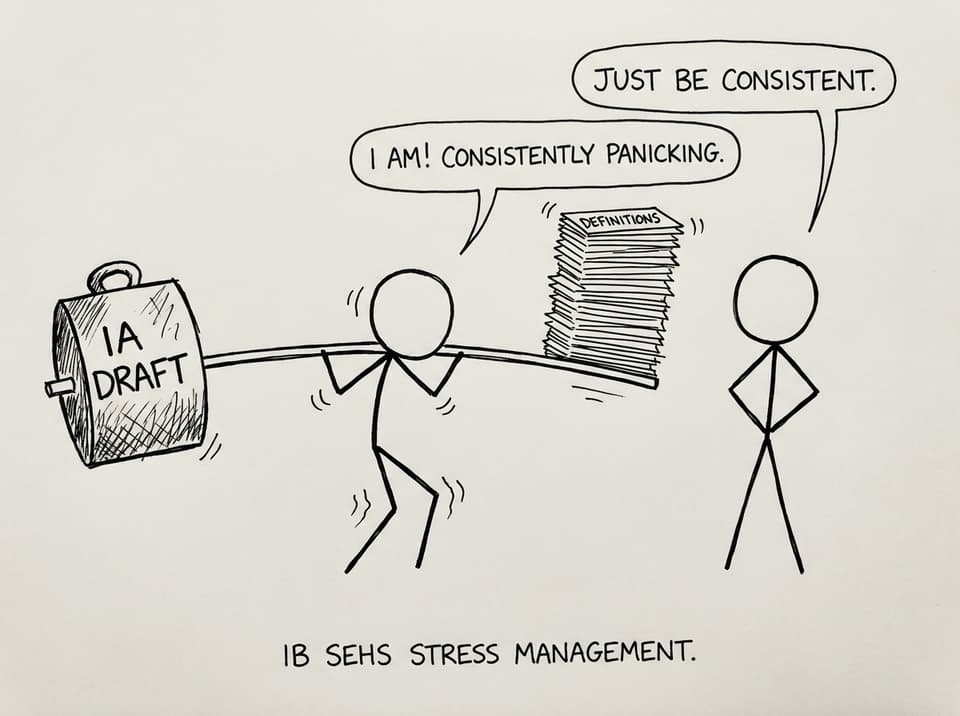
IB SEHS student seesaw stress comic
Quick checklist: what usually makes IB SEHS stressful (or not)
Content load: smaller than Biology, more concrete than Physics, still detailed.
Applied understanding: you’re rewarded for linking theory to performance and health.
Internal Assessment pressure: stress is mostly about planning, not difficulty.
IB SEHS vs other sciences: where the stress really comes from
Stress in IB isn’t one thing. It’s a mix of volume, abstraction, and how fast you can turn knowledge into marks.
IB SEHS vs Biology
Biology tends to feel heavy because the syllabus is wide and memorization-heavy. Students often describe the stress as “I can’t possibly cover everything.”
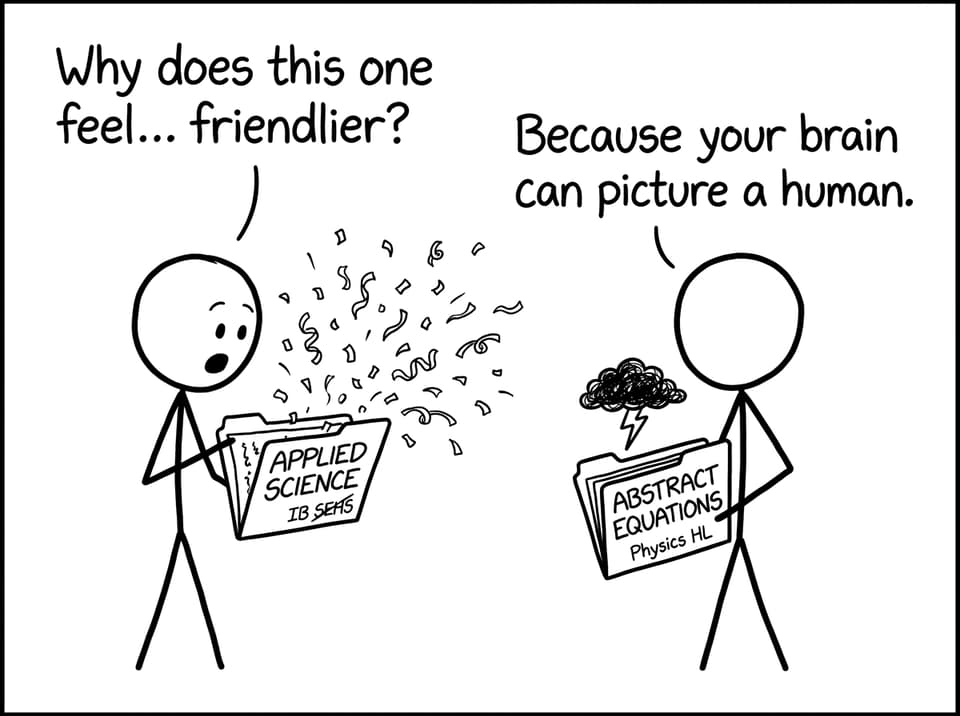
IB SEHS is typically narrower and easier to visualize because you can anchor ideas to the body, movement, training, and health. That doesn’t remove rigor--it shifts it. You still need precise terminology, strong explanations, and clean data interpretation. If you study with active recall, IB SEHS often feels more “learnable” week by week.
IB SEHS vs Chemistry
Chemistry stress often comes from abstract models plus multi-step problem solving. You can understand a topic and still lose marks because you miss one link in a calculation or assumption.
In IB SEHS, calculations exist (and data handling matters), but many marks come from explanation and application. The stress is less “did I remember the right equation” and more “can I justify this conclusion using evidence?”
IB SEHS vs Physics
Physics can feel like it demands a specific way of thinking under time pressure. If that style doesn’t click yet, stress skyrockets.
IB SEHS still needs scientific thinking, but it often feels more intuitive because the scenarios are familiar: fatigue, training methods, injury risk, skill acquisition. You’re not escaping difficulty; you’re choosing difficulty that connects to real life.
Applied vs abstract folders comic
The IA: why IB SEHS stress is mostly “slow-burn”
Ask students what spikes their IB SEHS stress, and many will point to the Internal Assessment.
Not because it’s impossibly complex, but because it’s unforgiving of procrastination.
The best way to lower IA stress is to treat it like training: small sessions, consistent form, progressive overload. RevisionDojo makes that practical with:
In other words, IA stress drops when you stop guessing.
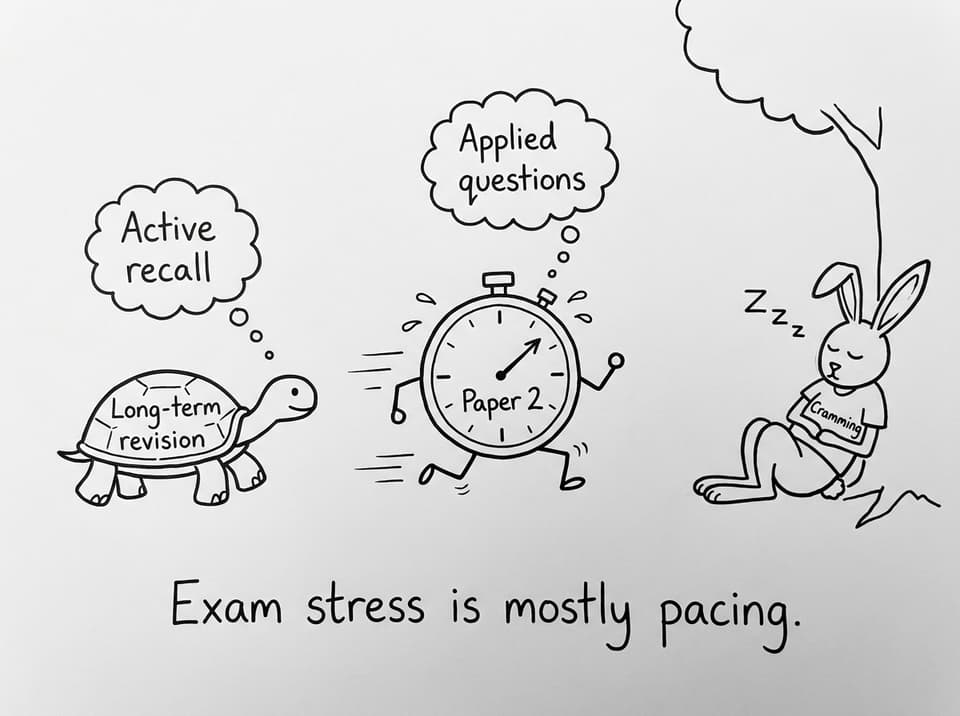
Exams: why IB SEHS feels fair (until it doesn’t)
Many students find IB SEHS exams less psychologically brutal than Physics or Chemistry, because the questions often feel relatable. But the subject has its own trap: it’s easy to write an answer that sounds right, yet earns few marks.
Your stress goes down when you replace “revision” with a loop:
Study Notes to build clean explanations
Flashcards for definitions and key processes
Questionbank to learn how marks are actually awarded
AI Chat when you’re stuck and don’t want to lose an hour
Mock Exams and Predicted Papers to make timing feel normal
Here’s a simple structure that keeps IB SEHS stress in the “useful pressure” zone:
Twice a week (understanding): use the SEHS hub notes and ask AI Chat one targeted question you’re avoiding.
Three times a week (marks): do small sets in the Questionbank and correct answers like a coach reviewing film.
Once a week (stamina): a timed section from a predicted paper or a mini mock, then review patterns.
IA every weekend (30--60 min): tidy data tables, write one paragraph, refine evaluation. Never “all day.”
Consistency beats intensity in IB SEHS, especially when other subjects are competing for your attention.
Conclusion: so, how stressful is IB SEHS?
IB SEHS is usually less stressful than the most theory-heavy sciences, but it’s not a “free subject.” The stress is simply different: fewer abstract leaps, more steady habits, more applied thinking, and an IA that rewards consistency.
If you want IB SEHS to feel calm and controllable, build a loop inside RevisionDojo: use the SEHS subject hub, drill with the Questionbank, tighten recall with Flashcards, ask AI Chat the questions you’re embarrassed to ask in class, and use Grading tools plus the Coursework Library to keep the IA from becoming a last-minute crisis. When your work has a rhythm, your stress stops being a mystery--and starts becoming feedback.
IB SEHS goal setting in sport made simple: goal types, SMART targets, common mistakes, and exam-ready tips using RevisionDojo practice tools.