


In IB Biology, there’s a moment every student hits: you can recite “DNA stores information, RNA helps make proteins,” but a data-based question asks why, and the sentence feels suddenly too small.
The good news is that examiners aren’t asking for poetry. They’re asking for structure leading to function. Once you learn to see DNA and RNA as molecules designed for different jobs, the topic stops being a list of differences and becomes a logic chain you can rebuild under pressure.
IB Biology checklist: the structural differences that matter
Use this mini-checklist in IB Biology short-answer questions:
-
Sugar: deoxyribose (DNA) vs ribose (RNA)
-
Base: thymine (DNA) vs uracil (RNA)
-
Strands: double-stranded helix (DNA) vs usually single-stranded (RNA)
-
Stability + location: DNA protected in nucleus/organelles; RNA moves and turns over faster
-
Folding: RNA folds into many shapes; DNA prioritizes consistent pairing for copying
For the syllabus-aligned core content, anchor your revision to 2.6 Structure of DNA and RNA and the deeper breakdown in Notes for 2.6 Structure of DNA and RNA.
Sugar choice: why one oxygen changes everything
The quiet difference is in the sugar.
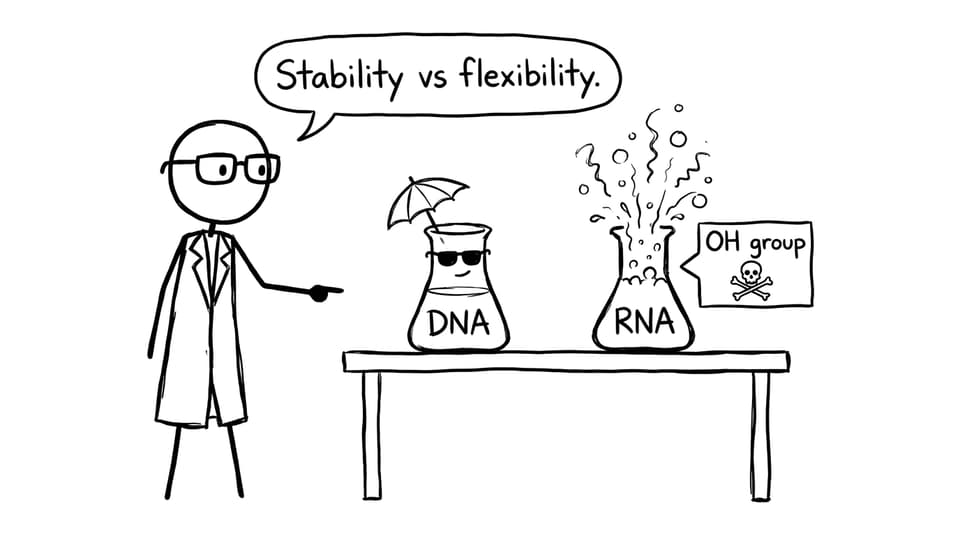
DNA contains deoxyribose, which lacks an -OH group found in RNA’s ribose. In IB Biology, you don’t need to reproduce organic chemistry mechanisms, but you do need the consequence: RNA is more reactive and less chemically stable.
That instability is not a flaw. It’s a feature.
-
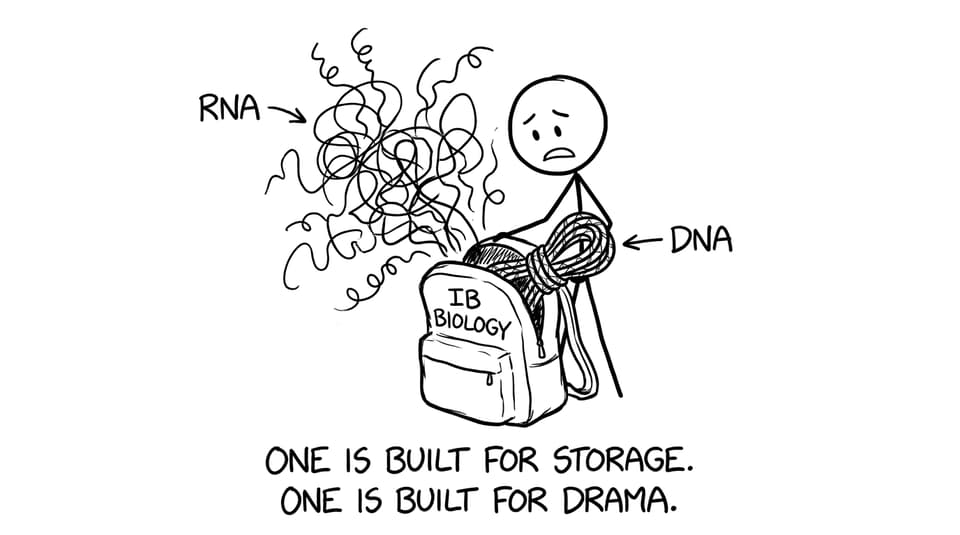
DNA is built for long-term storage. Cells need genetic information to persist, be copied, and be checked.
-
RNA is built for short-term work. Cells often need instructions to appear quickly, act, and then disappear so the cell can change what it’s doing.
If you want practice applying this in exam-style contexts, use the 2.6 Structure of DNA and RNA Questionbank and the broader IB Biology Topic A1.2 Nucleic Acids Questionbank.
Bases: thymine vs uracil is also a signaling system
Yes, the headline is simple: DNA uses thymine (T) and RNA uses uracil (U).
But in IB Biology, what matters is what this enables:
-
It helps enzymes and repair systems distinguish DNA from RNA.
-
RNA’s chemistry and typical single-stranded behavior allow more internal pairing, supporting folding and regulation.
-
DNA’s base pairing (A-T, C-G) supports highly consistent information storage and replication.
When a markscheme says “uracil replaces thymine,” it’s often worth adding the next clause: “which helps cells treat RNA as a temporary working copy.” That’s structure shaping function.
Strands: protection vs possibility
DNA is typically double-stranded and arranged as a double helix. The base pairs are tucked inside, protected by the sugar-phosphate backbone on the outside. The second strand also matters because it provides a built-in reference for accurate replication and repair.
RNA is usually single-stranded, which sounds like “less,” until you remember what single strands can do: fold.
Single-stranded RNA can bend back on itself and form short paired regions (A-U, C-G), creating complex 3D shapes. That’s why RNA can be:
-
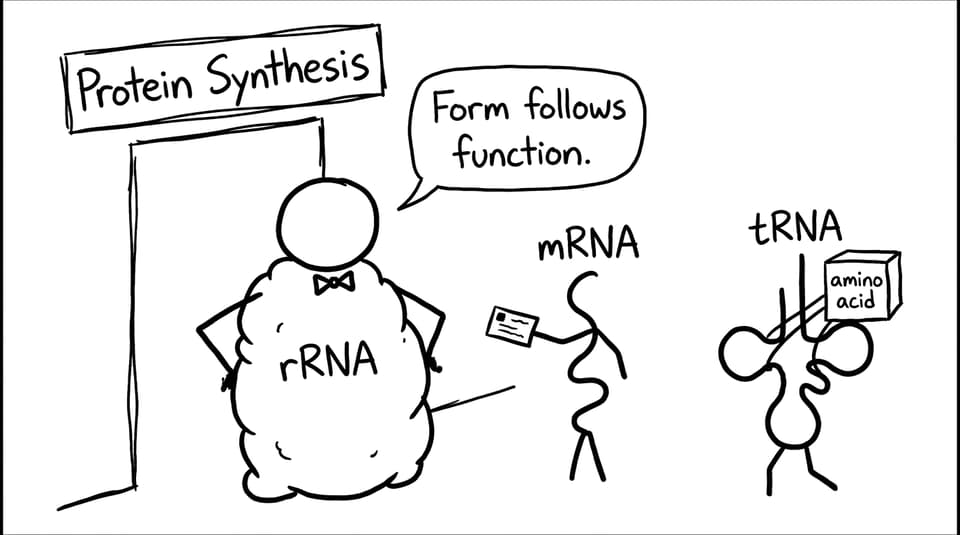
mRNA: a readable message that can leave the nucleus
-
tRNA: a folded adaptor that matches codons to amino acids
-
rRNA: a structural and catalytic core of the ribosome
To connect this directly to gene expression, pair this topic with 2.7 DNA replication, transcription and translation Notes and Notes for D1.2 Protein synthesis - IB.
The exam link: structure explains the central dogma
A reliable way to earn marks in IB Biology is to connect structure to the central dogma (DNA to RNA to protein).
-
DNA’s stability and double-stranded design suit replication and long-term storage.
-
RNA’s mobility and folding suit transcription outputs, translation machinery, and regulation.
For targeted reinforcement:
-
Use A1.2 Nucleic acids to keep the syllabus map in view.
-
Drill key definitions with Flashcards for 2.6 Structure of DNA and RNA and Flashcards for A1.2 Nucleic acids.
Bring it home with RevisionDojo
If you can explain how sugar, bases, and strand number shape function, you’re thinking like an examiner wants you to think in IB Biology.
To make that stick under timed conditions, RevisionDojo is built for the way IB students actually revise: lock in concepts with Study Notes and Flashcards, then pressure-test them in the Questionbank with instant feedback. When you’re close to exams, use Predicted Papers and Mock Exams to practise decision-making, not just memorization. And if you get stuck on a markscheme-style phrasing, AI Chat and the Grading tools help you refine answers into the language IB rewards. Add the Coursework Library and Tutors when you need guided support, and you’ve got a complete system, not scattered tabs.
Return to IB Biology structure-function questions this week and answer one in a single sentence: “Because the structure is ____, it allows the function of ____.” Then let RevisionDojo do what it does best: turn that sentence into exam marks.


