


The quiet advantage most IB students never see
In the last month before IB exams, it can feel like your future depends on what you do alone: the revision plan, the late-night flashcards, the timed practice that exposes a weak topic you were hoping wouldn’t show up.
But there’s a quieter force shaping your results long before you open a paper: your teacher’s Continuous Professional Development (CPD).
When CPD is thoughtful, something changes in class. Explanations get tighter. Feedback becomes clearer. Practice becomes more like the real IB experience. And you stop wasting effort on the wrong things.
That’s the core idea behind RevisionDojo: professional growth for teachers shouldn’t sit in a folder somewhere. It should turn into better lessons, better practice, and better outcomes for students preparing for IB exams.
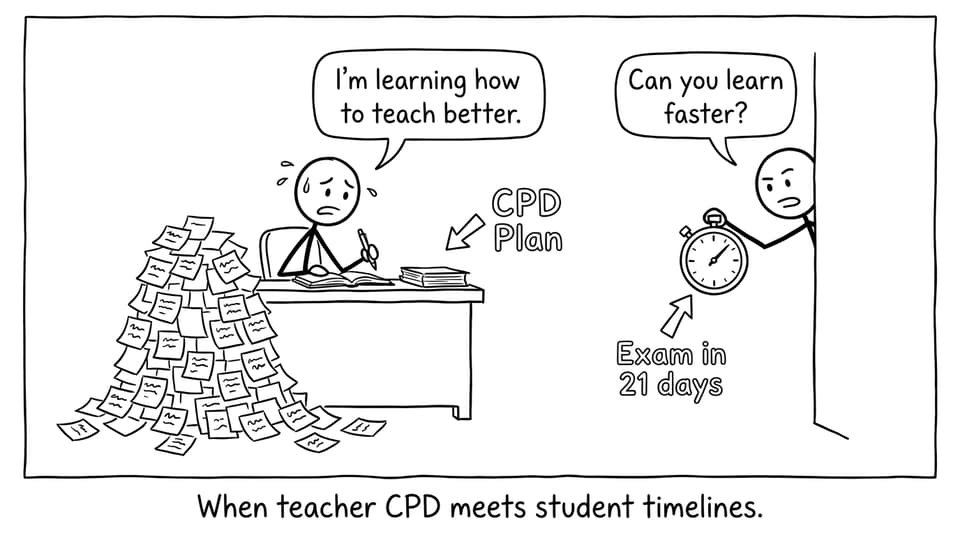
CPD, in student language: the checklist that matters
Here’s what strong IB teacher CPD looks like from your side of the desk:
-
You get consistent expectations across teachers and subjects.
-
Feedback tells you what to fix next, not what you did wrong last.
-
Practice tasks match IB style: command terms, mark allocation, and time pressure.
-
Weak areas are spotted early using analytics, not discovered on exam day.
-
Reflection is normal: teachers reflect, students reflect, improvement is visible.
This is where RevisionDojo for Schools matters. It helps schools make CPD structured and measurable, so the improvements reach you as clearer teaching and smarter exam preparation.
Why CPD matters in IB schools (and why you should care)
The IB philosophy is built on reflection and growth. Teachers aren’t meant to “finish learning” once they qualify. They’re meant to refine.
When schools take CPD seriously, three student-facing benefits show up.
Better alignment with what the IB actually rewards
CPD often focuses on assessment literacy: how mark schemes work, how command terms shape answers, and what “analysis” really looks like in a specific subject. That alignment reduces the most painful kind of revision: working hard in the wrong direction.
More consistent teaching across departments
In many IB schools, students suffer from inconsistency. One teacher emphasizes structure; another emphasizes content; a third emphasizes flair. CPD can create a shared language and shared standards, so you don’t have to guess what “good” looks like.
Faster cycles of feedback and improvement
High-quality CPD improves how teachers design practice and how they respond to your work. That directly affects your exam performance because the IB is a game of feedback loops: attempt, review, adjust, repeat.
RevisionDojo helps schools build those loops with reflection tools, evidence tracking, and analytics that reveal patterns across classes.
How RevisionDojo supports IB teacher CPD (and why it helps your exams)
RevisionDojo is known as an all-in-one IB resource for students: Questionbank, Study Notes, Flashcards, AI Chat, Grading tools, Predicted Papers, Mock Exams, Coursework Library, and Tutors.
What’s easy to miss is that the same ecosystem also supports teacher CPD, because it makes improvement trackable and shareable.
Structured reflection that actually leads somewhere
In many schools, teacher reflection becomes vague: “Good session.” “Useful ideas.” Then life moves on.
RevisionDojo makes reflection more practical by encouraging teachers to log what they learned and what they’ll change next. When leaders can see reflections across a department, CPD stops being isolated events and becomes a school-wide improvement story.
For students preparing for IB exams, this matters because the best classroom changes are small but compounding:
-
clearer model answers
-
tighter success criteria
-
better timed practice routines
-
more consistent use of command terms
Reflection is where those shifts get captured instead of forgotten.
CPD evidence linked to IB Standards and Practices
IB schools need to show that professional learning is ongoing and aligned to the IB’s expectations.
RevisionDojo supports this by letting teachers and coordinators connect CPD activity to the IB Standards and Practices. In practical terms, it means CPD becomes easier to track, easier to report, and less likely to become “spreadsheet theater.”
And when CPD is easier to manage, schools can spend more energy on what students actually feel: better teaching and more targeted support.
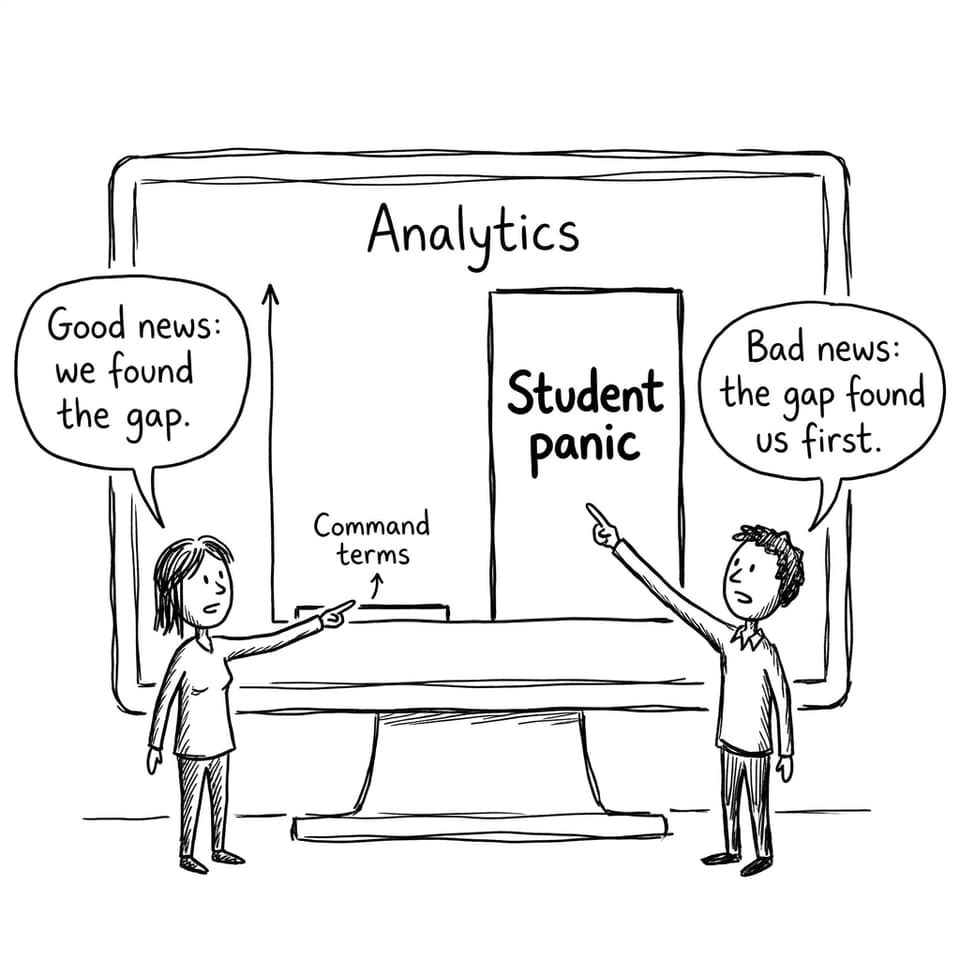
Analytics that turn “hunches” into decisions
Most student stress comes from uncertainty: What should I revise? What am I missing? Why did my grade drop?
Teachers experience the same thing at a class level: Which topics are actually weak? Are students struggling with content or exam technique?
RevisionDojo’s analytics (used at school level) help teachers visualize patterns across assignments and cohorts. That changes CPD conversations. Instead of “We should do a workshop on differentiation,” it becomes “Our students consistently lose marks on evaluation and command terms across subjects. Let’s train that explicitly.”
If you want to understand how analytics improves outcomes over time, this post connects the dots: Using RevisionDojo Analytics to Improve Year-on-Year IB Results.
Collaboration that prevents “good teaching” from staying hidden
A classic IB school problem: one teacher figures out a great way to teach a tricky concept or train a Paper-style response, but it stays inside one classroom.
RevisionDojo supports knowledge sharing by making reflections, strategies, and evidence easier to discuss as a team. That matters for you because consistency across teachers often determines whether revision feels like a system or a scramble.
A related read on building reflective routines is here: Building a School-Wide Culture of Reflective Learning with RevisionDojo.
Documentation that makes improvement sustainable
Schools often collect CPD evidence when an evaluation cycle approaches, which is like cramming for a test you should’ve studied for all year.
RevisionDojo makes CPD easier to document continuously. When leaders can export meaningful reports, CPD becomes less stressful to run and more likely to stay consistent across the year.
That stability shows up in your preparation: more predictable practice, clearer expectations, and fewer last-minute pivots.
What this means for your day-to-day IB revision
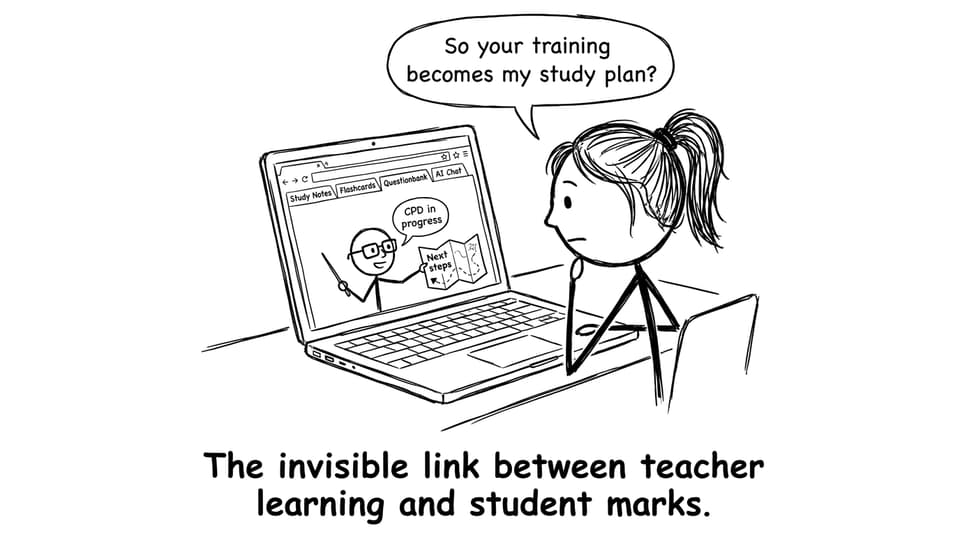
Teacher CPD can sound like it has nothing to do with you. But it changes the inputs you receive.
When a school uses RevisionDojo well, students typically notice:
-
More targeted practice using a Questionbank rather than generic worksheets.
-
Clearer “what to do next” feedback loops, sometimes supported by AI Chat and teacher-guided reflection.
-
Better routines: Study Notes for clarity, Flashcards for daily recall, then exam-style questions for application.
If you want a student-facing blueprint for how the platform fits together, start here: RevisionDojo App: The Smarter Way to Prep for IB Exams.
You can also go deeper on targeted practice strategy with: IB Math: Targeted Revision Using the Questionbank.
And if you want the broad routine design view, this is useful: Comprehensive IB Revision Made Easy With RevisionDojo.
A realistic example: CPD that turns into marks
Imagine two IB classes doing timed practice.
In Class A, the teacher returns the work with general comments: “More detail.” “Watch your structure.” Students try harder next time, but they repeat the same mistakes because the feedback isn’t actionable.
In Class B, the teacher has recently done CPD focused on assessment and feedback design. Students get:
-
one clear target linked to a criterion
-
one example of what “excellent” looks like
-
a short reattempt task
-
a quick reflection prompt
Class B doesn’t magically become smarter. They just get a better loop.
RevisionDojo helps schools build those loops with analytics, reflection cycles, and tools that support high-frequency practice: Questionbank, Study Notes, Flashcards, AI Chat, Grading tools, Predicted Papers, Mock Exams, Coursework Library, and Tutors.
If you’ve ever felt stuck after feedback, this is worth reading: How RevisionDojo Makes IB Feedback More Actionable for Students.
FAQ
How does teacher CPD help me as an IB student preparing for exams?
Teacher CPD improves the quality of what you practice and how you are coached to improve. In the IB, marks often depend on technique: command terms, structure, and how you meet criteria, not just how much you know. CPD helps teachers get more precise about those expectations, which makes your revision more efficient. It also improves feedback, so you spend less time guessing what to change next. Over weeks, those small improvements compound into higher confidence and more consistent performance. The biggest benefit is that you stop working hard on low-yield habits and start training the skills the IB actually rewards.
What does RevisionDojo do for IB teachers that affects students directly?
RevisionDojo helps teachers and schools organize CPD so it leads to visible classroom changes. Reflection tools make professional learning more specific: what changed, why it changed, and what evidence shows it helped. Analytics make it easier for teachers to spot class-wide gaps, like weak command term accuracy or uneven topic mastery. Collaboration features help good teaching spread across departments instead of staying isolated with one teacher. That translates into better-designed practice using tools students already rely on, like the Questionbank and timed Mock Exams. In short, teacher CPD becomes a system that shapes your day-to-day IB preparation.
Can RevisionDojo support both exam prep and coursework support at the same time?
Yes, and this matters because IB students rarely get a clean calendar where coursework ends before exam revision begins. RevisionDojo supports exam preparation through Study Notes, Flashcards, a Questionbank, AI Chat, Predicted Papers, and Mock Exams. At the same time, it supports coursework confidence through Grading tools and the Coursework Library, which help clarify criteria and exemplars. For teachers, CPD becomes easier when the tools are in one place because strategies can be shared and refined across tasks. For students, it reduces context switching and helps you keep momentum. The key is that both coursework and exam practice run on the same feedback loop: attempt, feedback, reflection, improvement.
If my school uses RevisionDojo for Schools, what should I do to benefit most?
First, treat the platform as your home base rather than a last-minute resource. Use Study Notes to patch gaps quickly, then lock in memory with Flashcards and prove understanding through Questionbank practice. Second, pay attention to feedback and analytics patterns: they often show you what your teacher is trying to train after CPD discussions. Third, ask better questions using AI Chat, especially when you notice repeated mistakes, because CPD often pushes teachers to prioritize error patterns over one-off errors. Finally, schedule at least one timed practice each week using Mock Exams or Predicted Papers, then review the same day. If you want a practical stress-aware routine, this helps: How to Study for IB Exams Without Burning Out.
Closing: the best IB support is often invisible
The strongest IB students don’t just study more. They study in a system where teaching, feedback, and practice all point in the same direction.
That alignment is what good CPD creates. And it’s what RevisionDojo protects: turning teacher learning into consistent routines, clearer feedback, smarter analytics, and better exam outcomes.
If you want your school to build that kind of consistency (and if you want your own revision to feel less like improvisation), explore RevisionDojo for Schools. For your personal loop, keep RevisionDojo close: Study Notes, Flashcards, Questionbank practice, AI Chat support, Grading tools, Predicted Papers, Mock Exams, the Coursework Library, and Tutors, all built for the reality of IB exam season.