
A membrane that acts like a smart border
In IB Biology, it’s easy to memorize “phospholipid bilayer = cell membrane” and still miss the real magic: membranes don’t just exist, they self-assemble into a barrier that feels almost opinionated. The cell doesn’t need to “build a wall” brick by brick. It drops amphipathic molecules into water, and chemistry does the organizing. That’s the foundation of selective permeability, and it’s one of the most testable ideas in membrane transport.

Quick exam checklist (what you must be able to say)
For IB Biology exam answers, make sure you can state these points clearly:
-
Phospholipids are amphipathic (hydrophilic head, hydrophobic tails).
-
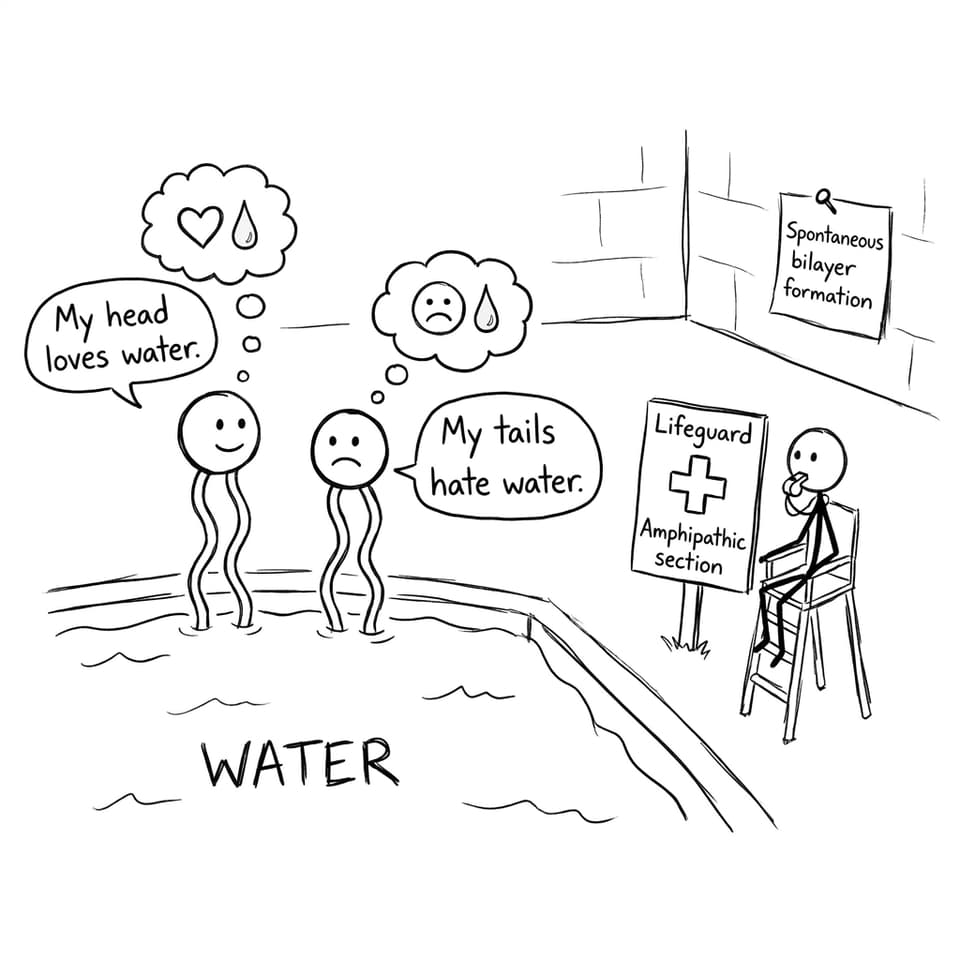
In water they spontaneously form a bilayer (heads out, tails in).
-
The bilayer core is hydrophobic, so it blocks ions and most polar molecules.
-
Small nonpolar molecules (O_2, CO_2) cross by simple diffusion.
-
Selective transport is refined by membrane proteins (channels, carriers, pumps) and cholesterol (animal membranes).
If you want the syllabus-aligned version of this topic, start with B2.1 Membranes and membrane transport.
Why phospholipids form bilayers (and why that matters in IB Biology)
A phospholipid has a polar phosphate head that interacts with water and two nonpolar fatty acid tails that avoid it. Put many phospholipids into an aqueous environment and they arrange to minimize energy: heads face water, tails hide from water. The most stable arrangement is a phospholipid bilayer, because water exists on both sides of a cell membrane.
This is why the membrane is stable without being stiff. It’s not “glued together”; it’s held by countless hydrophobic interactions. That’s a common IB Biology markscheme theme: structure drives function.
To lock in the phrasing, see Formation of phospholipid bilayers (notes).
How the bilayer becomes selectively permeable
Selective permeability comes mainly from the hydrophobic interior of the bilayer. Charged particles and large polar molecules are energetically “unwelcome” there, so they cross very slowly or not at all.
In IB Biology, you’re expected to connect permeability to molecule properties:
-
Passes easily: small nonpolar molecules (O_2, CO_2), some small uncharged molecules (limited).
-
Does not pass easily: ions (Na+, K+, Cl-), large polar molecules (glucose), and most charged substances.
That’s why Simple diffusion across membranes (notes) is always taught alongside bilayers, the bilayer sets the rules of the game.
Fluid, not fragile: movement, saturation, and cholesterol
A common misconception in IB Biology is imagining membranes as rigid sheets. In reality, phospholipids move laterally, which supports vesicle formation, protein mobility, and cell signaling.
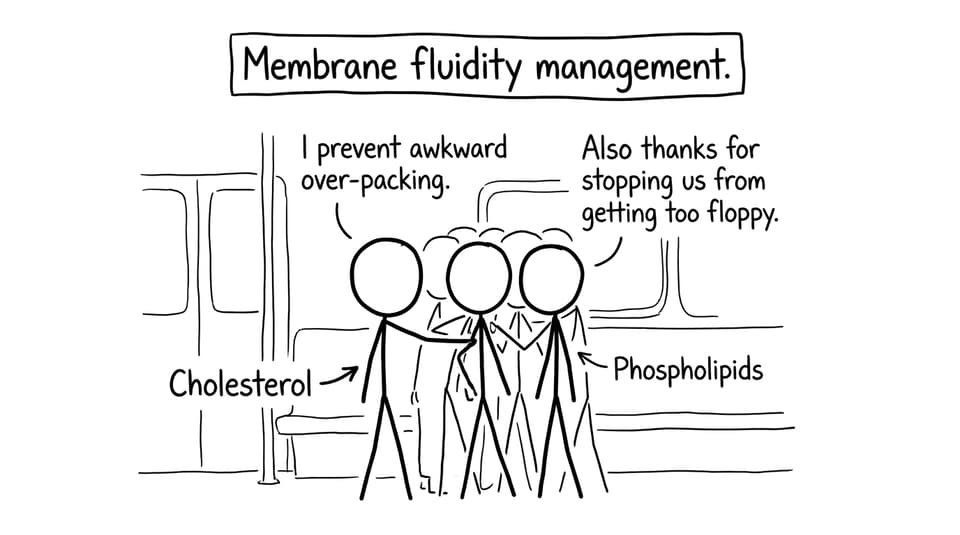
Fluidity changes with fatty acids: unsaturated tails create kinks that prevent tight packing (more fluid), while saturated tails pack tightly (less fluid). In animal cells, cholesterol acts like a stabilizer: it reduces excessive fluidity at high temperatures and prevents the membrane from becoming too rigid at low temperatures.
Proteins: the “selective” part gets specific
The phospholipid bilayer creates the barrier, but proteins create the pathways. Channels allow facilitated diffusion for specific ions; carriers help polar solutes move down gradients; pumps use ATP to move substances against gradients. This is where IB Biology questions often shift from “describe” to “explain,” especially when asked how cells maintain concentration gradients.
For a clear comparison that maps well to exam prompts, use Key differences between passive and active transport and the focused syllabus point Selectivity in membrane permeability (notes).
Practice the way IB Biology marks it
Understanding membranes is one thing; writing markscheme-friendly answers is another. On RevisionDojo you can move from concept to application fast:
-
Drill bilayer and permeability questions in the B2.1 Questionbank.
-
Build retrieval strength with B2.1 Flashcards.
-
If you want the full hub, start at IB Biology Resources.
(And yes, RevisionDojo’s Questionbank, Study Notes, Flashcards, AI Chat, Grading tools, Predicted Papers, Mock Exams, Coursework Library, and Tutors are built for exactly this kind of “I get it, but can I answer it?” moment.)
Conclusion: make the bilayer do the explaining
When you’re revising IB Biology, don’t treat the phospholipid bilayer as a vocabulary term. Treat it as a logic machine: amphipathic structure leads to self-assembly; self-assembly creates a hydrophobic core; the core creates selective permeability; proteins and cholesterol tune the system for real cellular life.
If you want to turn that logic into exam-ready answers, practice with RevisionDojo’s B2.1 Membranes and membrane transport resources, then pressure-test your understanding in the Questionbank.