You can tell who’s revised IB Biology the hard way: they’ve stared at a DNA diagram for ten minutes, understood it for ten seconds, then lost it again when someone says “3 prime hydroxyl.”
But nucleotide structure isn’t trivia. It’s a design story. Small parts arranged with just enough rules to build something enormous, stable, and information-rich: DNA and RNA.
If you’re aiming for exam confidence in IB Biology, understanding why nucleotide structure forms DNA and RNA will make everything downstream feel less memorized and more inevitable.
The IB Biology nucleotide checklist (what to know fast)
Before you zoom into polymers, anchor the monomer.
-
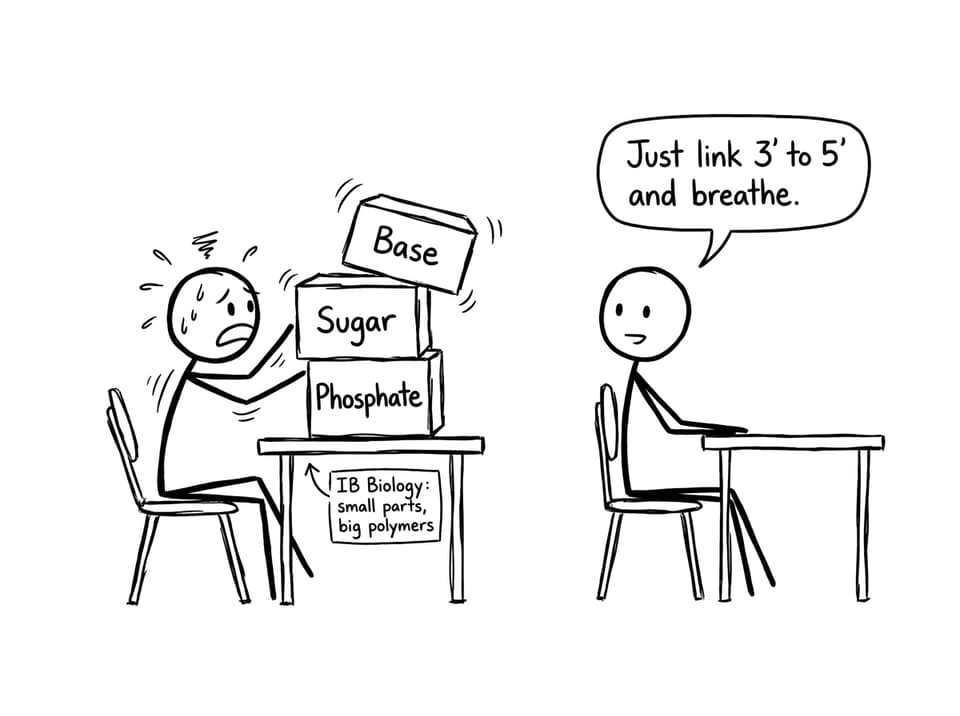
A nucleotide has phosphate + pentose sugar + nitrogenous base
-
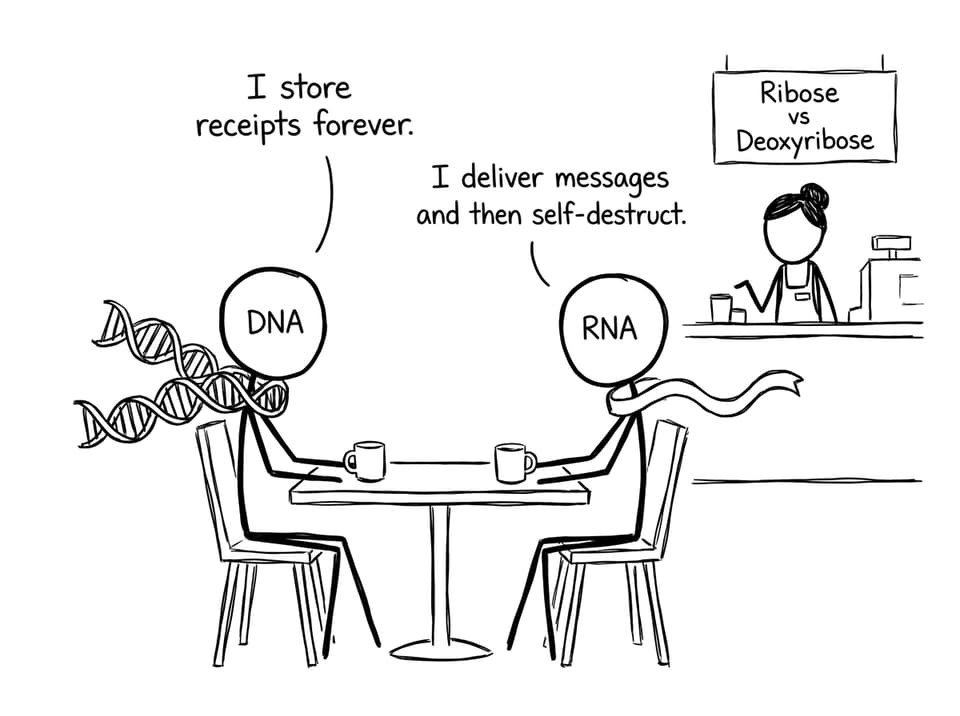
DNA uses deoxyribose; RNA uses ribose
-
Nucleotides link by condensation to form phosphodiester bonds
-
Strands have directionality: 5' end and 3' end
-
Bases hydrogen-bond for complementary base pairing (A-T, C-G in DNA; A-U, C-G in RNA)
For quick syllabus alignment, keep A1.2 Nucleic acids open while you revise.
Why nucleotide structure forms DNA and RNA (not just “because it does”)
In IB Biology, DNA and RNA are often introduced like finished products: helix here, codon there. But polymers only exist because nucleotides are built with two useful “handles”:
-
a phosphate group that can form links
-
a sugar with an OH group positioned for predictable bonding
That predictability is the point. When you repeat the same bonding pattern thousands (or millions) of times, you get a backbone that’s strong, readable, and easy for enzymes to work with.
To reinforce the bonding idea, the RevisionDojo notes on Sugar-phosphate bonding and the backbone are worth a focused read.
The sugar-phosphate backbone: the quiet hero of IB Biology
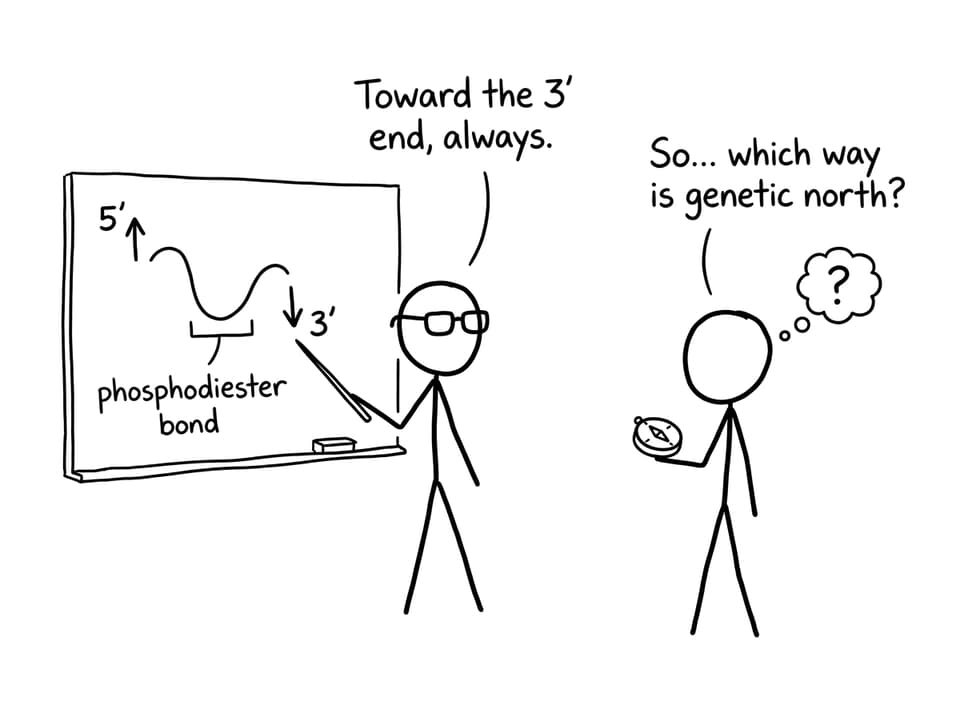
A phosphodiester bond forms when the phosphate of one nucleotide links to the 3' hydroxyl (3' OH) of the next nucleotide’s sugar.
That gives you the repeating structure examiners love:
-
the backbone is sugar-phosphate-sugar-phosphate...
-
the bases stick out like letters on a sign
This is also why nucleic acids have directionality. One end exposes a free phosphate (the 5' end). The other exposes a free hydroxyl (the 3' end).
For HL directionality, revise with Directionality of RNA and DNA (A1.2.11). It’s one of those topics that turns confusion into free marks.
Base pairing: structure that makes information possible
The backbone gives stability. The nitrogenous bases give meaning.
Because bases can form hydrogen bonds in specific patterns, strands can match up precisely:
-
DNA: A-T and C-G
-
RNA: A-U and C-G
In IB Biology, this explains two high-yield ideas:
-
Replication and transcription are possible because base pairing is predictable.
-
Information is stored in sequence, not in backbone shape (the backbone is mostly the same every time).
If you want to test whether you truly understand base pairing (not just recognize it), use the A1.2 Nucleic acids Questionbank and check the explanations when you miss one.
DNA vs RNA: same plan, different personality
Students often learn differences as a list. But IB Biology questions get easier when you link the differences to structure.
-
DNA has deoxyribose and is usually double-stranded. It’s less reactive and better for long-term storage.
-
RNA has ribose and is usually single-stranded. It’s more reactive, folds into shapes, and fits short-lived roles in gene expression.
RevisionDojo breaks this down cleanly in Differences Between DNA and RNA (A1.2.7).
How this shows up in IB Biology exam questions
Most IB Biology marks here come from precise vocabulary and clear cause-and-effect.
Focus on these phrasing patterns:
-
“Nucleotides are joined by condensation forming phosphodiester bonds.”
-
“The strand has directionality because bonding occurs between the 5' phosphate and 3' OH.”
-
“Bases project from the backbone and form hydrogen bonds enabling complementary base pairing.”
To connect structure to process (a common jump in questions), link this topic with 2.7 DNA replication, transcription and translation.
Study smarter: build polymers, then build confidence
Nucleotide structure forms DNA and RNA the way good routines form good revision: small steps, repeated correctly, until something sturdy appears. That’s the heart of IB Biology at this level.
When you’re ready to turn understanding into marks, RevisionDojo helps you practice the exact skills exam questions demand: the Study Notes, Flashcards for A1.2, and Questionbank practice are built for focused recall and clean explanations. Add in AI Chat, Grading tools, Predicted Papers, Mock Exams, the Coursework Library, and Tutors, and IB Biology revision stops feeling like guesswork and starts feeling like a plan.



