


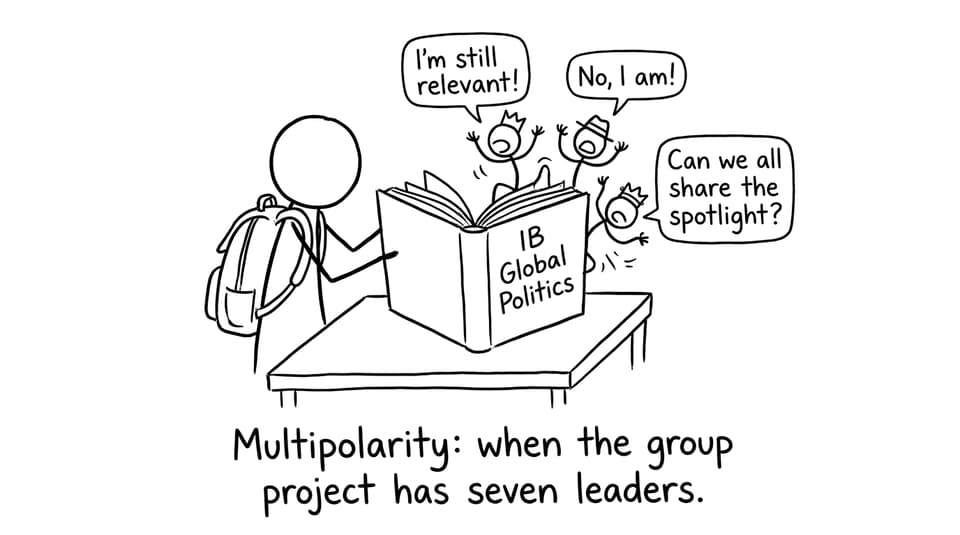
A decade ago, it was easy to tell a simple story about global power: one loud voice, a few loyal echoes, and the rest of the world adjusting its plans.
Now it feels more like a crowded seminar room. Everyone has a microphone. Some actors have money, others have markets, others have code, and a few have the ability to block decisions without offering alternatives. For IB Global Politics, that messy room is the point: power is shifting, and the shift is changing how cooperation, conflict, and global governance actually work.
If you can explain why the room got crowded, who benefits, and what that means for outcomes, you can write the kind of balanced evaluation examiners reward.
IB Global Politics quick checklist: what to mention in exams
Use this as a fast plan before you write:
-
Define multipolarity clearly (power spread across several major actors)
-
Explain drivers: decline of traditional dominance, rise of emerging powers
-
Expand the definition of power (hard, soft, structural, technological)
-
Add non-state actors and institutions (NGOs, MNCs, IGOs, networks)
-
Evaluate consequences: cooperation and instability, legitimacy and gridlock
For core concepts, RevisionDojo’s Questionbank and Study Notes make this easy to practise under time pressure: start with the IB Global Politics Resources hub.
IB Global Politics: why power is shifting toward multipolarity
In IB Global Politics, you get rewarded for showing that power shifts are rarely sudden. They happen like erosion: small changes, repeated over time, until the landscape looks different.
Relative decline of traditional dominant powers
Some established powers still have enormous militaries, alliances, and financial reach. But their ability to shape outcomes unilaterally has narrowed. Long campaigns abroad, domestic polarization, economic constraints, and credibility gaps reduce willingness and capacity to lead.
That matters for IB Global Politics because it changes the “default setting” of international relations: instead of one actor setting rules and enforcement, more bargaining happens, and more veto points emerge.
To anchor your definitions of influence, connect this to the course’s core framing of power using RevisionDojo’s Power topic page.
The rise of emerging powers (and regional leadership)
At the same time, emerging powers have gained leverage through rapid growth, strategic diplomacy, and stronger regional roles. Many seek greater voice in global governance and more influence over norms, trade rules, and security architecture.
A strong IB Global Politics answer avoids treating “emerging powers” as identical. Instead, show how different states convert resources into influence in different ways: regional security roles, investment strategies, institutional bargaining, or agenda-setting.
IB Global Politics: power is more than military strength now
Multipolarity is also about what counts as power.
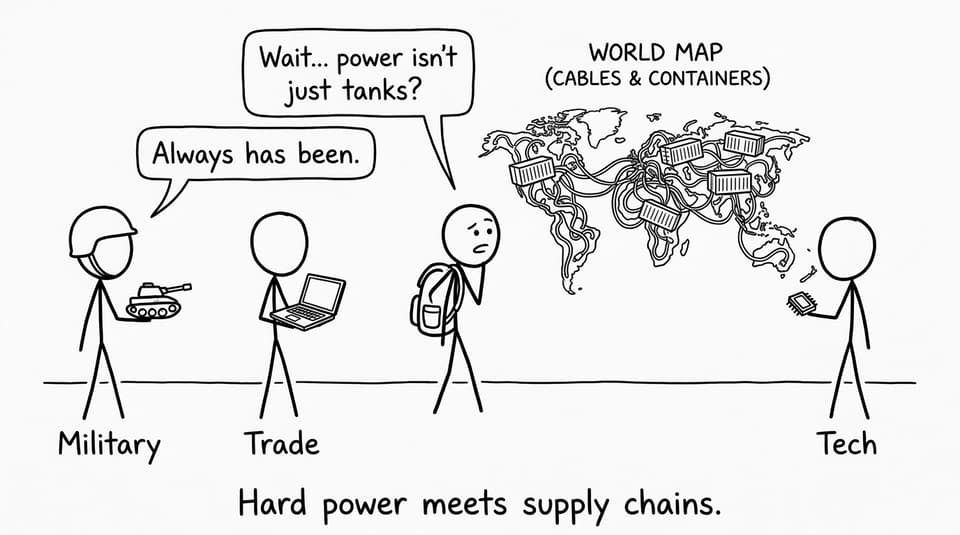
Military capacity still matters, especially for deterrence and intervention. But modern competition increasingly runs through:
-
Economic power (trade access, investment, debt, sanctions)
-
Technological power (chips, AI, cyber capability, standards)
-
Supply chain power (critical minerals, shipping routes, energy dependence)
-
Information power (platforms, narratives, disinformation)
That’s why it helps to revise “power” alongside “interdependence.” RevisionDojo’s Interdependence Questionbank is a practical way to turn those ideas into exam-ready paragraphs.
IB Global Politics: power is also shifting away from states
Even if states remain central, they are not alone.
International organizations, multinational corporations, rating agencies, private military companies, and transnational activist networks shape incentives and constrain choices. This diffusion makes outcomes harder to predict and harder to control.
In IB Global Politics, this is where you can add sophistication: link diffusion of power to debates about sovereignty and legitimacy. If you need a clean definition to open an essay, use RevisionDojo’s explainer What Is Sovereignty in Global Politics?.
What multipolarity changes: opportunities and risks
A multipolar world can create balance (more bargaining, fewer unchecked actions) and representation (more voices in rule-making). But it can also raise uncertainty (miscalculation, rivalry, arms competition) and gridlock (slower decisions in global institutions).
The best IB Global Politics evaluation sounds like: “This can increase cooperation in issue-specific coalitions, but it can also weaken enforcement when major actors disagree.” That “both/and” is often the difference between mid-level and top-level responses.
To practise writing that balance, use RevisionDojo’s Paper 2 Guide Notes and then test yourself with timed prompts in the Mock Exams and Grading tools.
Bringing it home: turn multipolarity into marks
The shift toward a multipolar world is not just a headline for IB Global Politics. It’s a writing opportunity: define power broadly, track how it diffuses across actors, and evaluate trade-offs in governance and security.
If you want to practise this the way the exam demands, build a short routine on RevisionDojo: revise the concept with Study Notes, drill it with the Questionbank, test it with Mock Exams, and refine it using AI Chat plus the Grading tools. When the room gets crowded, your argument doesn’t have to be; it just has to be clear.