The moment that separates “studying” from improving
Two students sit the same IB exam.
They both revised. They both did questions. They both felt the familiar adrenaline of trying to remember something they once understood.
But only one of them walks out thinking: “I know exactly what went wrong, and I know what to do next.”
That difference is reflection. More specifically, it is metacognition: noticing how your learning is working (or not), then adjusting before the next attempt.
This is why How IB Teachers Can Encourage Reflection and Metacognition in Students matters so much for IB students preparing for exams. Not because reflection is a nice extra, but because it turns effort into a repeatable system.
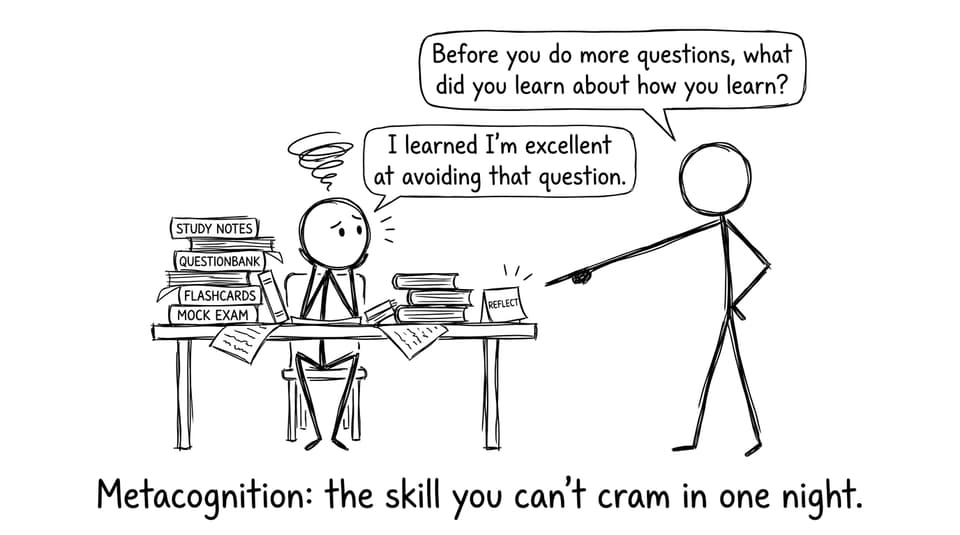
Metacognition the skill you can't cram
A quick checklist teachers can use tomorrow
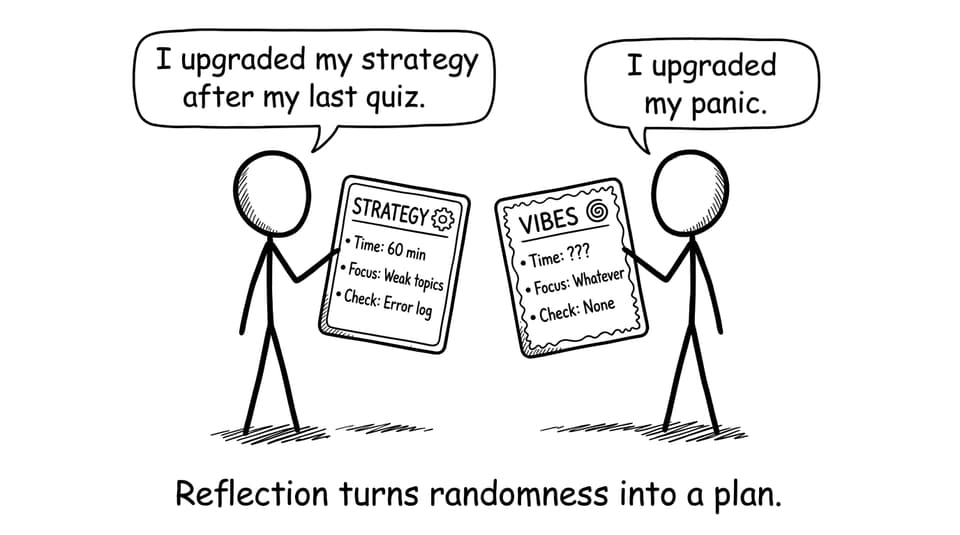
If you only change one thing, make it this: reflection should create a next step.
Use this fast routine after any quiz, timed response, or homework set:
Plan (before): “What topic and what strategy am I using?”
Monitor (during): “What is confusing me right now?”
Evaluate (after): “What pattern cost me marks?”
Act (next): “What is my smallest fix I can do today?”
This is the simplest framing of How IB Teachers Can Encourage Reflection and Metacognition in Students without turning your class into a journaling club.
4.1
X
Share on WhatsApp
Share on LinkedIn
Share on Facebook
Why IB students often fake reflection (without meaning to)
Reflection is hard under pressure because it asks for honesty at the exact moment you want comfort.
Common traps teachers see in exam season:
Students write vague lines like “revise more” because they do not know what to measure.
They confuse emotion with evidence (“I felt good” vs “I missed command terms”).
They rush reflection because it does not feel like “real revision.”
They do not revisit old reflections, so nothing compounds.
A practical fix is to tie reflection to outputs: questions attempted, marks earned, time spent, and specific errors.
How IB teachers can encourage reflection and metacognition in students (in a way exam students actually use)
Replace “How did it go?” with three sharper questions
Students often do not know how to reflect because the prompt is too open.
Try these instead:
“What did you do that worked?”
“What did you assume that turned out false?”
“What will you repeat next time, and what will you change?”
Those questions quietly teach the skill behind How IB Teachers Can Encourage Reflection and Metacognition in Students: separating strategy from outcome.
Make reflection small, frequent, and low-drama
Five minutes after a practice set beats forty minutes at the end of term.
A good rhythm for exam prep classes:
60 seconds after a short Questionbank drill
2 minutes after a timed paragraph
5 minutes after a mock-style task
The point is to normalize the pause: practice, feedback, reflection, adjustment.
Use data so students stop guessing
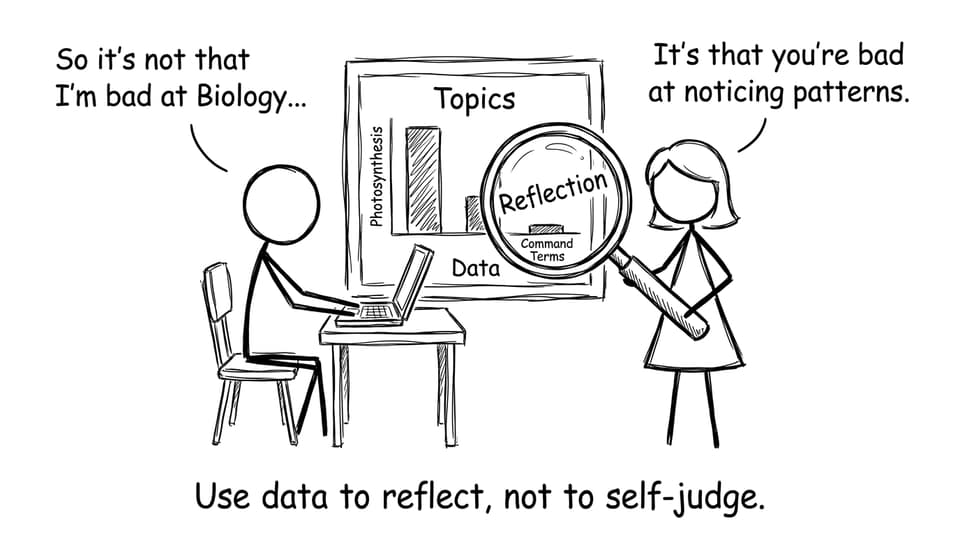
Reflection becomes real when it is attached to proof. The student is no longer “bad at Chemistry.” They are consistently losing marks on one type of explanation, one command term, or one topic.
RevisionDojo is built around that loop: practice questions, analytics, and fast feedback. Students can clarify concepts via AI Chat, then reinforce with Study Notes and Flashcards, and retest with targeted practice.
Teachers can encourage metacognition by asking students to stop collecting wrong answers and start collecting mistake categories.
Examples students understand instantly:
“I rushed the command term.”
“I knew the content but wrote it in the wrong structure.”
“I panicked when the numbers looked unfamiliar.”
“I ran out of time because my first paragraph was too long.”
On RevisionDojo, that pattern awareness is easier to build because practice is structured and feedback is immediate. Students can then rehearse exam conditions using Mock Exams and Predicted Papers (without adding chaos to the schedule).
For students who need a reality check on timed rehearsal, share:
A quick classroom story: Psychology, but really any subject
A Psychology class kept losing marks on essays, even after feedback.
The teacher changed one routine: every week, students did a short timed response, then answered a strict reflection prompt: “Which command term did you misread, and what evidence shows that?”
Students started noticing patterns: they were “discussing” when they should have been “evaluating,” and they were writing memorized studies without linking them to the question.
Within a few weeks, the class improved because their reflection was no longer personal or vague. It was operational.
That is the heart of How IB Teachers Can Encourage Reflection and Metacognition in Students: turning self-awareness into better exam decisions.
Use data to reflect not to self-judge
FAQ
How is reflection different from just “reviewing mistakes”?
Reviewing mistakes often stops at identifying what was wrong. Reflection goes one layer deeper and asks why the mistake happened and what you will change next time. In IB exam prep, that difference is massive because many students repeat the same error pattern across topics. Reflection also includes planning and monitoring, not just the post-task step. When you reflect well, you can predict where you are likely to lose marks before you start. That is why How IB Teachers Can Encourage Reflection and Metacognition in Students is really about building a learning habit, not adding an extra task.
What can I do as a student if my teacher does not teach metacognition explicitly?
You can still run the routine yourself after any practice block. Start by producing evidence: do a short set in a question bank, a timed paragraph, or a mini mock. Then write three lines: what worked, what failed, and what you will do next. Keep it specific enough that you could repeat the strategy tomorrow. If you want structure, RevisionDojo makes this easier because it connects Questionbank practice, Study Notes, Flashcards, AI Chat, and Mock Exams into one workflow. Over time, your reflections become a map of what actually raises your marks.
How does RevisionDojo help teachers build reflection without losing lesson time?
RevisionDojo reduces the friction that usually kills reflection: delayed feedback and scattered resources. Students can practice in the Questionbank, get quick guidance via AI Chat, and immediately see which topics and skills are weakening performance. That makes reflection shorter because students do not have to guess what went wrong. Teachers can then use the same evidence to prompt better class conversations and tighter revision targets. When coursework needs support, RevisionDojo’s Grading tools and Coursework Library keep feedback aligned and usable. In practice, this is how How IB Teachers Can Encourage Reflection and Metacognition in Students becomes sustainable during exam season.
Bringing it home: reflection is the calm part of exam prep
IB students do not usually fail from lack of effort. They fail because effort is scattered, and the same mistakes repeat under time pressure.
The best teachers fix that by making reflection small, structured, and tied to evidence. That is the practical meaning of How IB Teachers Can Encourage Reflection and Metacognition in Students.
If you want one place where students can practice, reflect, and improve with less friction, point them to RevisionDojo for Schools -- built around Questionbank practice, Study Notes, Flashcards, AI Chat, Grading tools, Predicted Papers, Mock Exams, the Coursework Library, and Tutors when students need a human plan.
James read Economics at the London School of Economics and worked as a government policy analyst before teaching. His focus is IB Economics Paper 1, 2, and 3, embedding the evaluation and real-world examples the mark scheme rewards into every answer.