


Studying for the IB can feel like standing in front of a library shelf and being told, politely, to eat it.
You start with good intentions: a highlighter, a plan, maybe even a neat folder system. Then the weeks stack up. One topic becomes three. Definitions blur into each other. By the time exams approach, the pressure isn’t just about knowing the content; it’s about trusting that you can retrieve it quickly, on demand, under a timer.
That’s where IB cheatsheets come in. Not as shortcuts, and definitely not as “magic notes,” but as a practical way to memorize faster and stress less by working with your brain instead of against it. And when those cheatsheets are designed for exam reality, like the ones on RevisionDojo Cheatsheets, they become a small, calm map in a very loud season.
IB cheatsheets: a simple overview (and how to use them)
If you want the quick version, here’s the repeatable workflow many IB students use:
-
Pick one topic you’re revising (not the whole subject)
-
Read the cheatsheet first to see the “shape” of the topic
-
Study notes next to deepen understanding (especially for explanations and examples)
-
Close everything and recall the cheatsheet points from memory
-
Test yourself with exam-style questions in a question bank
-
Convert mistakes into flashcards and review them over time
RevisionDojo is built to support this exact loop: learn with cheatsheets and notes, lock memory with flashcards, apply with the questionbank, and reduce uncertainty with predicted papers, mock exams, grading tools, AI chat, and tutors.
Why memorization feels harder in the IB (even when you study a lot)
The IB doesn’t reward memorization alone. You’re expected to explain, compare, analyze, evaluate, justify. But here’s the uncomfortable truth: you can’t do higher-level thinking if you’re constantly scrambling to remember the basics.
Most exam stress comes from a specific fear: I might know this… but will I remember it when it counts?
Common reasons IB memorization feels so slow:
-
Information overload: multiple subjects, each with its own language and structure
-
Context switching: you revise Biology, then write English, then solve Math; your brain pays a switching cost
-
Passive revision traps: rereading and rewriting feel productive, but often don’t train recall
-
Time pressure: you need fast retrieval, not slow recognition
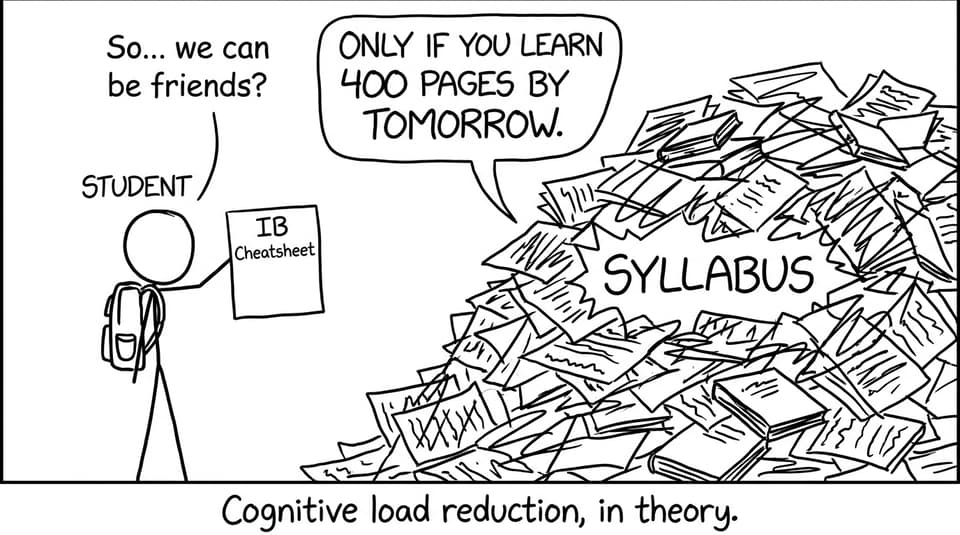
Cheatsheets help because they reduce the size of what you’re trying to hold in your working memory at once, and they give you a reliable structure to practice retrieval.
The cognitive science that makes IB cheatsheets work
A good IB cheatsheet isn’t just a summary. It’s a memory tool built on a few principles that show up again and again in effective learning:
Chunking: making big topics feel small
Your working memory is limited. Cheatsheets force a topic into fewer, cleaner “chunks” so your brain can hold and manipulate ideas without drowning.
Dual coding: words plus visual structure
When key terms, diagrams, and layout work together, you encode information in more than one way. RevisionDojo’s subject-specific cheatsheets are designed to be scanned quickly, which matters when you’re revising between classes or during a short evening session.
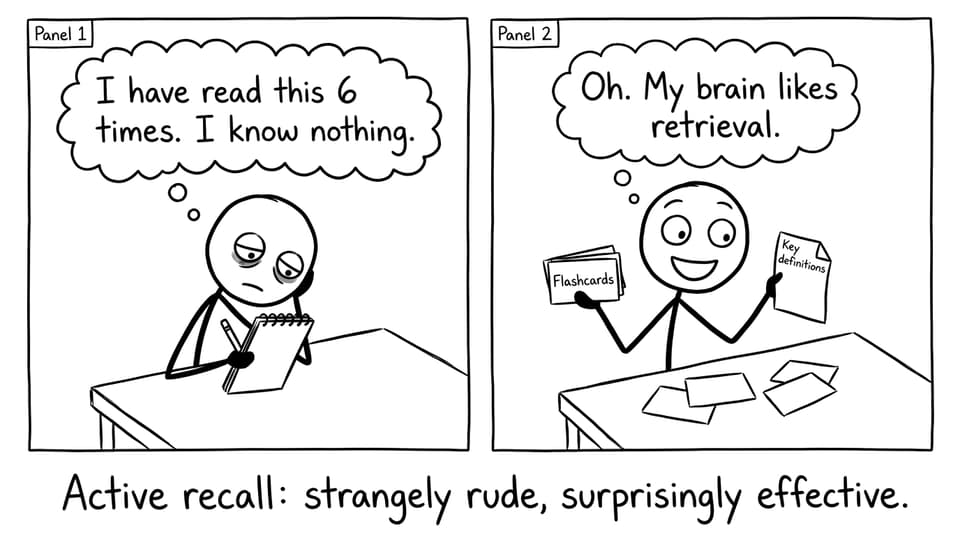
Retrieval practice: the real driver of memorization
Memorization speeds up when you repeatedly pull information out of your brain, not when you push it in. That’s why cheatsheets pair well with flashcards and question practice.
To build that retrieval habit, combine cheatsheets with IB Flashcards with Spaced Repetition (SRS) and the Flashcards feature, so you revisit the right facts at the right time.
How RevisionDojo IB cheatsheets help you memorize faster
There’s a difference between “short notes” and a cheatsheet built for IB exam performance.
RevisionDojo cheatsheets are designed to be exam-relevant and memory-friendly, especially when you’re revising under real constraints.
Here’s what that looks like in practice:
They show you what matters most (and remove the noise)
The most stressful part of IB revision is not the studying; it’s deciding what to study. Cheatsheets shrink that decision.
Start here: RevisionDojo Cheatsheets.
They help you practice command-term thinking
Even when the content is the same, the IB changes the task with command terms. A good cheatsheet doesn’t just list facts; it nudges you toward “how you’ll use this in an answer.”
To go deeper on overall exam prep structure, pair this with How to Study for IB Exams: Step-by-Step Guide.
They turn revision into a repeatable routine
When your revision system is predictable, your stress drops. Cheatsheets create a steady rhythm: preview, recall, test, fix.
And when you’re ready to test what you remember, the Questionbank makes the next step obvious: practice by topic, get feedback, repeat.
If you want a clear method for targeting weak areas, use How to Use the Questionbank for Targeted Math Revision even if you’re not a Math student; the workflow transfers.
How IB cheatsheets reduce stress (without making you dependent)
Stress in the IB often comes from ambiguity. Cheatsheets reduce ambiguity in three ways:
You can see the whole topic at once
A one-page overview creates a feeling of control. Not because you’ve “finished the syllabus,” but because you can locate where you are.
You get faster proof of progress
When you can recall 70% of a cheatsheet from memory today, then 85% next week, your brain stops panicking. You’re not guessing anymore.
You build exam confidence through simulation
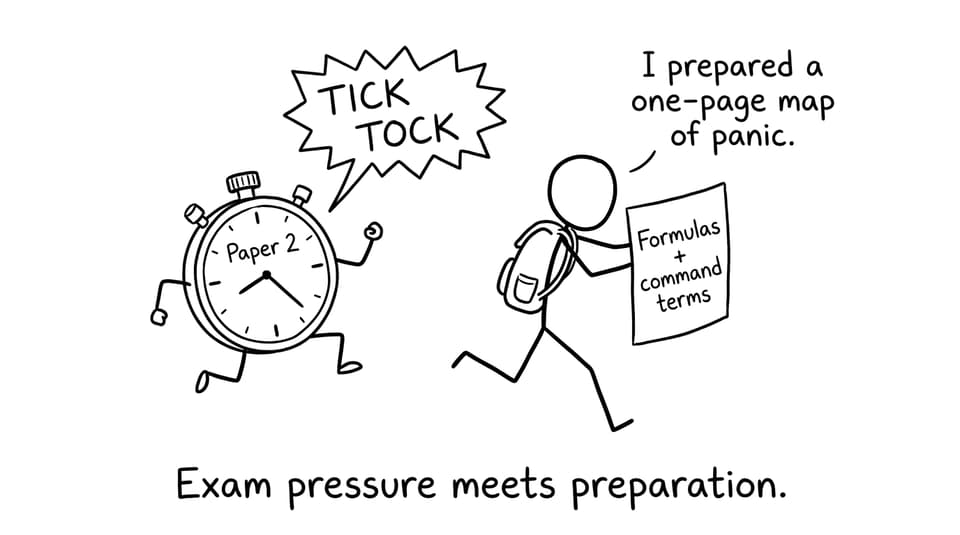
Once cheatsheets make the content lighter, you can spend more energy on performance: timing, interpretation, and mark allocation.
That’s where predicted papers and mock exams matter. For a smart approach, read IB Predicted vs Specimen Papers: What They Mean. (And yes, RevisionDojo supports Predicted Papers and Mock Exams as part of the full prep loop.)
A weekly IB cheatsheet routine you can actually sustain
Here’s a practical schedule that fits real IB life (IAs, deadlines, and all):
Two short sessions (10-15 minutes)
-
Pick one cheatsheet section
-
Read it once, then cover it
-
Write what you remember in messy bullet points
-
Check, correct, and highlight gaps
One practice session (25-40 minutes)
-
Do a focused question set in the Questionbank
-
Mark errors and classify them: content, command term, timing, careless
-
Ask RevisionDojo AI Chat to explain the exact step you missed (fast, specific, no spiraling)
One retention session (7-10 minutes, daily if possible)
-
Review flashcards (especially the ones created from mistakes)
-
Let spaced repetition do the heavy lifting
If you need a broader toolkit, Top Resources for IB Exam Preparation is a useful hub-style read.
Closing: turn IB revision into something calmer
The most effective IB students aren’t the ones who “work the hardest” in a dramatic way. They’re the ones who build a system that stays calm under pressure.
IB cheatsheets help you do that. They shrink the syllabus into something you can hold, practice, and improve. They make memorization faster because they’re built for retrieval. And they reduce stress because they turn revision from a vague fear into a clear routine.
If you want a simple next step, open RevisionDojo Cheatsheets, pick one topic you’re revising this week, and run the loop: cheatsheet overview, recall from memory, then question practice. In the IB, that kind of quiet consistency is a competitive advantage.