Join 650k+ students breezing through the IBReady to breeze through the IB?
Gene duplication sounds like a typo the genome forgot to delete. But in IB Biology, it’s closer to a quiet superpower: evolution gets a spare copy of a gene, and suddenly it can experiment without risking the original.
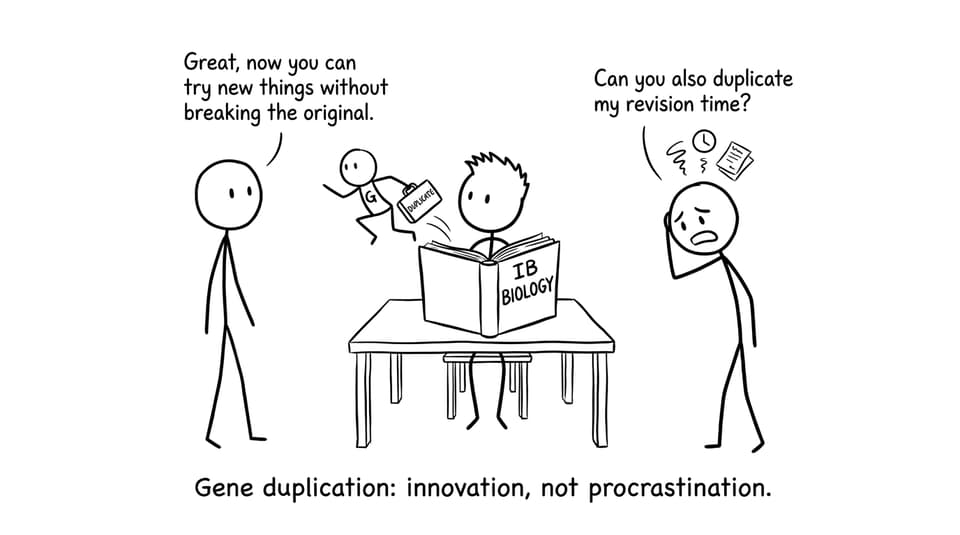
Think about how you revise. You keep one “safe” set of notes you trust, and you make a messy version where you test new diagrams, mnemonic tricks, and practice answers. Gene duplication works the same way. One copy keeps doing the essential job. The other copy becomes a sandbox for change, and sometimes that sandbox turns into an innovation.
Gene duplication comic relief
IB Biology quick checklist: what examiners want
Before you dive into examples, make sure you can do these quickly in IB Biology:
Define gene duplication as the creation of an extra copy of a gene (or larger DNA segment)
State common causes: unequal crossing over, replication errors, chromosomal rearrangements
Explain why duplication is “low risk”: the original copy preserves function
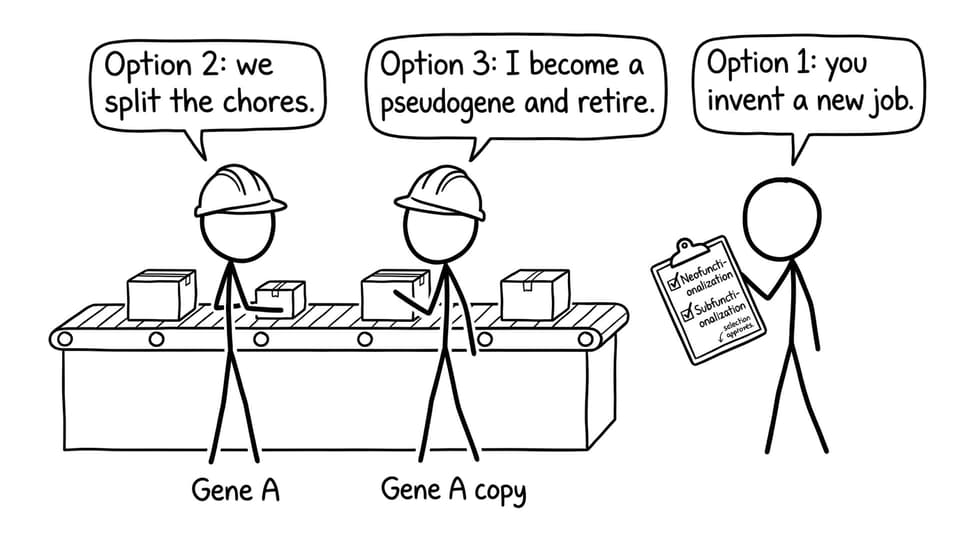
Distinguish three fates: neofunctionalization, subfunctionalization, pseudogene formation
How gene duplication happens (and why it matters in IB Biology)
A duplication event occurs when DNA is copied twice. In IB Biology, you’ll usually describe it at the chromosome level: during meiosis, homologous chromosomes can misalign and undergo unequal crossing over, producing one chromosome with a duplicated segment and the other with a deletion. Duplications can also appear through replication slippage or larger-scale genome rearrangements.
Why is this such a big deal? Because most mutations are risky when they hit an essential gene. Duplication changes the risk profile. With two copies, selection can keep the “working” version while the spare copy accumulates mutations. That creates genetic variation that can be tested by the environment.
The three classic outcomes: innovation, teamwork, or silence
In IB Biology, exam questions often ask what happens to duplicated genes over time. There are three clean pathways you can explain.
Neofunctionalization: the copy finds a new job
This is the headline story. One gene copy maintains the original function. The duplicated copy gains mutations that alter protein structure, regulation, or expression patterns. Over many generations, the copy can take on a new function.
The phrasing that tends to score well is: “duplication provides raw material for evolution because one copy is freed from selective constraint.” It’s the spare tire that gets converted into a whole new wheel design.
Subfunctionalization: the two copies split the workload
Sometimes neither copy becomes “new.” Instead, the original set of functions gets divided between the two copies. For example, one copy might be expressed in one tissue and the other copy in a different tissue, or each might handle part of a regulatory pattern.
In exam language: “both copies are retained because together they cover the ancestral gene’s role.”
Pseudogene formation: the copy drifts into non-function
Not every spare copy becomes brilliant. If the duplicated gene accumulates disruptive mutations and is not maintained by selection, it can become a pseudogene. This is still evolution in action: sometimes variation is tried, and sometimes it quietly disappears.
Gene fates comic relief
Gene families and complexity: why duplication scales up
Zoom out and you see why gene duplication is such a powerful evolutionary force. Repeated duplication events can produce gene families: groups of related genes with similar sequences but specialized functions. Classic examples include hemoglobin-like proteins, olfactory receptors, and immune-related proteins.
This is also where IB Biology connects molecular events to big-picture patterns: more genetic material means more opportunities for specialization, regulation, and adaptation. If you’re revising natural selection alongside this, it pairs nicely with What is natural selection in IB Biology?.
Whole-genome duplication: the plant advantage
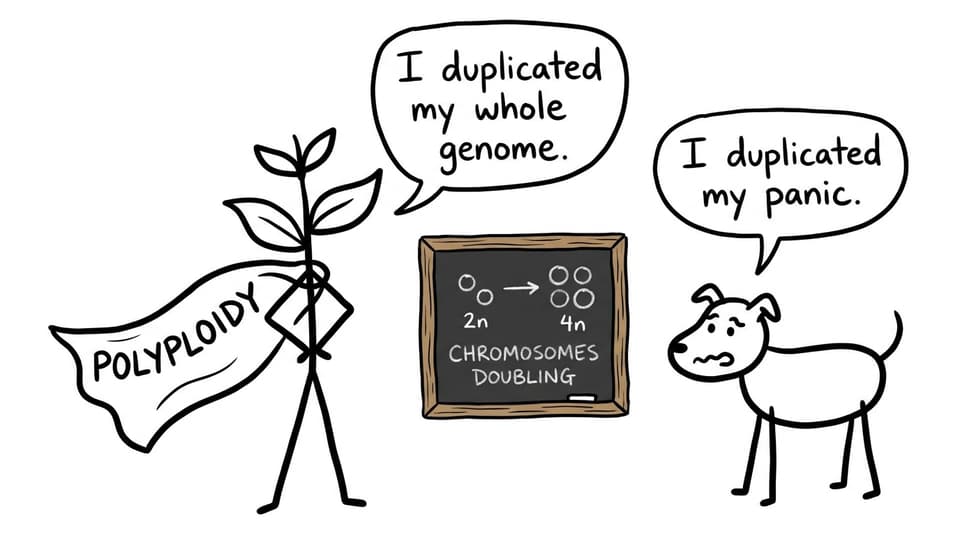
A special case is whole-genome duplication (polyploidy), which is especially common in plants. Instead of copying one gene, the organism temporarily gains extra copies of everything. That creates a huge burst of redundancy, and redundancy creates evolutionary room.
In IB Biology, it’s worth remembering that polyploidy can be tied to abrupt speciation in plants: new chromosome set numbers can create reproductive isolation.
Polyploidy comic relief
How to revise this fast with RevisionDojo
When you’re short on time, you need tight loops: learn, practice, correct, repeat. RevisionDojo is built for that.
If you need the surrounding genetics foundations, reinforce terms using 3.1 Genes Notes.
And when you want to go beyond reading, RevisionDojo’s Flashcards, AI Chat, and Grading tools help you practice explanation-heavy prompts the way examiners mark them. Add Mock Exams, Predicted Papers, the Coursework Library, and Tutors when you need structure and accountability, not just content.
Conclusion: the spare copy that changes everything
Gene duplication is evolution’s way of keeping a backup while trying something risky. That’s why it shows up so often in IB Biology: it connects the small, precise mechanics of DNA to the big story of complexity, adaptation, and new traits.
If you want to turn this topic into marks, build one clear paragraph you can reuse: define duplication, name causes, and explain the three fates. Then test it under pressure with RevisionDojo’s Questionbank, Flashcards, AI Chat, and Mock Exams. In IB Biology, innovation isn’t just what genes do. It’s what you do with your revision.