

Epigenetics is the quiet editor of your DNA.
In IB Biology, you learn that the DNA sequence is a set of instructions. But epigenetics explains something more human: why the same “book” can be read as a comedy in one cell and a tragedy in another. A neuron and a muscle cell share (almost) identical genes, yet they live totally different lives. The difference is not the letters of DNA. It’s which pages get bookmarked, sealed shut, or left open on the desk.
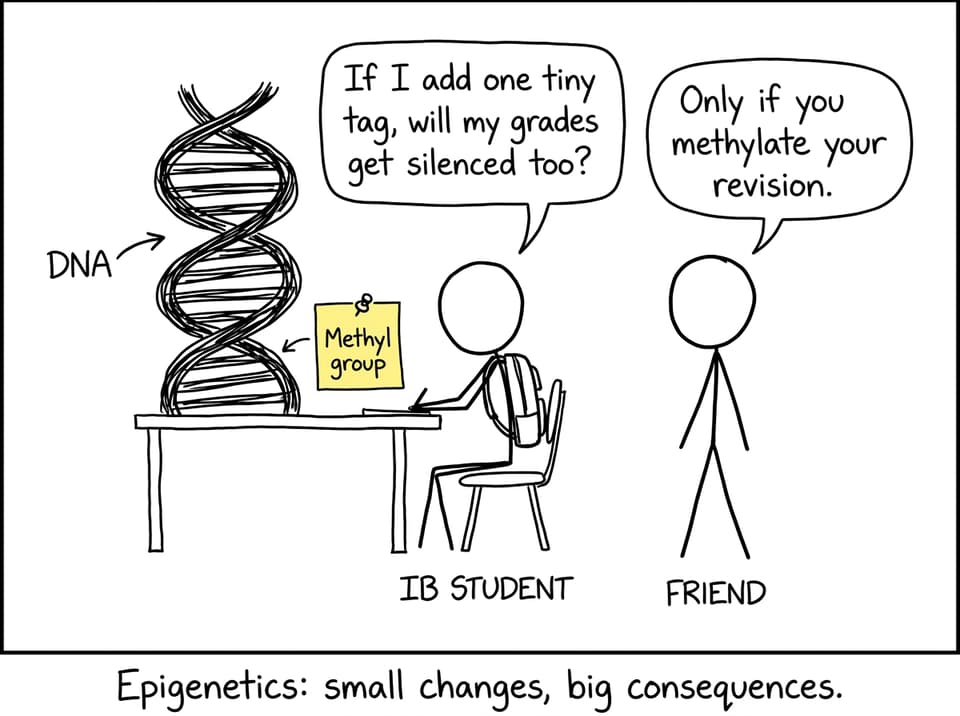
IB Biology epigenetics: the exam-ready definition
Epigenetics is the regulation of gene expression without changing the DNA base sequence. Instead, cells alter DNA accessibility and the likelihood that RNA polymerase and transcription factors can reach promoters.
Keep this quick checklist in your head for IB Biology questions on epigenetics:
-
DNA methylation usually reduces transcription (gene silencing)
-
Histone acetylation usually increases transcription (open chromatin)
-
Histone deacetylation usually reduces transcription (condensed chromatin)
-
Chromatin remodeling shifts nucleosomes to expose or hide regulatory DNA
-
Some marks can be stable through cell divisions, shaping cell identity
If you want a broader frame for how genes get turned on/off, connect epigenetics to How Activators & Repressors Control Genes.
DNA methylation: the “do not read” sticker
In IB Biology, DNA methylation typically means adding a methyl group (CH_3) to cytosine, often at CpG sites. When promoter regions become heavily methylated, transcription factors struggle to bind, and proteins that compact chromatin may be recruited. The practical outcome is simple: the gene is far less likely to be transcribed.
This is why methylation is often linked with long-term silencing, including developmental pathways that must stay off in certain tissues.
To see how this fits into the wider HL gene expression unit, revise alongside D2.2 Gene expression (HL) Notes and then test yourself using the Gene Expression (HL) Questionbank.
Histone modifications: opening and closing the library
DNA wraps around histone proteins to form nucleosomes. In IB Biology, you can think of histone modifications as changing how tightly that DNA is wrapped.
-
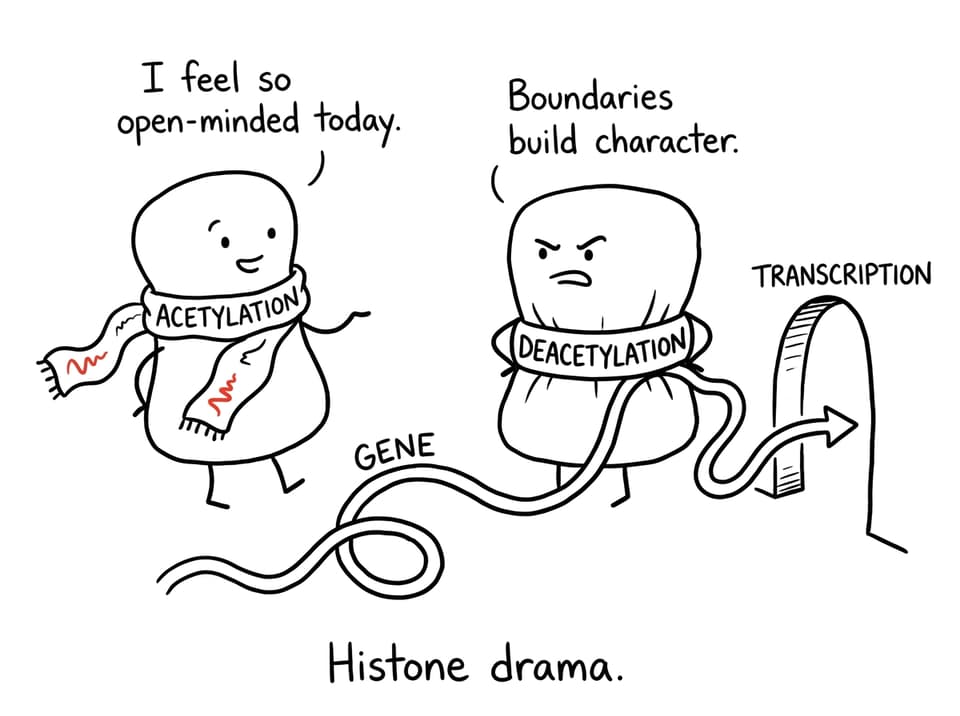
Histone acetylation (adding acetyl groups) reduces the positive charge on histones, loosening DNA binding and making chromatin more open. Transcription becomes more likely.
-
Histone deacetylation tightens packing, making promoters harder to access. Transcription becomes less likely.
-
Histone methylation can either activate or repress depending on which amino acid residue is modified.
When epigenetics feels abstract, anchor it to what you already know about transcription mechanics: How mRNA Processing Prepares for Translation and How mRNA, tRNA, and rRNA Coordinate During Translation.
Chromatin remodeling: moving the furniture
Chromatin remodeling complexes don’t change chemical tags directly. They reposition nucleosomes, sliding them along DNA or restructuring them so that promoters, enhancers, and silencers become exposed or hidden.
This is a powerful IB Biology idea because it explains speed. Methylation can be stable and long-term; remodeling can be more dynamic, helping cells respond quickly to signals.
For syllabus-specific reinforcement, use D2.2.7 Epigenetic inheritance and the related D2.2.9 consequences of incomplete erasure.
Environment and epigenetics: why context matters in IB Biology
A helpful way to remember epigenetics in IB Biology is that it sits between “nature” and “nurture.” Nutrition, stress, toxins, and other environmental factors can influence methylation patterns and histone modifications. That doesn’t mean every stress instantly rewires your genome. It means gene expression is responsive, and the cell has tools to tune output.
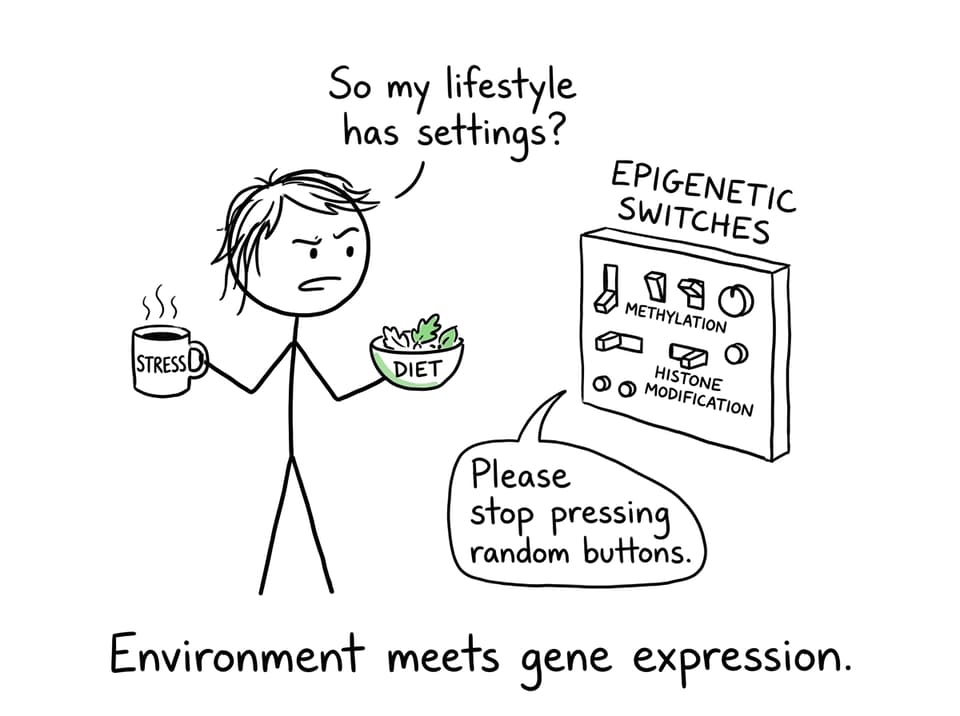
If you’re revising environmental effects, pair this with D2.2.8 environmental effects on gene expression.
Quick exam strategy for IB Biology questions on epigenetics
When an IB Biology prompt asks “explain how epigenetics regulates gene expression,” build a clean chain:
-
Name the mechanism (methylation / histone modification / remodeling)
-
State the chromatin effect (more condensed or more open)
-
Link to transcription access (promoter accessible or blocked)
-
Conclude with expression change (more or less mRNA)
On RevisionDojo, you can train this structure fast: read the notes, then drill with the Questionbank, then turn your weak points into Flashcards. When you get stuck mid-explanation, Jojo AI Chat can help you repair the logic without rewriting the whole topic.
Bring epigenetics back to marks (and calm)
Epigenetics can feel like a hidden layer of biology, but in IB Biology it’s really a pattern: tags and remodeling change chromatin, and chromatin changes transcription. Once you can say that clearly, you can earn marks quickly.
If you want a single system for that clarity-to-marks journey, RevisionDojo connects Study Notes, Flashcards, the Questionbank, AI Chat, Grading tools, Predicted Papers, Mock Exams, the Coursework Library, and Tutors so your revision stays focused, measurable, and calm--especially when exams get close.