



If you want a fast way to spot who really holds influence in the world, don’t start with tanks or speeches. Start with invoices, supply chains, and who can say “yes” or “no” to investment.
In IB Global Politics, economic power is the quiet force that often decides what is possible long before leaders step in front of cameras. It shapes alliances, punishes rivals, rewards cooperation, and sometimes hurts people it claims to protect. Understanding that tension is exactly what pushes an answer into the top markbands.
IB Global Politics quick checklist: economic power in one page
Use this as a quick exam scaffold for IB Global Politics essays and Paper 1 commentary:
-
Define economic power as influence through wealth, production, trade, finance, and resources.
-
Explain at least two tools: trade access, sanctions, aid/investment, or global institutions.
-
Add one concept link: interdependence, sovereignty, legitimacy, or global governance.
-
Evaluate: Who benefits? Who pays the cost? What are the unintended effects?
-
Ground it with a real example, even briefly.
If you want the course concepts laid out clearly, start with RevisionDojo’s IB Global Politics resources and the unit framing in the Paper 2 Guide.
Trade and market access: the world’s most polite pressure
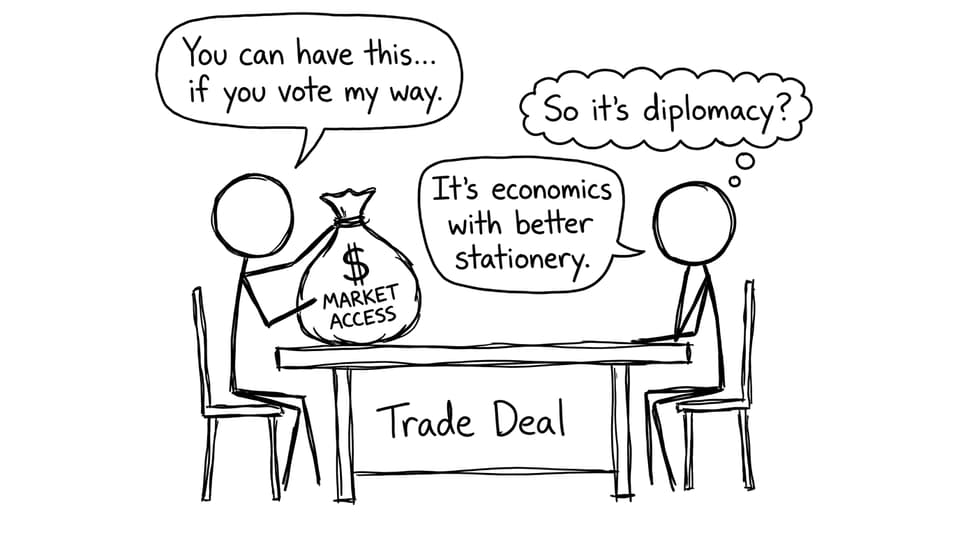
Trade looks cooperative on the surface. But in IB Global Politics, trade is also leverage: access to a large market can act like a reward, and losing that access can act like punishment.
A state (or bloc) with a huge consumer market can shape what others do simply by setting conditions: standards, tariffs, quotas, or rules about strategic goods. The “pressure” doesn’t need to be dramatic. It can be administrative. And that’s why it works.
To build sharper examples, pair politics with the economics mechanism. RevisionDojo’s explainer on how trade barriers affect economies helps you explain consequences like higher prices, retaliation, and uncertainty, then link those effects back to political goals.
Exam move: trade as both cooperation and coercion
A high-scoring IB Global Politics line often sounds like: “Trade increases cooperation through mutual gain, but it also creates asymmetrical dependence that stronger actors can exploit.”
That one sentence shows balance, interdependence, and power dynamics.
Sanctions: influence that can miss its target
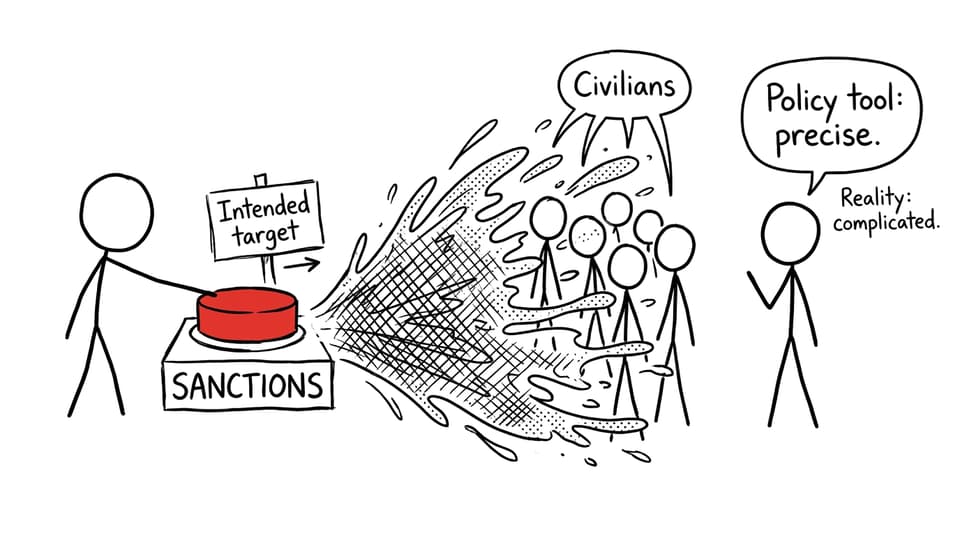
Sanctions are one of the most testable tools of economic power in IB Global Politics because they invite evaluation. They’re often presented as an alternative to military force: less violent, more legitimate, and easier to coordinate with allies.
But sanctions can fail, backfire, or create humanitarian costs. They can strengthen nationalist narratives inside the target state, or shift harm onto civilians and neighbouring economies. That ethical ambiguity is exactly what examiners reward you for discussing.
For a broader lens on how economic shocks and pressure campaigns feed instability, see what geopolitical risks threaten global stability.
Aid, loans, and investment: the power of “help”
Aid and investment can genuinely support development, rebuild after crises, or expand access to health and education. Yet in IB Global Politics, you’re expected to ask the uncomfortable second question: what conditions come with the money?
Loans can shape domestic spending priorities. Development packages can reshape infrastructure choices. Even “neutral” investment can pull a country into a new alignment if its exports, jobs, or debt repayments depend on one external partner.
If you’re doing coursework, RevisionDojo’s IB Global Politics coursework exemplars can help you see how strong students connect economic relationships to political outcomes without drifting into pure economics.
Global institutions and structural economic power
Not all economic power looks like a policy decision. Some of it is structural: rules, voting shares, and agenda-setting within international institutions and financial systems.
In IB Global Politics, this matters because it helps you explain why outcomes can look “normal” even when they reproduce inequality. Who writes the rules? Who can access credit cheaply? Who gets believed by markets? Those patterns shape what governments can do at home, which is ultimately a story about sovereignty.
To strengthen your conceptual vocabulary, keep the IB Global Politics glossary open while you revise.
How to turn this into marks on exam day
A lot of students understand economic power but underperform because they don’t practise applying it under time pressure.
Use RevisionDojo like a training loop:
-
Build fluency with the Power unit notes and the targeted Power Questionbank.
-
Practise the interdependence angle with the Interdependence Questionbank.
-
For overall structure and habits, follow how to revise effectively for IB Global Politics.
RevisionDojo’s Questionbank, Study Notes, Flashcards, AI Chat, and Grading tools are most powerful when you use them together: learn the concept, apply it to an unseen question, get feedback, then tighten your evaluation.
Conclusion: the quiet force you can actually write about
Economic power shapes global politics because it sits inside everyday life: what a country can buy, sell, borrow, build, and deny. For IB Global Politics, your job is to show how trade, sanctions, aid, and institutions turn money into influence, and to evaluate who gains, who loses, and why.
If you want to turn that understanding into exam marks, use RevisionDojo’s Questionbank, Predicted Papers, Mock Exams, AI Chat, Flashcards, and Tutors to practise the same skill repeatedly: clear definition, real-world application, and calm evaluation under time pressure.