




In IB Global Politics, legitimacy can feel like a strange currency: you can control territory, command a military, and still struggle to be treated as “real” by the outside world. It’s the difference between speaking in a room and being heard in that room. International legitimacy is that permission slip (not always fair, not always consistent, but often decisive) when aid, treaties, and cooperation are on the line.
International legitimacy means other states and international institutions accept a government as the rightful authority of a country. In IB Global Politics, this concept sits quietly behind diplomacy, sanctions, intervention debates, and global governance. It also shows up in exam questions because legitimacy is rarely permanent; it is earned, signaled, challenged, and sometimes withdrawn.
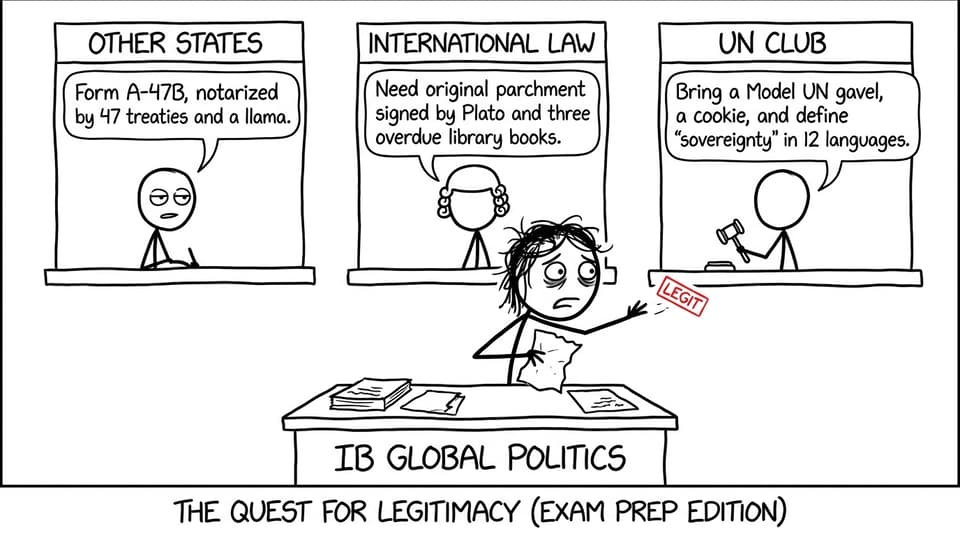
Quick checklist: the main routes to international legitimacy
-
Diplomatic recognition by other states
-
Compliance with international law and widely accepted norms
-
Membership and participation in international institutions
-
Credible domestic political processes (especially elections and constitutional rule)
-
Performance: stability, security, and effective governance
If you want a structured place to practise how legitimacy appears in exam prompts, start with RevisionDojo’s Legitimacy Questionbank for IB Global Politics.
Diplomatic recognition: the “you exist to us” moment
In IB Global Politics, diplomatic recognition is often the first mechanism students think of because it’s formal and visible. When other states recognise a government, they accept it as the official representative of that country. That recognition unlocks practical outcomes: embassies, treaties, official visits, and the right to sit at negotiating tables.
Recognition becomes especially contested after revolutions, coups, regime collapse, or disputed elections. In those moments, legitimacy is not just about who holds power domestically, but who the international community is willing to treat as the lawful authority. For a broader conceptual frame, RevisionDojo’s IB Global Politics resources hub helps you connect legitimacy to sovereignty and international relations.
International law and norms: legitimacy as reputation
A government can gain international legitimacy by aligning itself with international law and global norms, especially around human rights and the rule of law. In IB Global Politics, this is where students can add evaluation: states talk about norms, but they also interpret them strategically.
Compliance signals predictability. Signing treaties, allowing monitoring, cooperating with courts, and limiting unlawful force can all build legitimacy over time. Violations can do the opposite: they may not remove a government from power, but they can restrict its ability to partner, trade, and lead.
To strengthen this angle, link legitimacy to human rights debates using What Are Human Rights in Global Politics? and the tension with sovereignty using What Is Sovereignty in Global Politics?.

International institutions: legitimacy through membership and participation
Membership in international institutions can convert recognition into something sturdier: routine participation. In IB Global Politics, institutions matter because they create venues where legitimacy becomes normalised: votes, speeches, committees, agreements, and shared rules.
Even without “perfect” domestic politics, a government may gain legitimacy by showing up consistently, complying with procedures, and contributing to collective problem-solving. Conversely, exclusion, suspension, or consistent obstruction can signal contested legitimacy.
For quick institution definitions and exam-ready phrasing, see Intergovernmental Organizations (IGOs) notes.
Domestic processes: when internal legitimacy spills outward
International legitimacy is not purely external. In IB Global Politics, examiners reward students who show how domestic legitimacy and international legitimacy overlap. Transparent elections, constitutional transitions, and accountable institutions make it easier for other states to justify recognition and cooperation.
But avoid simple claims like “democracies are always more legitimate.” Sometimes, states prioritise stability, regional security, or economic ties. The high-scoring move is to show that legitimacy is both normative (values-based) and pragmatic (interest-based). For theory framing, RevisionDojo’s Theoretical Foundations in IB Global Politics is a useful bridge.

Performance and stability: legitimacy earned by outcomes
A final pathway is performance: providing security, basic services, economic stability, and predictable governance. In IB Global Politics, this is where students can show nuance. Some governments gain international legitimacy not because the world loves their ideology, but because the alternative looks like chaos.
Performance-based legitimacy is also fragile. A crisis can flip narratives fast: instability can trigger sanctions, reduced cooperation, or rival recognition claims.
Closing: how to use this in exam answers
International legitimacy in IB Global Politics is best treated as a moving target: recognition, norms, institutions, domestic processes, and performance all interact. When you write, aim for layered analysis rather than a single-cause explanation. A simple structure is: define legitimacy, explain two mechanisms, then evaluate why states sometimes prioritise principles and sometimes prioritise interests.
To turn this into marks quickly, use RevisionDojo as your routine: revise with Study Notes and Flashcards, practise with the Questionbank, pressure-test your timing with Mock Exams and Predicted Papers, and refine evaluation using AI Chat and Grading tools. When legitimacy shows up in a prompt, you won’t just describe it, but you’ll explain how governments gain it, how they lose it, and why the world’s approval is never purely neutral.