



When one event becomes a crowd
In IB Physics, a chain reaction is one of those ideas that feels almost unfair: one tiny nuclear event can snowball into an energy output that dwarfs everyday chemical reactions. It is not just that energy is released; it is that the ability to keep releasing energy multiplies with every successful step.
That is the heart of energy amplification: each reaction creates the conditions for more reactions, and the total energy grows faster than your intuition expects.
Quick checklist: what to say in an exam “Explain” question
Use this mini-structure any time IB Physics asks about chain reactions and energy amplification:
-
Define fission as a heavy nucleus splitting (e.g., U-235 or Pu-239).
-
State that fission releases energy and free neutrons.
-
Explain that neutrons can trigger further fissions in nearby nuclei.
-
Introduce the neutron multiplication factor (often written as k).
-
Link k to outcomes: dying out (k < 1), steady (k = 1), runaway (k > 1).
-
Add one line on control rods absorbing neutrons to keep k near 1 in reactors.
For the syllabus-aligned version, use RevisionDojo’s E.4 Fission hub and the linked notes.
How a fission chain reaction amplifies energy
In IB Physics, the “amplification” is not magic. It is bookkeeping.
A single fission event releases energy (mostly as kinetic energy of the fission fragments, plus gamma radiation) and typically emits multiple neutrons. Those neutrons fly off and may be absorbed by other fissile nuclei. If absorption causes new fission events, each of those events releases more energy and more neutrons, which can trigger more fissions again.
So the total energy is not simply one reaction plus another plus another. Instead, the number of reactions can grow rapidly because the triggers (neutrons) are reproduced.
To lock this down with syllabus language, RevisionDojo’s E.4 Fission notes walk through the mechanism clearly.
The neutron multiplication factor (k): the lever behind the amplification
The cleanest exam explanation in IB Physics uses the neutron multiplication factor, k, the average number of neutrons from each fission that go on to cause another fission.
-
If k < 1, too many neutrons escape or get absorbed without causing fission. The chain reaction fades.
-
If k = 1, the system is critical: one generation of fissions leads to exactly one more generation. Energy output is steady (reactor behavior).
-
If k > 1, the number of fissions grows each generation. Energy release rises extremely fast.
This is why chain reactions illustrate energy amplification so well: k determines whether energy output stays calm, dwindles, or accelerates.
Why neutrons matter (and why charge gets in the way)
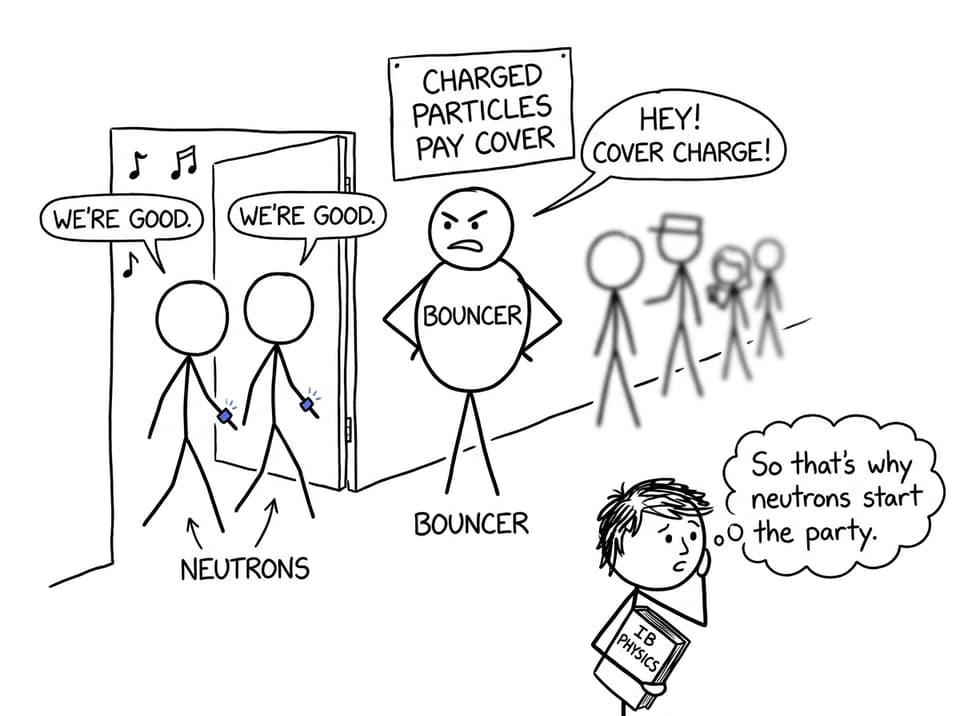
A common IB Physics question is why neutrons are the key drivers of chain reactions.
Neutrons have no electric charge, so they are not repelled by the positively charged nucleus. That makes it much easier for them to enter the nucleus and be absorbed, compared to protons or alpha particles which face Coulomb repulsion.
If you want practice wording that matches exam style, do a timed set in RevisionDojo’s E.4 Fission Questionbank and compare your explanations to the markscheme logic.
Controlled amplification: why reactors don’t “run away”
In IB Physics, controlled chain reactions are basically a story about neutron management.
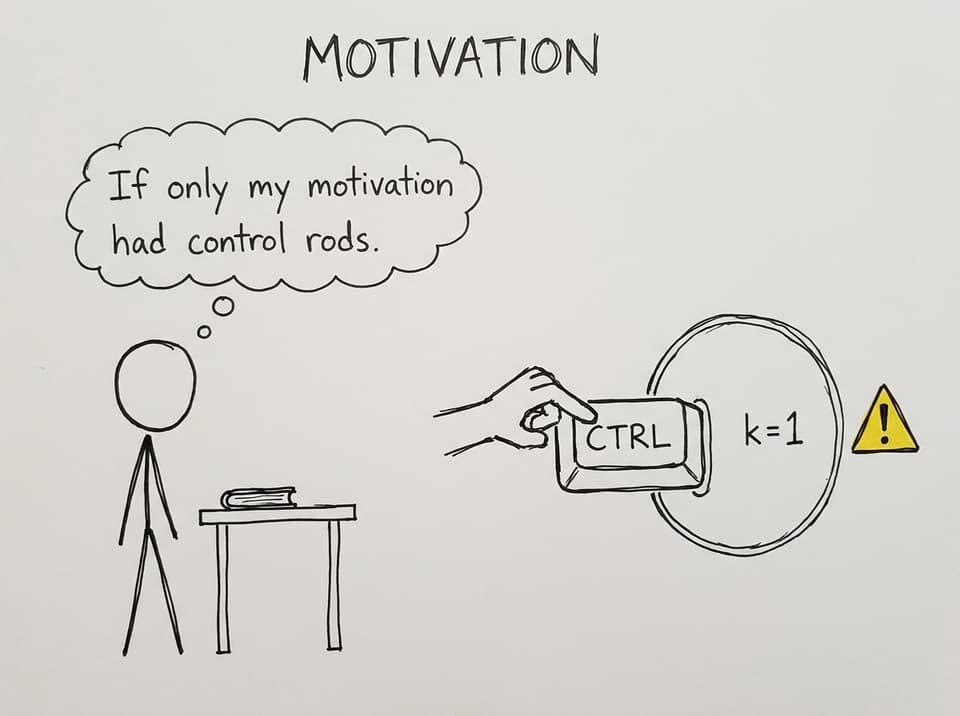
A reactor aims for k = 1, so energy is produced continuously but not explosively. Control rods (made of neutron-absorbing materials such as boron or cadmium) can be inserted further to absorb more neutrons and reduce k, or withdrawn to allow more neutrons to cause fission and increase k.
Moderators also matter because many fissile nuclei are more likely to undergo fission with slower neutrons, improving the probability that a neutron actually triggers the next event.
RevisionDojo’s Nuclear reactors notes (E.4.2) summarize these roles in exam-ready detail.
How to revise this fast with RevisionDojo
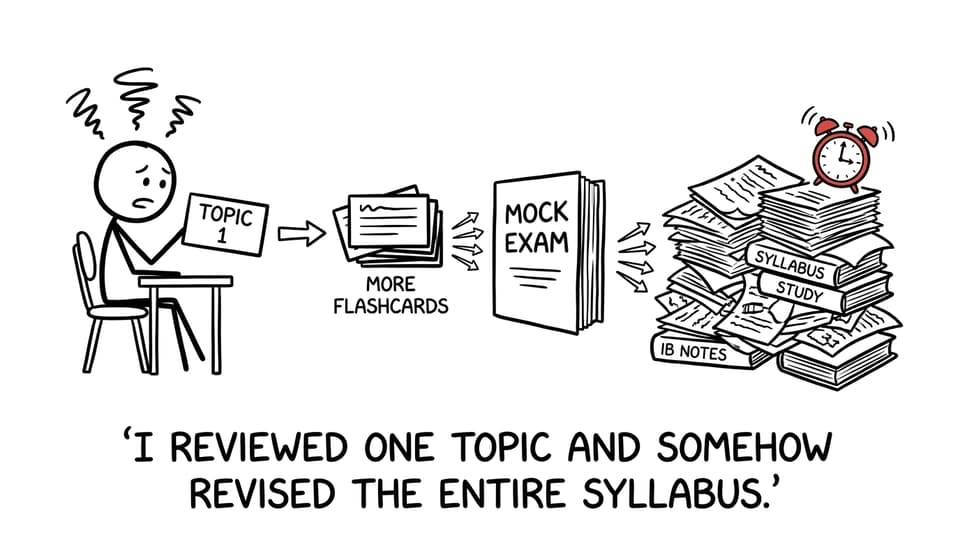
To make this chain-reaction explanation automatic in IB Physics, use a tight loop:
-
Read the relevant section in the Topic E hub.
-
Drill definitions and “what does k mean?” using RevisionDojo Flashcards.
-
Apply under pressure with the Questionbank.
-
Then do a short timed review session using the broader study workflow from How to Study for IB Exams.
If you want a bigger-picture strategy (and fewer last-minute panics), the IBO Physics success guide is a solid map.
Bringing it home: one concept, many marks
Chain reactions illustrate energy amplification in IB Physics because fission events reproduce the very particles (neutrons) that trigger further fission. Once you can explain k and connect it to controlled vs runaway behavior, you have a high-scoring, reusable explanation.
To turn that understanding into exam performance, revise it the RevisionDojo way: Study Notes for clarity, Flashcards for recall, Questionbank for application, and timed Mock Exams to make it stick. Start with the IB Physics resources hub and build momentum the safe way, one well-controlled chain reaction at a time.