



In IB Physics, the greenhouse effect can feel like one of those topics everyone “knows” until a question asks why some gases matter more than others. You picture sunlight, a warm planet, and an atmosphere acting like a blanket. But the real story is subtler: it is less about “trapping heat” and more about changing the path radiation takes on its way back to space.
If you can explain that calmly, with the right keywords and one clean diagram in your head, you are already writing top-band answers.
The IB Physics snapshot: what to say in 20 seconds
Here is a quick checklist you can memorise for IB Physics short-answer questions:
-
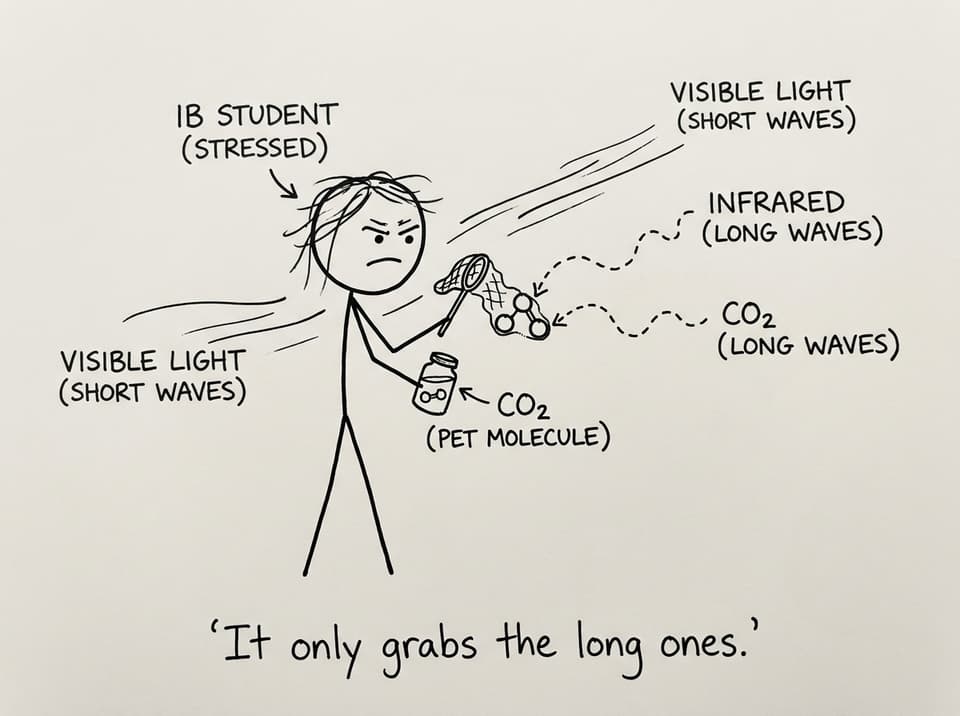
Sun emits mostly short-wave radiation (visible/UV) that largely passes through the atmosphere.
-
Earth’s surface absorbs energy and warms, then emits long-wave infrared (IR) radiation.
-
Greenhouse gases (H₂O, CO₂, CH₄, etc.) absorb some outgoing IR because of their molecular vibration/rotation modes.
-
They re-emit IR in all directions; some returns downward, increasing the energy arriving at the surface.
-
Net effect: slower energy loss to space, so a higher equilibrium surface temperature.
For the syllabus-aligned version (with the exact phrasing examiners like), use IB Physics B.2 Greenhouse Effect.
Why only certain gases absorb infrared (the part examiners love)
In IB Physics, the key word is interaction. An IR photon will only be strongly absorbed if its frequency matches a molecule’s allowed vibrational or rotational modes (often discussed as resonance).
-
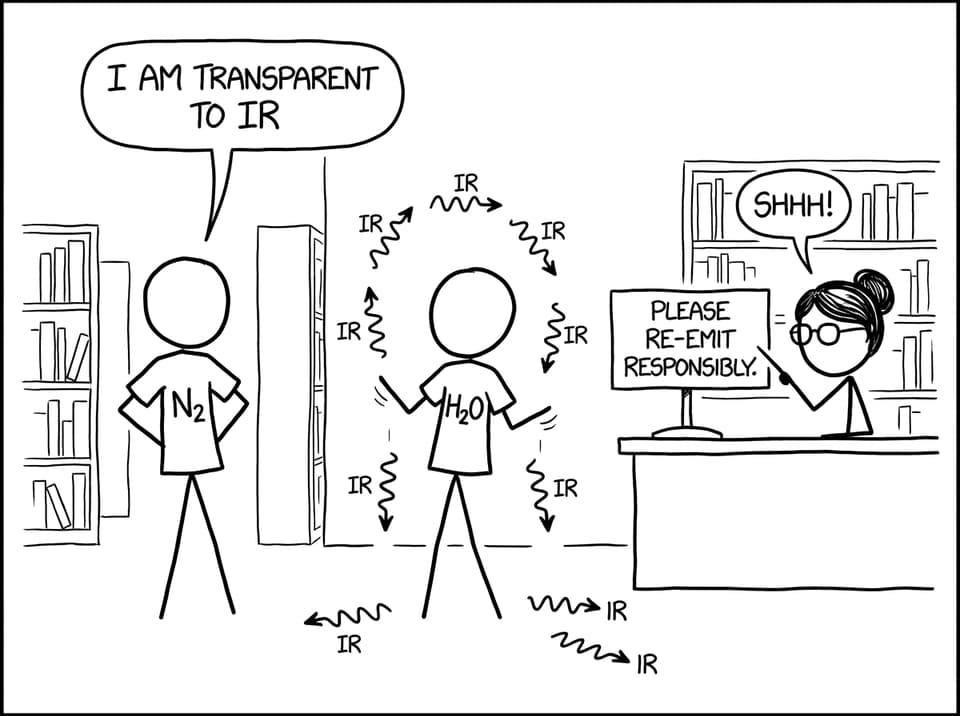
Molecules like N₂ and O₂ are symmetric and do not get a changing dipole moment in the right way when they vibrate, so they barely absorb Earth’s IR.
-
Molecules like CO₂ and H₂O have modes that do interact with IR, so they absorb specific bands strongly.
This is why tiny concentrations can matter: greenhouse gases “cover” parts of the infrared spectrum that the dominant gases ignore.
To sharpen your definitions (absorption spectrum, radiation, resonance), revise with IB Physics Key Definitions.
Absorption, collisions, re-emission: the three-step microscopic loop
A high-scoring IB Physics explanation usually includes at least two of these mechanisms:
Absorption
Greenhouse gas molecules absorb outgoing long-wave IR, moving into a higher energy rotational/vibrational state.
Collisions (thermalisation)
Excited molecules collide with other air molecules, sharing energy. This increases the average kinetic energy of the surrounding gas, i.e., it warms the lower atmosphere.
Re-emission
The molecule can also emit IR photons later. Crucially, emission is in random directions. Some photons head upward toward space; some head downward toward the surface.
If you want extra practice turning this into exam wording, use the B.2 Greenhouse Effect Questionbank and check your phrasing against mark-scheme logic.
The “blanket” analogy, corrected for IB Physics
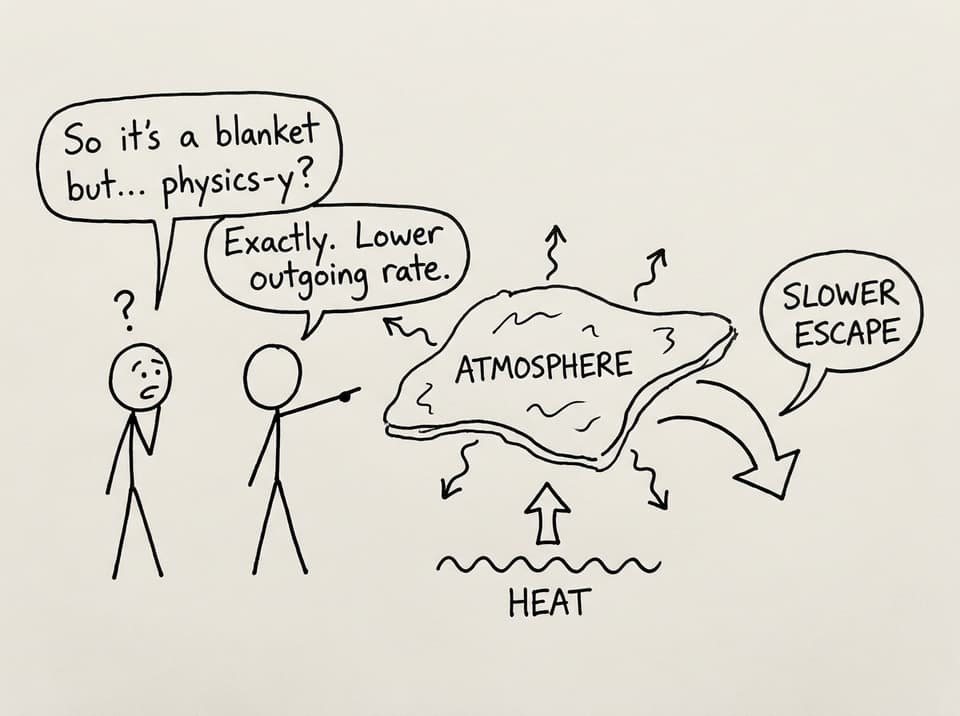
A blanket works mainly by reducing convection. The atmosphere is different. In IB Physics, the atmosphere “warms” the surface because greenhouse gases reduce the rate at which Earth can lose energy by radiation.
Earth still loses energy overall (otherwise temperature would rise forever), but the effective pathway to space becomes longer and more complex.
RevisionDojo’s explanation pairs well with this framing: Why Does Absorption and Re-Emission of Infrared Matter?
Exam tip: link it to energy balance (without overcomplicating)
If a question hints at equilibrium, you can name-drop the idea: incoming solar power (after albedo) balances outgoing IR. With more greenhouse absorption and re-emission, the surface must reach a higher temperature so that outgoing radiation to space matches incoming again.
To connect this to the wider Topic B toolkit, see Lessons for Topic B: The Particulate Nature of Matter and the broader hub IB Physics Resources.
Bring it home with RevisionDojo
This is the kind of IB Physics topic that improves fastest when you cycle: read a clear explanation, practise questions, then tighten your wording. On RevisionDojo, you can do that loop using Study Notes, Flashcards, the Questionbank, and AI Chat to fix weak explanations. If you want to go further, the platform’s Mock Exams, Predicted Papers, and Grading tools help you train under time pressure, and Tutors can quickly diagnose why a “correct idea” is still losing marks.
When you can explain how atmospheric gases interact with radiation to warm Earth in two calm paragraphs, you are not just revising climate physics; you are practising the exact clarity IB Physics rewards.