
A quiet moment that shows why this matters (IB Physics)
You know that feeling when you step outside at night and the air seems to “hold” the day’s warmth a little longer than you expected? Nothing looks different. The sky is still the sky. Yet the cooling rate changes.
That subtle difference is the whole point of IB Physics when you study absorption and re-emission of infrared (IR). It’s not just climate trivia. It’s a clean, exam-friendly story about energy pathways: how radiation leaves a surface, how gases interact with it, and why the route energy takes matters as much as the amount.
The exam checklist (memorise this)
For IB Physics short answers, keep it simple:
-
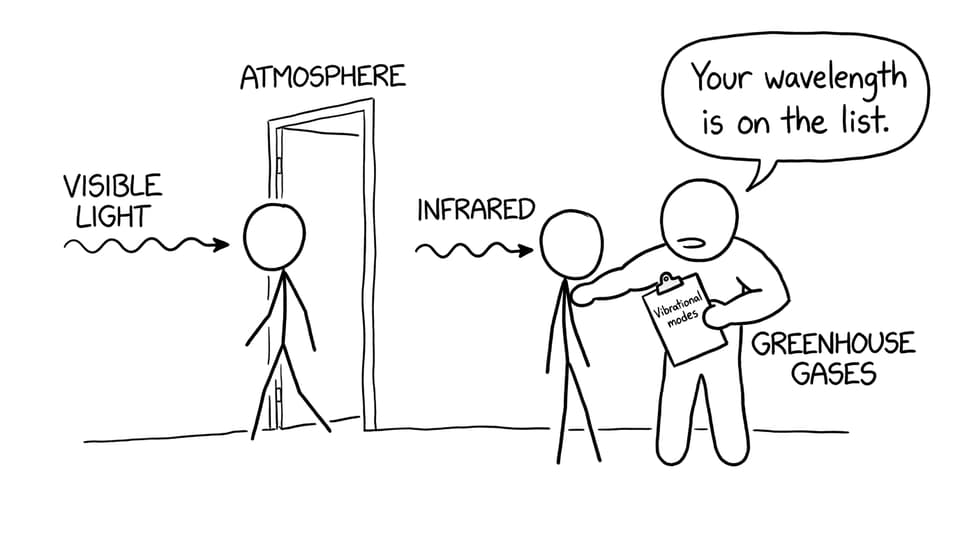
Sunlight arrives mostly as short-wave radiation (visible/UV) and largely passes through the atmosphere.
-
Earth’s surface absorbs energy, warms up, and emits long-wave infrared radiation.
-
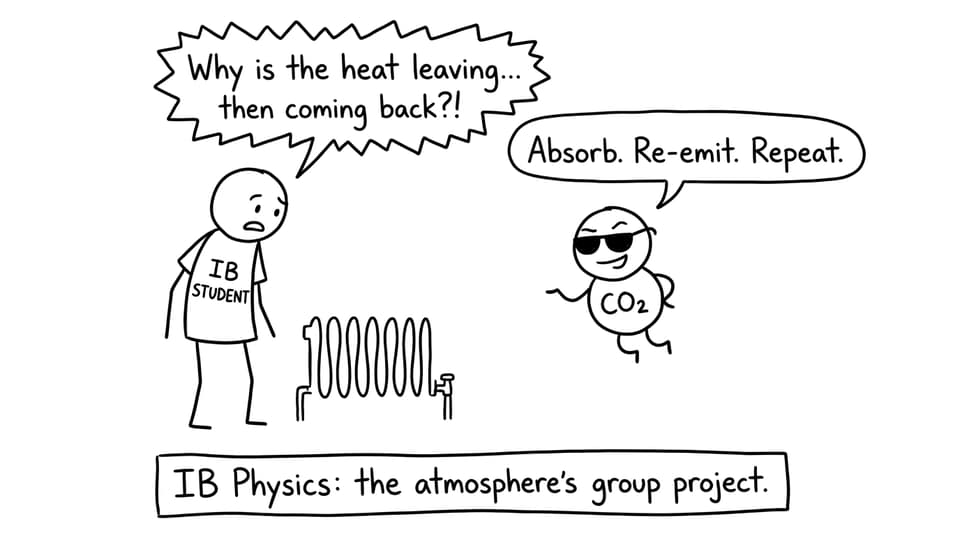
Greenhouse gases (CO₂, H₂O, CH₄, etc.) absorb some outgoing IR because their vibrational/rotational modes match IR frequencies.
-
They then re-emit IR in all directions.
-
Net effect: energy escapes to space more slowly, so the equilibrium surface temperature is higher.
If you want the syllabus-aligned version of this flow, use B.2 Greenhouse effect - IB Physics.
Why absorption of infrared is a big deal in IB Physics
Absorption is the “gate” in the story. If the gate doesn’t exist, the rest of the mechanism can’t happen.
In IB Physics, the key word is interaction: an IR photon is absorbed when its frequency matches allowed molecular vibration/rotation modes that create a changing dipole moment. That’s why symmetric diatomic molecules like N₂ and O₂ barely absorb Earth’s IR, while gases like CO₂ and H₂O do.
When greenhouse gases absorb IR, the atmosphere becomes part of the radiative transfer problem. Outgoing radiation is no longer just a straight path from surface to space. It becomes a detour with extra steps.
For a deeper dive that reads like an examiner’s model answer, see How atmospheric gases interact with radiation to warm Earth.
Why re-emission changes everything (it’s a delay mechanism)
After absorption, the molecule doesn’t store energy forever. It redistributes it.
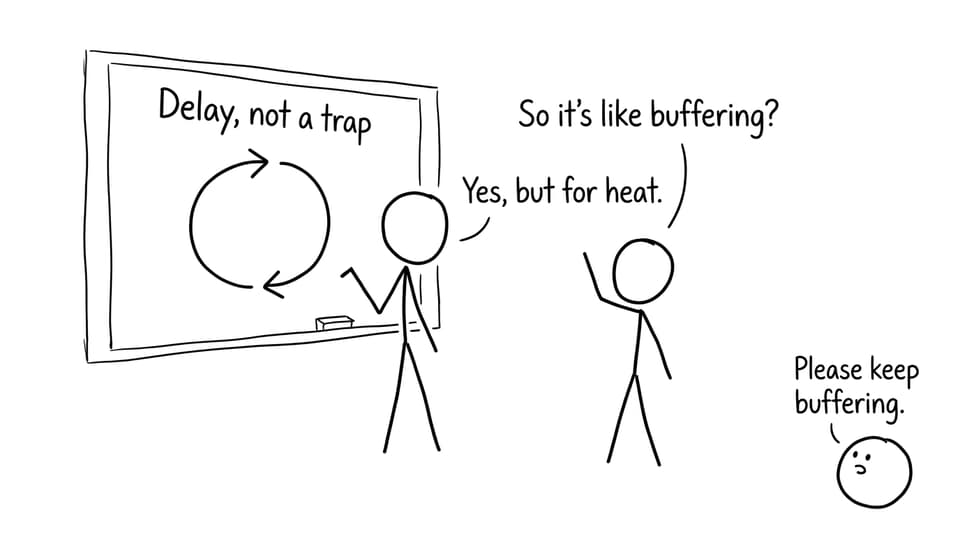
Re-emission happens in random directions. Some photons continue upward and eventually escape. But some are sent back downward, increasing the infrared radiation reaching the surface and lower atmosphere.
This is why the greenhouse effect is better described as a delay than a “trap.” In IB Physics, that phrasing helps you avoid sloppy explanations. The energy still leaves. It just takes a longer, more complicated route to get out.
This idea connects neatly to energy balance and radiation laws. If you need a refresher on radiation as a transfer mechanism, use 8.2: Thermal energy transfer Notes.
What this means for temperatures (and why small changes matter)
Because absorption and re-emission affect the step that controls outgoing IR, even small concentration changes in greenhouse gases can shift the balance between incoming solar power and outgoing thermal radiation.
That sensitivity is exactly why this topic shows up in IB Physics questions about equilibrium temperature, albedo, and the Stefan-Boltzmann law. RevisionDojo’s B.2 Greenhouse effect notes are a good place to connect the qualitative story to equations.
To practise how examiners frame this, try IB Physics B.2 Greenhouse Effect Questionbank.
Bring it home: how to score on this in IB Physics
If you can explain absorption plus re-emission as a change in the pathway of outgoing infrared, you can handle most IB Physics questions on the greenhouse effect.
To tighten your exam technique, use IB Physics Revision Notes (SL/HL) for quick theory, then lock it in with practice from IB Physics B.1 Thermal Energy Transfers Questionbank and B.2 question sets.
RevisionDojo is built for this exact moment: when concepts feel “obvious” in a paragraph, but slippery under timed conditions. Between the Questionbank, Study Notes, Flashcards, AI Chat, Grading tools, Predicted Papers, Mock Exams, Coursework Library, and Tutors, you get both understanding and the reps that make IB Physics answers dependable.