
Global warming potential is one of those IB Chemistry ideas that feels simple until you see a question that asks you to compare gases across time, justify policy choices, and avoid three classic traps at once. It is not hard because the definition is complicated. It is hard because it forces you to think like a scientist who also has to think like a decision-maker.
In other words: it is very IB Chemistry.
Global warming potential (GWP): the definition you actually need
In IB Chemistry, global warming potential (GWP) compares the warming effect of different greenhouse gases using a shared reference point.
Global warming potential is the amount of heat trapped by a given mass of a gas, relative to the same mass of carbon dioxide (CO₂), over a specified time period.
By definition:
-
CO₂ has GWP = 1
-
If a gas has GWP = 25, then 1 kg of that gas causes 25 times the warming of 1 kg of CO₂ (over the stated time horizon)
That “time horizon” detail is not decorative. It is where exam questions often live.
Quick exam checklist for IB Chemistry students
Use this mini-checklist when GWP appears in IB Chemistry:
-
Identify the baseline: CO₂ = 1
-
Check the time period: 20-year vs 100-year vs 500-year
-
Explain GWP using three factors (not just one)
-
Compare gases using both potency and amount emitted
-
Link to real decisions: regulation, industry, modeling
If you want a syllabus-aligned place to drill this skill, the RevisionDojo IB Chemistry hub is built around that exact loop: Study Notes for clarity, Flashcards for recall, then Questionbank to make it automatic under pressure.
Why global warming potential matters in IB Chemistry
GWP matters in IB Chemistry because it turns “greenhouse gases cause warming” into a quantitative comparison. Not all gases behave the same way in the atmosphere.
GWP helps scientists and governments:
-
Compare emissions across different gases using a common unit
-
Set targets and design climate policies
-
Prioritize gases that create the biggest warming effect per unit mass
It also helps you earn marks, because examiners love when you can explain why CO₂ is still the focus even though other gases have higher GWP.
To connect GWP to the bigger picture, pair it with the mechanism in Greenhouse Effect Explained.
The three factors that control global warming potential
In IB Chemistry, you can usually explain a gas’s GWP by combining three ideas. The trick is to name all three, then apply them.
Infrared absorption efficiency
Greenhouse gases warm the planet because they absorb infrared (IR) radiation emitted by Earth’s surface.
Some gases (like methane, CH₄, and nitrous oxide, N₂O) absorb IR more effectively than CO₂. Stronger absorption generally pushes GWP up.
Atmospheric lifetime
A gas that stays in the atmosphere for longer can keep influencing Earth’s energy balance.
Approximate lifetimes you may see referenced:
-
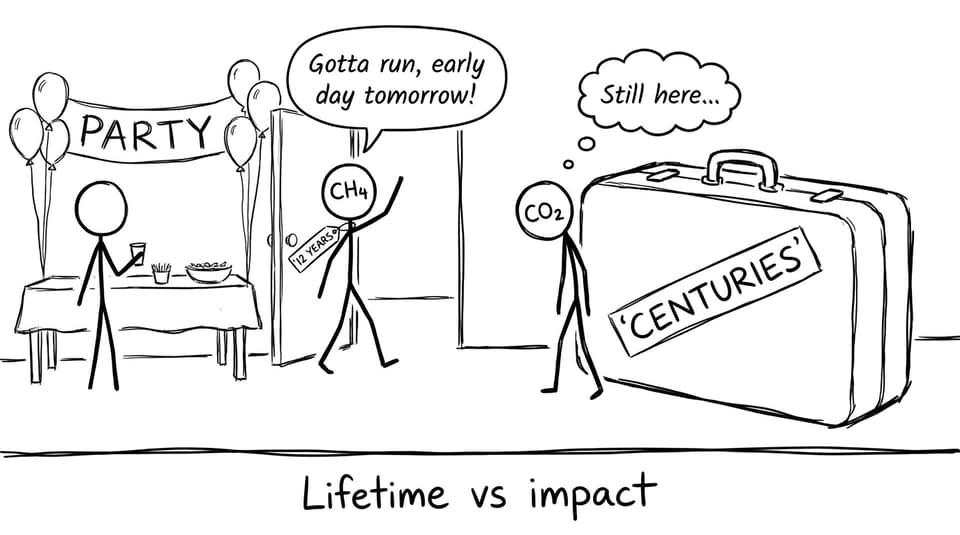
CH₄: about 12 years
-
N₂O: about 120 years
-
CO₂: variable, but effectively decades to centuries
-
Many fluorinated gases: hundreds to thousands of years
Radiative forcing (overall warming influence)
Radiative forcing is the change in Earth’s energy balance caused by a factor (like greenhouse gases). A gas that produces a stronger energy imbalance contributes more to warming.
In IB Chemistry, you do not usually need to calculate radiative forcing, but you do need to show you understand that GWP blends how strongly a gas warms and how long it stays.
Typical GWP values you should recognize
For IB Chemistry exam context, you only need approximate, order-of-magnitude familiarity (always tied to a time period, often 100 years).
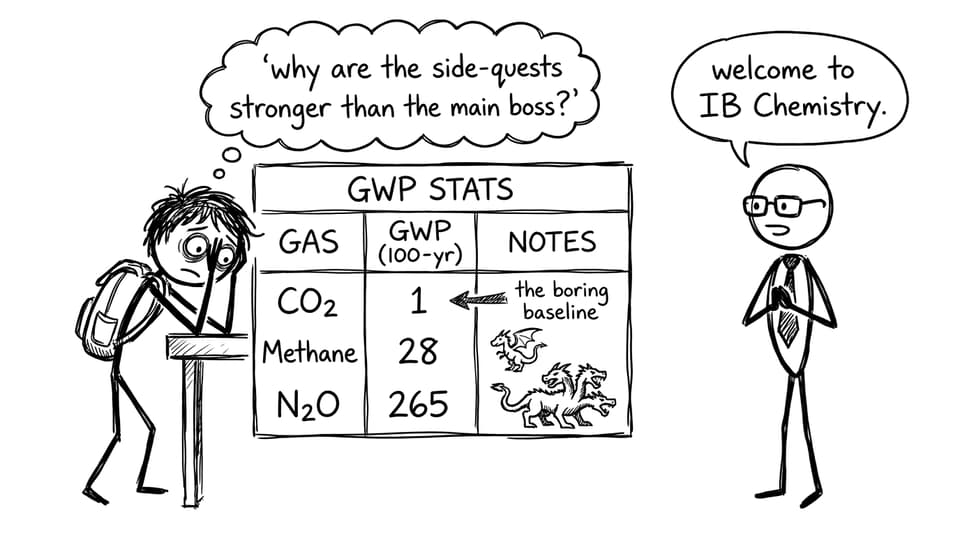
Approximate 100-year GWP values (CO₂ = 1):
-
CO₂: 1
-
CH₄ (methane): ~28
-
N₂O (nitrous oxide): ~265
-
O₃ (tropospheric ozone): variable
-
CFCs/HFCs (fluorinated gases): often 1,000 to 10,000+
If you want an adjacent, highly testable example of methane’s role, see Methane (HL) Notes.
GWP20 vs GWP100: why the time window changes the story
A powerful IB Chemistry insight: the same gas can look “worse” or “less bad” depending on the chosen time horizon.
Methane is the classic example:
-
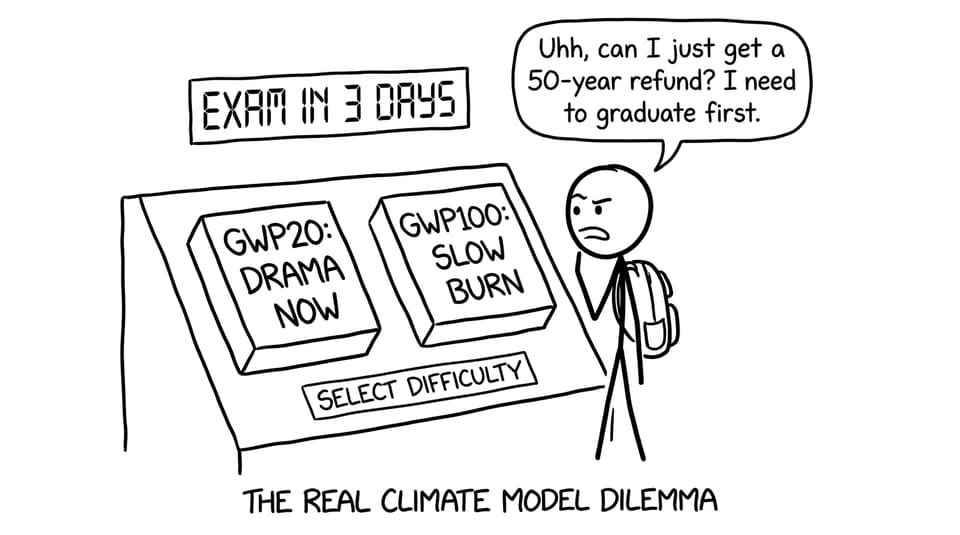
GWP20 ≈ 84
-
GWP100 ≈ 28
Methane hits hard in the short term because it is a strong IR absorber, but it breaks down relatively quickly compared with CO₂.
Why CO₂ is still the main focus (even with GWP = 1)
Students sometimes think a low GWP means “not important.” In IB Chemistry, that is exactly backwards.
CO₂ remains central because:
-
Humans emit it in huge quantities
-
It persists for a very long time (parts of it effectively for centuries)
-
Emissions are continuous and globally widespread
-
It drives long-term warming trends even if other gases are more potent per kg
To tie this into what you already study, link CO₂ discussions to combustion topics like Incomplete Combustion Notes and energy sources like Fossil Fuels Notes.
Common IB Chemistry misconceptions (and how to phrase the correction)
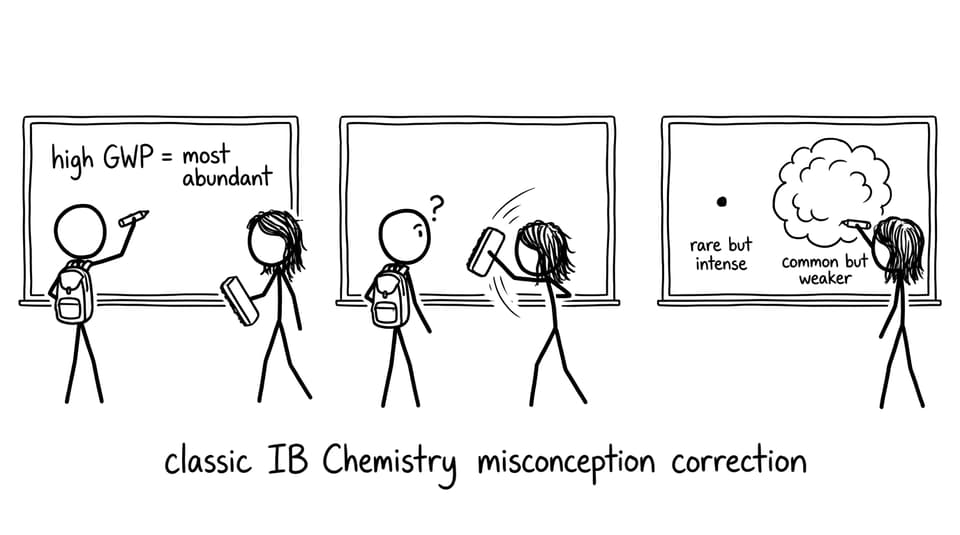
“Higher GWP means the gas is more common.”
Not necessarily. Some gases have extremely high GWP but exist in tiny concentrations. In exam wording: GWP measures warming impact per mass, not abundance.
“CO₂ is the strongest greenhouse gas.”
No. Other gases can absorb IR more strongly. In IB Chemistry, the better statement is: CO₂ is the most important anthropogenic greenhouse gas overall because of quantity and persistence.
“GWP is only about IR absorption.”
Incomplete. You must also mention atmospheric lifetime (and ideally radiative forcing as the combined effect).
“Water vapor has a GWP value.”
Water vapor is not assigned a GWP in the same way, because its concentration is mainly controlled by temperature and feedbacks, not direct emissions.
Conclusion: turn GWP into easy marks
Global warming potential is a scoring topic in IB Chemistry because it rewards calm, structured thinking: define it relative to CO₂, state the time horizon, and explain the three drivers (IR absorption efficiency, atmospheric lifetime, radiative forcing). Once you can do that, comparison questions stop feeling like “climate trivia” and start feeling like chemistry.
If you want this to stick before exams, build a tight loop: read the key idea in the RevisionDojo IB Chemistry Notes ecosystem, lock in definitions with IB Flashcards, then pressure-test yourself with targeted Questionbank sets like IB Chemistry S2.4 Questionbank. That is how IB Chemistry concepts become reflexes, not just definitions you once understood.