
A room can feel warm for two very different reasons: because the heater is on, or because someone shut all the windows.
The greenhouse effect is the second situation on a planetary scale. In IB Chemistry, it shows up when tiny molecular details (bond polarity, vibration, IR spectra) quietly scale into something massive: Earth’s temperature. If you can explain why some gases absorb infrared radiation and others don’t, you’re not just revising a definition; you’re doing the kind of reasoning IB examiners reward.
Greenhouse effect quick checklist (IB Chemistry exam-ready)
Before you move on, make sure you can do these five things in IB Chemistry:
-
Define the greenhouse effect as a natural warming mechanism.
-
Outline the energy pathway (shortwave in, longwave/IR out).
-
Name major greenhouse gases (CO₂, CH₄, H₂O, N₂O, O₃).
-
Explain IR absorption using molecular vibrations and symmetry.
-
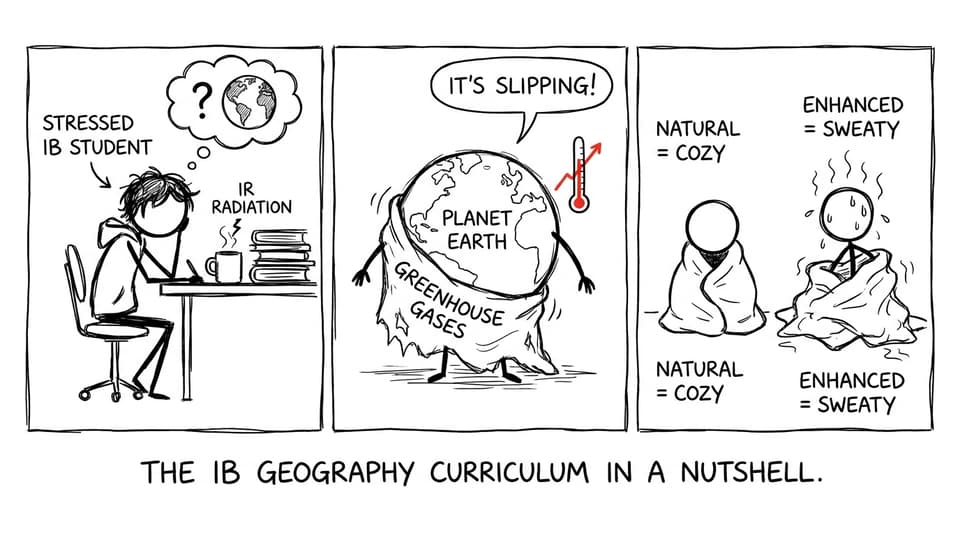
Distinguish natural vs enhanced greenhouse effect with human sources.
If you want a broader environmental framing alongside the chemistry, pair this with RevisionDojo’s ESS support on atmospheric systems and societies.
Greenhouse effect explained in one clean story (IB Chemistry)
In IB Chemistry, the greenhouse effect is best remembered as an energy loop with a molecular “speed bump.”
Sunlight gets in
Most incoming solar radiation is short-wavelength (visible and UV). It passes through the atmosphere relatively easily.
Earth warms up and sends IR back out
The surface absorbs energy and re-emits it as longer-wavelength infrared (IR) radiation.
Greenhouse gases interact with IR
Certain atmospheric gases absorb IR because IR matches the energies of vibrational mode changes in those molecules. They then re-emit IR in all directions, including back toward the surface.
Result: heat loss slows
Heat isn’t “trapped” like in a sealed box; it’s delayed. The planet loses energy more slowly, so the average temperature rises to a life-supporting level.
For a physics-leaning treatment (useful if you like equations and energy balance), see B.2 Greenhouse effect notes.
Why some gases absorb IR (and N₂ doesn’t): the IB Chemistry core
This is where IB Chemistry becomes the difference between a vague explanation and a top-mark one.
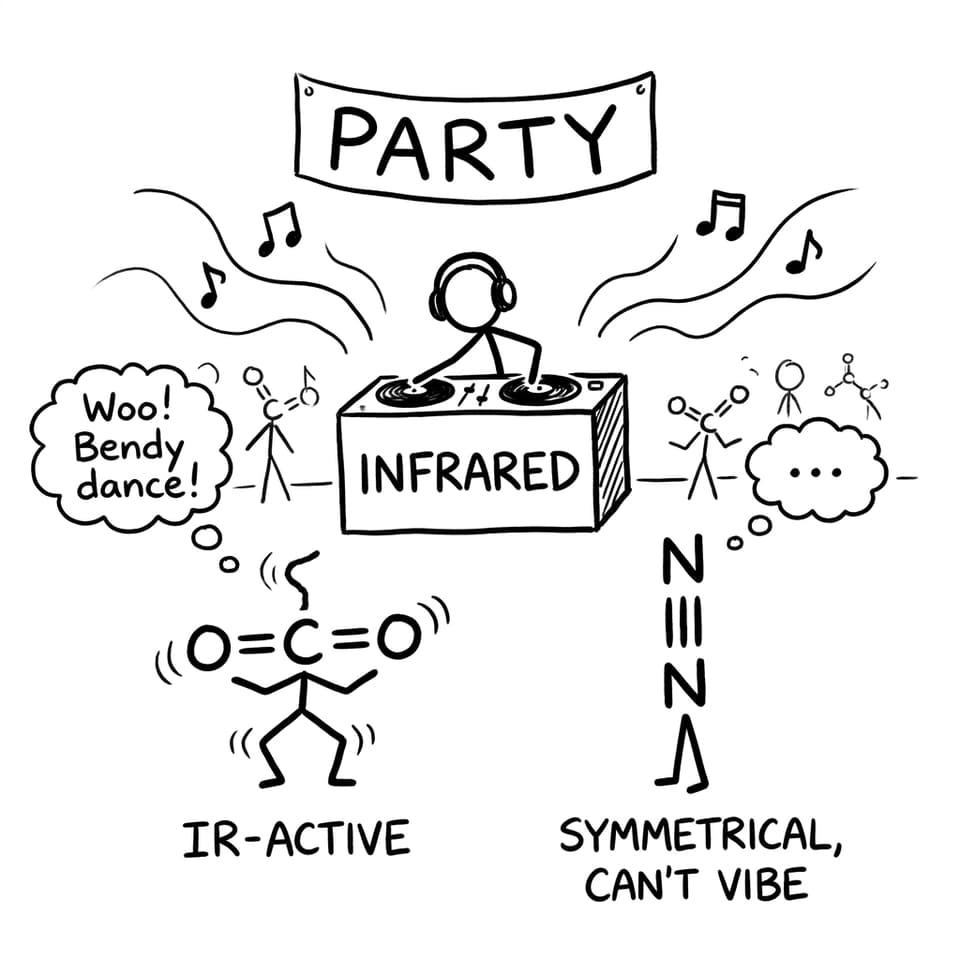
A molecule will absorb IR if a vibration causes a change in dipole moment. That usually happens when:
-
the molecule has polar bonds, and
-
its vibrational modes are IR-active (dipole changes during stretching/bending).
CO₂ is the classic exam example. Even though CO₂ is linear overall, it has vibrational modes (especially bending) that create a temporary dipole, making it IR-active.
By contrast, N₂ and O₂ are symmetric diatomic molecules. Their stretching vibration does not change dipole moment (it stays zero), so they are essentially IR-inactive.
If you want to deepen the “absorb then re-emit” mechanism in exam language, RevisionDojo breaks it down clearly in Why absorption and re-emission of infrared matter.
Natural vs enhanced greenhouse effect (the comparison examiners love)
In IB Chemistry, you’ll often need to compare these precisely.
Natural greenhouse effect
-
Happens without human input.
-
Keeps Earth warm enough for liquid water.
-
Without it, Earth’s average temperature would be about -18°C (instead of around 15°C).
Enhanced greenhouse effect
-
Caused by increased greenhouse gas concentrations from human activity.
-
Increases IR absorption and re-emission, shifting Earth’s energy balance.
-
Drives global warming and broader climate change impacts.
Human drivers you can safely list in an IB Chemistry response:
-
Combustion of fossil fuels (CO₂ increase)
-
Agriculture and landfills (CH₄ increase)
-
Fertiliser use and industry (N₂O increase)
-
Deforestation (reduced CO₂ uptake)
To link combustion to real syllabus content, see RevisionDojo’s fossil fuels notes.
Which greenhouse gases matter most (and how to write it)
A strong IB Chemistry paragraph is specific but not bloated.
-
H₂O (water vapour): most abundant; often a feedback (warmer air holds more water vapour).
-
CO₂: key human-driven greenhouse gas due to scale and long atmospheric lifetime.
-
CH₄: very effective IR absorber; shorter lifetime but high warming impact.
-
N₂O: potent, linked to agriculture and industry.
-
O₃: greenhouse gas in the troposphere; different role in stratospheric UV absorption.
-
Fluorinated gases: extremely potent and long-lived but lower concentrations.
When exam questions ask you to compare gases, the concept of global warming potential helps you sound like you’re thinking, not reciting. Use Global warming potential explained to revise that comparison tool.

Common IB Chemistry mistakes to avoid
These are small wording slips that cost marks.
“Greenhouse gases trap sunlight.”
In IB Chemistry, be precise: greenhouse gases primarily absorb infrared radiation, not visible light.
“The greenhouse effect is bad.”
The natural greenhouse effect is essential. The enhanced greenhouse effect is the problem.
“Ozone layer depletion causes the greenhouse effect.”
Different mechanism. Ozone depletion mainly affects UV transmission, not the core IR absorption loop.
If you want the examiner-friendly comparison between greenhouse effect and global warming (with ESS-style clarity), see the difference between the greenhouse effect and global warming.
How to revise the greenhouse effect fast with RevisionDojo (IB Chemistry)
When students say they “know” the greenhouse effect, they often mean they’ve read it once. In IB Chemistry, marks come from retrieval and application.
Try this:
-
Use the IB Chemistry resources hub to skim the syllabus-aligned notes first.
-
Drill definitions and misconceptions with Flashcards (fast recall beats rereading).
-
Use the Questionbank to answer short structured questions on IR absorption and sources of gases.
-
Ask AI Chat to mark your explanation for precision and missing points.
-
Build a timed set with Mock Exams and use Grading tools to see where your phrasing loses marks.
-
If coursework links come up (like environmental data interpretation), the Coursework Library and Tutors can help you tighten analysis.
For broader exam strategy, RevisionDojo’s top resources for IB exams prep complements this topic well.
Conclusion: make the molecular story your advantage in IB Chemistry
The greenhouse effect is simple to describe, but powerful to explain. In IB Chemistry, your edge comes from linking the big picture (warming) to the small mechanism (IR-active vibrations and dipole changes). Keep your wording crisp: shortwave in, IR out, greenhouse gases absorb and re-emit, enhanced effect from human emissions.
If you want to turn that understanding into marks, head to RevisionDojo’s IB Chemistry hub for Study Notes, Flashcards, the Questionbank, AI Chat feedback, Grading tools, Predicted Papers, and Mock Exams, then practise explaining the greenhouse effect until it sounds effortless under time pressure.