
A list can look simple until someone tries to live by it. The five precepts are easy to memorize: do not kill, steal, engage in sexual misconduct, speak falsely, or consume intoxicants that cause heedlessness. Yet Buddhist ethics begins where memorization ends. What counts as harm? How important is intention? Is avoiding wrongdoing enough, or must a Buddhist cultivate compassion?
For IB World Religions SL students, the central point is this: the precepts are voluntary rules of ethical training for Buddhist laypeople, not commandments issued by a creator deity. They cultivate moral discipline, reduce suffering, shape kamma or karma, and support progress toward awakening.
Students building their wider context can begin with RevisionDojo's introduction to Buddhism notes before connecting the precepts to doctrine, practice, texts, and lived experience.
The five precepts at a glance
The Pali expression is pañcasīla, while Sanskrit sources use pañcaśīla. The word sīla means ethical conduct, virtue, or moral discipline. Each precept is also called a sikkhāpada, a principle of training. The traditional formula begins, “I undertake the training rule,” emphasizing willing practice rather than external compulsion.
| Precept | Traditional meaning | Positive quality cultivated |
|---|---|---|
| Refrain from taking life | Avoid intentionally killing living beings | Loving-kindness and compassion |
| Refrain from taking what is not given | Avoid theft, fraud, and exploitation | Generosity and respect |
| Refrain from sexual misconduct | Avoid conduct that causes harm or violates commitments | Responsibility and contentment |
| Refrain from false speech | Avoid lying and deceptive communication | Truthfulness and trust |
| Refrain from intoxicants causing heedlessness | Avoid substances that undermine awareness | Mindfulness and clarity |
A useful revision checklist is to know each rule, its Pali terminology, its positive virtue, its doctrinal purpose, and one example of differing interpretation. RevisionDojo's Buddhist ethics flashcards can help separate these elements before combining them in an essay.
Why Buddhist ethics depends on intention
Buddhist morality is closely connected to cetanā, meaning intention or volition. In the Nibbedhika Sutta of the Aṅguttara Nikāya 6.63, the Buddha identifies intention as kamma. An accidental action and a deliberate one therefore do not carry identical ethical significance, even when their consequences appear similar.
Good intentions do not automatically excuse harmful conduct. Evaluation considers intention, action, consequences, awareness, and the mental qualities being strengthened. Deliberately lying for personal advantage reinforces attachment and deception. Speaking inaccurately through an innocent mistake is ethically different, although correcting it may still be appropriate.
Actions are often driven by the three unwholesome roots: greed, hatred, and delusion. These states sustain dukkha, the dissatisfaction and suffering described by the Four Noble Truths. Practising sīla restrains those tendencies and creates conditions in which meditation and wisdom can develop.
What each precept means in practice
Protecting life
The first precept means abstaining from destroying living creatures. It reflects ahiṃsā, non-harming, and encourages mettā, loving-kindness, and karuṇā, compassion. The Dhammapada 129-130 reasons from shared vulnerability: living beings fear violence and value life, so one should neither kill nor cause killing.
Its application raises questions involving diet, warfare, abortion, euthanasia, insects, and environmental responsibility. Buddhist responses are not uniform. A strong IB response should explain the principle, identify the conflict, and avoid claiming that all Buddhists reach one conclusion.
Respecting what is given
The second precept prohibits taking adinnādāna, literally “what is not given.” It covers more than obvious theft. Fraud, coercion, plagiarism, exploitation, and knowingly retaining something borrowed can violate the underlying respect for ownership and consent.
Its positive counterpart is dāna, generosity. This shows that Buddhist ethics is not only about avoiding wrongdoing. Restraint protects others, while generosity replaces grasping and transforms the practitioner's character.
Avoiding sexual misconduct
The third precept concerns kāmesu micchācāra, misconduct in sensual or sexual relations. Early texts discuss prohibited relationships within ancient Indian society. Contemporary Buddhists commonly interpret the principle through non-harm, consent, honesty, fidelity, responsibility, and freedom from exploitation.
Lay ethics should not be confused with monastic discipline. Buddhist monks and nuns generally undertake celibacy under the Vinaya, whereas the lay precept does not prohibit every sexual relationship. Ethical expectations therefore depend partly on religious role and commitment.
Speaking truthfully
The fourth precept prohibits musāvāda, false speech. Its relationship to Right Speech broadens the discussion beyond factual lying to divisive, abusive, or irresponsible communication. Forwarding an unverified accusation online can cause harm even when the sender did not invent it.
Truthfulness is not bluntness without compassion. Buddhist analysis asks whether speech is true, beneficial, appropriately timed, and motivated by a wholesome state of mind. Silence, careful wording, or correction may be more ethical than speaking impulsively.
Preserving a clear mind
The fifth precept concerns alcohol, drugs, and intoxicants that produce pamāda, heedlessness. Its positive aim is appamāda, diligence, alongside sati, mindful awareness. Impaired judgment matters because it can make the other precepts easier to break.
Many Buddhists understand the traditional undertaking as abstinence, although interpretations vary around medicine, moderate consumption, and addiction. Some modern teachers extend its logic to compulsive media or gambling that clouds awareness. This is a contemporary interpretation rather than the wording of the early formula.
Theravada and Mahayana interpretations
The precepts are shared widely, but Buddhist traditions frame them differently. RevisionDojo's guide to Buddhist branches and the spread of the Dhamma provides background, while the Buddhist schools flashcards support comparison.
In Theravada Buddhism, the precepts are commonly presented as the basic ethical discipline of lay followers. Their observance produces wholesome kamma, supports mental calm, and prepares the practitioner for meditation and insight. On observance days, some lay Buddhists undertake eight precepts, adding temporary renunciations such as celibacy and avoiding entertainment.
In Mahayana Buddhism, the five principles may be interpreted within the bodhisattva ideal. Conduct is directed toward awakening for the benefit of all sentient beings. Compassion and upāya, skilful means, can generate debate about exceptional circumstances. Some narratives describe a bodhisattva accepting grave karmic consequences to prevent greater harm, but these stories are not casual permission to disregard the precepts.
The Plum Village tradition, associated with Thich Nhat Hanh, expresses them as Five Mindfulness Trainings, addressing social injustice, responsible relationships, compassionate communication, and mindful consumption. Vajrayana communities also preserve lay ethics, often alongside bodhisattva and tantric commitments.
Primary texts and the five IB themes
The precepts connect naturally to all five IB World Religions themes.
- Rituals: Lay Buddhists may undertake them during refuge ceremonies, temple observances, retreats, or daily recitation.
- Sacred texts: The formulas appear throughout the Pali tradition. The Aṅguttara Nikāya 8.39 describes their observance as giving others freedom from danger, hostility, and oppression. RevisionDojo's sacred texts of Buddhism flashcards can help distinguish textual evidence from commentary.
- Doctrines and beliefs: They connect to kamma, rebirth, the Four Noble Truths, the Noble Eightfold Path, and the unwholesome roots.
- Religious experience: Ethical restraint can reduce remorse and agitation, supporting meditation and mindfulness.
- Ethics and moral conduct: The rules guide relationships while cultivating compassion, generosity, honesty, and awareness.
These connections create analysis. Instead of writing that Buddhists avoid intoxicants because drinking is forbidden, explain that heedlessness threatens mindfulness and can obstruct the discipline needed for liberation.
Linking the precepts to fundamental questions
What is the human condition? Human life is marked by dukkha, impermanence, craving, ignorance, and karmically significant choices. Untrained desires can harm oneself and others.
Where are we going? Buddhist traditions describe rebirth within saṃsāra, with actions influencing future experience. The ultimate goal is nibbāna in Pali or nirvāṇa in Sanskrit, liberation from greed, hatred, delusion, and suffering.
How do we get there? The precepts support Right Speech, Right Action, and Right Livelihood within the Noble Eightfold Path. They do not produce awakening mechanically, but establish conditions in which concentration and wisdom can grow.
Turning knowledge into an IB response
An effective paragraph should identify a precept, explain its doctrinal purpose, provide a primary text or technical term, and evaluate variation in interpretation. This moves the answer beyond description.
For revision, combine the IB World Religions resource hub with Study Notes and Flashcards for knowledge, then use the Questionbank for application. AI Chat can test distinctions such as commandment versus training rule, while Grading tools can identify unsupported generalizations. RevisionDojo's World Religions mock preparation guide can support timed practice.
RevisionDojo also brings together Predicted Papers, Mock Exams, the Coursework Library, and Tutors. The value is not simply having more material. It is choosing the right tool when understanding must become explanation.
The deeper purpose of the five precepts
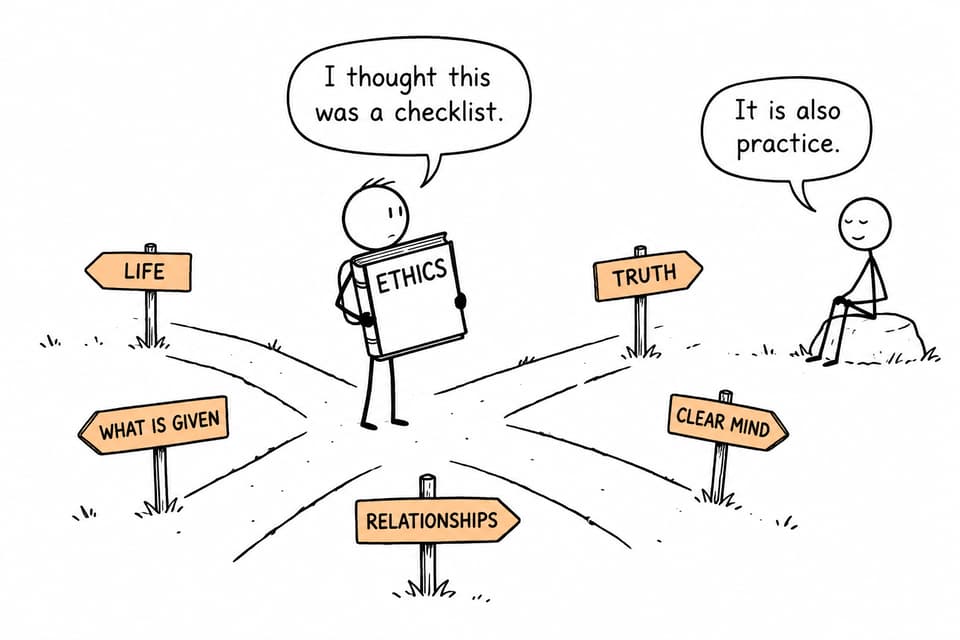
The five precepts are boundaries, but boundaries are not their final purpose. Each restraint creates space for a virtue: non-killing for compassion, non-stealing for generosity, sexual responsibility for respect, truthful speech for trust, and sobriety for awareness.
Buddhist ethics therefore cannot be reduced to obedience. The practitioner trains attention, intention, and character. For an IB student, the strongest conclusion connects personal conduct with doctrine, communal identity, sacred texts, religious experience, and the Buddhist path beyond suffering.