
The first term IB Physics experience is less about racing through spectacular ideas and more about building the habits that make those ideas manageable. You will meet equations, graphs, practical work, uncertainty, and unfamiliar problem-solving conventions, often within the same week.
A realistic term may begin with measurement and mathematical foundations, move into a substantial content unit such as mechanics, and finish with tests that combine concepts. The exact order varies because the current IB Physics syllabus does not prescribe a teaching sequence. Your school might begin with thermal physics, waves, or another theme instead.
Your first-term overview
Expect the term to include:
- A faster pace than many pre-IB science courses
- Early work on units, vectors, graphs, and uncertainty
- One or two substantial syllabus areas, depending on your school
- Regular calculations alongside written explanations
- Practical work that requires analysis, not merely following instructions
- A noticeable difference between understanding a lesson and solving a new question alone
The IB Physics resource hub is useful for mapping what your class is covering against the wider course. It helps prevent the common feeling that every lesson is an isolated island.
A realistic first term IB Physics arc
The timeline below uses a mechanics-first course as a representative example. Treat it as a model, not a universal calendar.
| Stage | Likely classroom experience | What changes for you |
|---|---|---|
| Weeks 1-2 | Units, significant figures, vectors, graphs, measurement, and uncertainty | Precision begins to matter as much as the final number |
| Weeks 3-5 | Motion, displacement, velocity, acceleration, and graphical analysis | You must translate between words, diagrams, equations, and graphs |
| Weeks 6-8 | Forces, free-body diagrams, Newton's laws, and momentum | Problems become multi-step and assumptions matter |
| Weeks 9-10 | Work, energy, power, or another connected unit | Earlier ideas return inside newer questions |
| Weeks 11-12 | Practical analysis, cumulative assessment, and correction | Revision becomes diagnosis rather than rereading |
The opening weeks feel deceptively familiar
Your teacher may begin with quantities such as velocity, acceleration, force, and energy. You may have seen these before. That familiarity can create false confidence.
IB Physics expects more than substituting numbers into an equation. For acceleration, you may need to understand the sign, identify the relevant time interval, read values from a graph, and decide whether the model applies. Units and significant figures are not decorative details added at the end.
This is why the first weeks can feel easy in class but harder in homework. The definitions are recognizable. The questions are not.
The middle of term is where the pace becomes visible
By the middle of the term, each new lesson is likely to depend on the previous one. A forces question may require kinematics. An energy problem may rely on a diagram and a conservation principle. A graph may ask you to interpret a gradient before calculating.
At this point, falling one lesson behind can feel like falling three lessons behind. The solution is not necessarily more study time. It is a shorter feedback loop.
After each lesson, check whether you can:
- Explain the central model without looking at notes
- State what each quantity and unit means
- Draw the relevant diagram
- Complete one unfamiliar question
- Identify and correct your own error
RevisionDojo's IB Physics Questionbank makes this kind of narrow practice possible. Use it by topic before attempting mixed work. If the explanation is unclear, return to concise Study Notes or follow this guide to succeeding in IB Physics.
The end of term becomes cumulative
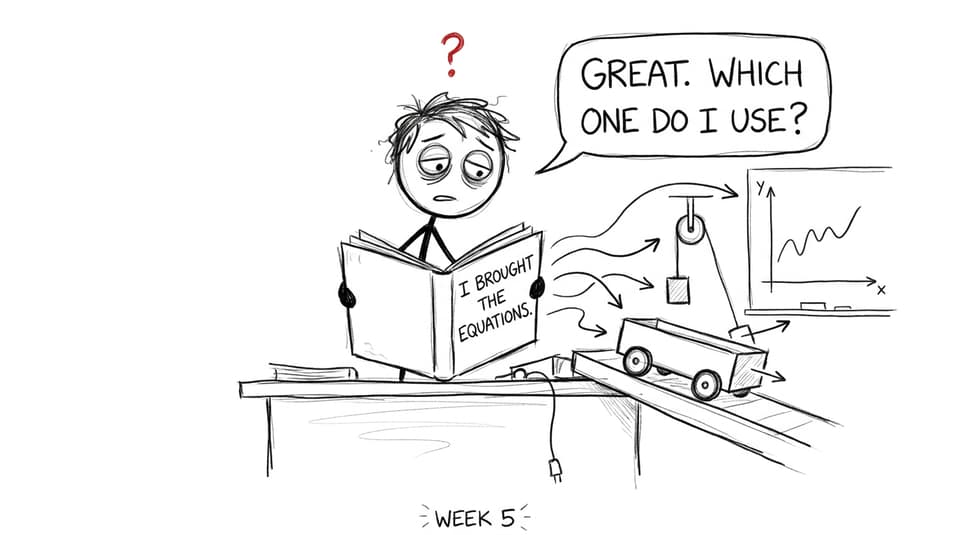
Early questions often signal the required method. Later questions are less generous. You may need to decide whether momentum, force, energy, or a kinematic relationship provides the cleanest route.
That decision is the real intellectual work. Algebra matters, but model selection usually comes first.
A term-ending test may feel harder than the homework sets that preceded it. It combines ideas, removes topic labels, and requires retrieval under time pressure. The IB Physics topic-by-topic revision guide can help you progress from isolated practice to mixed questions.
What the weekly workload actually feels like
Physics workload is uneven. One week may bring routine calculations. The next may contain a practical, graphing task, problem set, and test preparation.
A sustainable week usually works better as several short sessions than one rescue operation on Sunday night:
- After class: Spend 10-15 minutes cleaning up definitions, diagrams, and unresolved questions.
- Twice during the week: Complete a small set of questions without notes.
- After marking: Record why each error happened, not merely the correct answer.
- At the weekend: Reattempt one difficult question and retrieve older material.
Study time depends on your level, prior mathematics, timetable, and current topic. HL has greater depth and more syllabus content, but SL is not effortless. Both require consistent application.
RevisionDojo's IB study features support this cycle in one place. Study Notes establish the model, Flashcards reinforce definitions and relationships, the Questionbank tests application, and Jojo AI Chat can unpack a difficult step. This connected workflow is more useful than collecting disconnected resources.
What surprises new students most
Knowing formulas is not the same as solving problems
The data booklet reduces the value of blind memorization. You still need to recognize the conditions behind an equation, rearrange it correctly, and connect it to other relationships.
Do not ask only, “What formula contains these variables?” Ask, “What physical principle governs this situation?”
Written explanations carry real weight
Some students expect Physics to be almost entirely numerical. In reality, you may need to explain a trend, justify an assumption, compare models, or evaluate evidence. A correct calculation does not automatically produce a complete explanation.
Practical work is about imperfect evidence
A laboratory result is rarely exactly equal to a theoretical value. That is not failure. You will learn to discuss random and systematic effects, measurement uncertainty, graph quality, and whether the evidence supports a conclusion.
These skills later feed into the scientific investigation. Careful lab habits matter from the beginning. The IB Physics coursework guides and Physics internal assessment tips show where those habits eventually lead.
Confidence can fall before competence rises
As you learn more Physics, you also become more aware of what you cannot yet do. A lower early test result may reflect the transition from familiar examples to genuine application.
Treat that result as evidence. Separate conceptual errors from algebra mistakes, graph-reading problems, missing units, and rushed explanations. Different errors require different repairs.
How to finish the term stronger than you started
Do not wait for complete confidence. Build a repeatable loop:
- Learn one small idea through class materials or Study Notes.
- Retrieve it without looking.
- Apply it in several questions.
- Inspect the reasoning behind every mistake.
- Reattempt the weak skill after a delay.
RevisionDojo is the ultimate IB resource for keeping that loop connected. Its Questionbank, Study Notes, Flashcards, AI Chat, and Grading tools support daily learning and feedback. Predicted Papers and Mock Exams become more valuable when you have enough content for realistic timed practice, while the Coursework Library and Tutors can support scientific investigation work or persistent conceptual gaps.
Your first term is not supposed to make you feel finished. It is supposed to change how you approach a problem. By the final weeks, the most important progress may be quiet: you draw the diagram before calculating, check the unit before trusting the answer, and see a difficult question as something to model rather than something to fear.