
The first term IB ESS experience usually begins with perspectives, systems, and sustainability before moving into ecology or another applied topic. Expect scientific concepts, social analysis, data work, case studies, and practical activities. The workload becomes demanding when students assume familiar environmental issues can be explained through common sense alone.
Environmental Systems and Societies asks you to express familiar ideas through precise terminology, systems thinking, evidence, and balanced evaluation. Topic order and term lengths vary by school, but the outline below offers a useful guide to the opening months.
Your first-term IB ESS overview
| Stage | Likely focus | What the workload feels like |
|---|---|---|
| Weeks 1-2 | Perspectives and environmental value systems | New vocabulary, discussion, and short explanations |
| Weeks 3-5 | Systems, models, feedback, and equilibrium | Diagrams and data interpretation |
| Weeks 6-8 | Sustainability and resource management | Case studies and evaluative writing |
| Weeks 9-12 | Ecology or another teacher-selected topic | Scientific content, fieldwork, and tests |
| Throughout | Practical and assessment skills | Graphs, sampling, research questions, and revision |
By the end of the term, aim to:
- define key terms precisely and explain systems using inputs, outputs, storages, and flows
- distinguish positive feedback from negative feedback
- connect environmental science with economic, political, cultural, and ethical perspectives
- interpret unfamiliar data and respond to command terms such as explain and evaluate
- organize useful case studies and practical skills
The opening weeks change how you see environmental issues
The current ESS course begins with Topic 1, Foundation. The IB recommends 16 teaching hours for perspectives, systems, and sustainability. Discussions and practical tasks can stretch that across several weeks.
You may compare ecocentric, anthropocentric, and technocentric thinking, then consider how culture, economics, and experience shape decisions. Environmental disagreements often begin with different assumptions about what should be protected, who should pay, and which risks are acceptable.
This may feel more like social science than biology. ESS combines scientific understanding with the study of societies: a technically effective proposal can still be politically unpopular or ethically contested. RevisionDojo's Topic 1 Perspectives notes help organize the terminology before you apply it.
Systems thinking is where the course becomes less obvious
A forest becomes more than a collection of trees. In ESS, it is a system with boundaries, storages, transfers, transformations, inputs, outputs, and feedback loops.
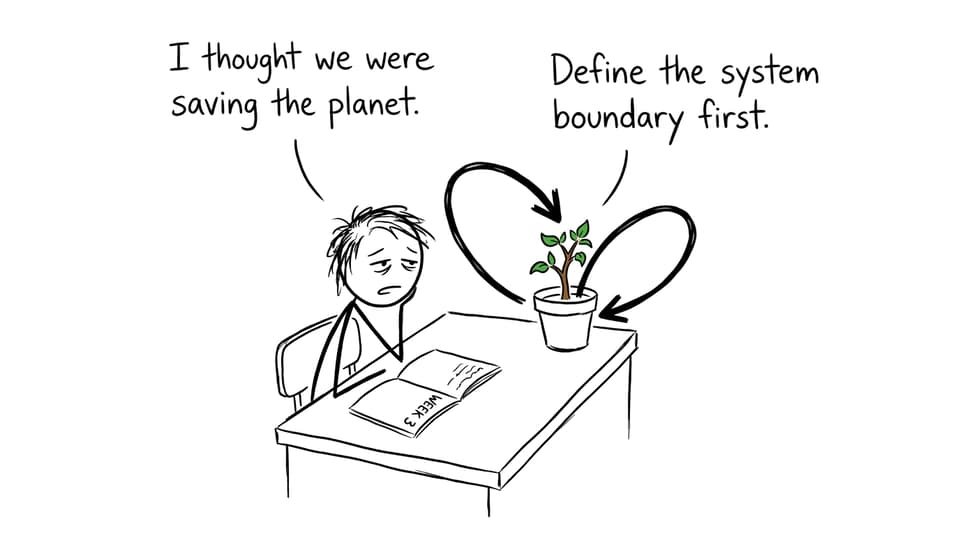
Students may understand a process but struggle to describe it in course language. Knowing that vegetation affects soil differs from explaining the linked flows and consequences within a defined system.
Review a concept in the IB ESS systems notes, then redraw its model from memory. Ask what crosses the boundary, what remains stored, and what might amplify or reduce change. RevisionDojo's Flashcards can secure definitions; its Questionbank tests whether you can apply them to unfamiliar situations.
Sustainability introduces ambiguity, not easy slogans
Sustainability questions do not necessarily reward the most environmentally protective answer. You must recognize trade-offs and judge strategies using evidence.
A renewable resource can still be used unsustainably. Conservation can protect biodiversity while restricting local access to land. A technology may reduce one pressure while creating costs elsewhere. A strong response explains the environmental process, identifies stakeholders, and evaluates benefits and limitations across scales and time.
The guide to IB ESS approaches that raise marks explores how systems language, evidence, and evaluation work together. HL students also study environmental law, economics, and ethics. Your teacher may introduce those lenses now or later.
The workload is steady rather than dramatic
An ESS week might combine content lessons, discussion, graph interpretation, and short homework. Some weeks add fieldwork, a quiz, or a structured response. Two or three focused sessions outside class can help, depending on your timetable:
- 20-30 minutes: retrieve definitions and redraw a system
- 30-45 minutes: answer data or written questions
- 20-30 minutes: update a case-study card or correct earlier work
The hidden workload is organization. Case studies, methods, and mistakes accumulate quietly. Keep one glossary, one case-study bank, and one error log. After an assessment, identify whether errors came from missing knowledge, weak terminology, data interpretation, or unsupported evaluation. The advice in how to score a 7 in IB ESS is easier to use before revision becomes urgent.
Early assessments teach you how ESS awards marks
Your first assessment may be a short quiz, a data-response task, or an extended answer. Whatever its format, treat it as information about the course rather than a verdict on your ability. Read the mark allocation and command term before writing. A two-mark identify question needs a different response from an eight-mark evaluate question.
When correcting work, do not simply copy the teacher's answer. Rebuild the reasoning:
- underline the instruction and topic
- note the knowledge or evidence you missed
- rewrite one weak paragraph using claim, evidence, and explanation
- add a balanced judgment where evaluation is required
This turns feedback into a reusable process. RevisionDojo's Grading tools can show where an answer lacks precision or balance, while a Tutor can help distinguish a content gap from an exam-technique gap. The goal is not to produce a perfect paragraph immediately. It is to make the next paragraph more deliberate.
Keep the corrected response beside the original and revisit it one week later. If you can explain why the revision is stronger without reading the model answer, the feedback has become learning rather than decoration.
Practical work appears earlier than many students expect
ESS includes inquiry-based work such as field observations, sampling, experiments, surveys, mapping, or analysis of secondary data. Your first exercise may be modest, perhaps examining biodiversity, water, or microclimate. Its value lies in learning to choose methods, record units, present data, identify uncertainty, and suggest specific improvements.
You may hear about the individual investigation before you begin it. This open-ended research task has a report of up to 3,000 words and contributes 25% of the final grade at SL or 20% at HL. Schools may schedule it later, but early practical work develops the skills needed to design it.
The RevisionDojo IB ESS resource hub outlines the course and assessments. When investigation planning begins, the Coursework Library, Grading tools, and Tutors can help you understand quality while keeping your approach your own.
What surprises new ESS students most
The surprise is often the number of thinking modes required in one answer. You might interpret ecological data, explain a mechanism, compare stakeholder values, and justify a conclusion. Accurate facts alone cannot compensate for ignoring a command term or making an unsupported judgment.
The opening concepts also keep returning. Perspectives, systems, and sustainability reappear in ecology, conservation, water, climate change, resources, agriculture, and urban systems. Rather than memorize disconnected examples, build a smaller collection of flexible case studies. For each, record the location, issue, causes, measurable impacts, management response, outcome, and limitations.
How to finish the term in control
Measure progress by what you can retrieve and apply without support, not by highlighted pages. Each week, review a concept in the syllabus-aligned ESS Study Notes, then answer questions from memory. Use AI Chat to clarify a stubborn misunderstanding and test yourself again afterward.
Later, Predicted Papers and Mock Exams help with timing and stamina. For now, shorter drills let you build accurate language before adding pressure. RevisionDojo brings the Questionbank, Study Notes, Flashcards, AI Chat, Grading tools, Predicted Papers, Mock Exams, Coursework Library, and Tutors together, so an interesting ESS lesson can become knowledge you can actually use.