

Fiscal policy is one of those IB Economics topics that feels simple until you try to write it under time pressure. You know the words: spending, taxes, aggregate demand. Then the question says evaluate, and suddenly your brain is negotiating a coalition government with your pen.
These Revision Tips are built for that moment: when you need clean definitions, diagram logic, and evaluation points that sound like an examiner wrote them.
Fiscal policy, in one exam-ready definition
In IB Economics, fiscal policy is the use of government spending (G) and taxation (T) to influence aggregate demand (AD), real output, and employment. It is a demand-side policy (alongside monetary policy), and it’s everywhere in Paper 1 essays and Paper 2 data response because it connects directly to macroeconomic objectives like growth, low inflation, and low unemployment.
If you want a syllabus-aligned home base for this topic, start with IB Economics resources on RevisionDojo.
Revision Tips checklist: what to memorise (and what to practise)
-
Definition of fiscal policy (spending + taxes)
-
How fiscal policy shifts AD in the AD/AS model
-
Expansionary vs contractionary fiscal policy (when and why)
-
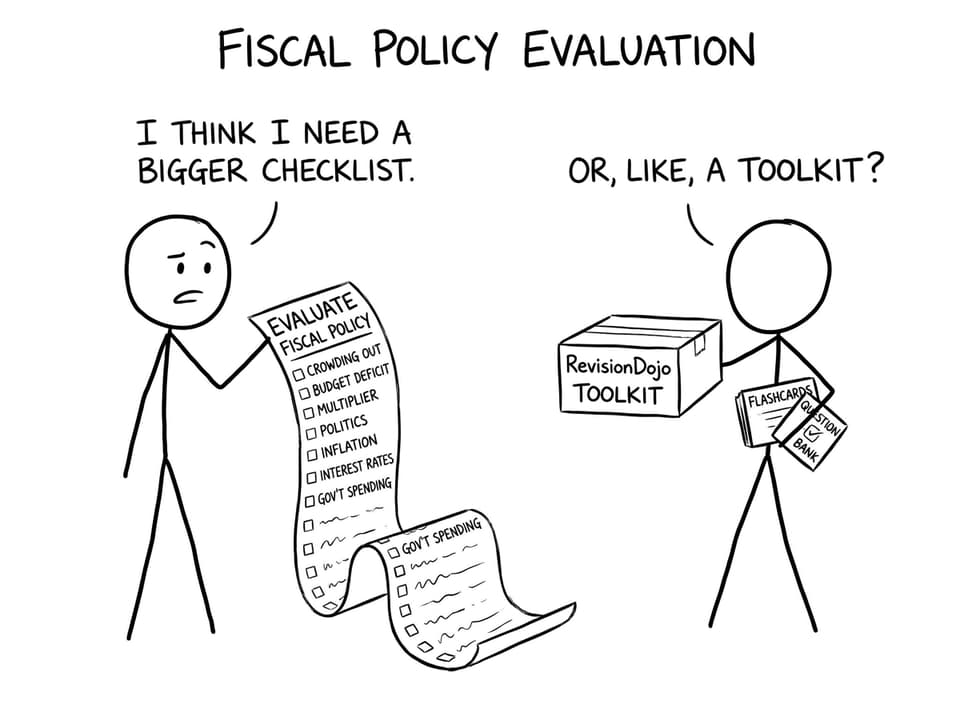
3+ evaluation points (time lags, crowding out, debt, effectiveness)
-
The multiplier formula: k = 1 / (1 - MPC)
These Revision Tips work best when you immediately apply them to exam-style questions in the RevisionDojo Questionbank.
The two fiscal policy tools (the only levers you need)
Government spending (G)
Government spending includes public goods and services (healthcare, education, infrastructure). In the AD equation, higher G directly increases total planned expenditure, so AD tends to shift right.
To connect this properly to diagrams, review how AD is constructed and what causes shifts using AD/AS notes (Variations in economic activity).
Taxation (T)
Taxes affect disposable income and incentives. A tax cut can raise consumption (C) and sometimes investment (I), shifting AD right; a tax rise usually does the opposite. The key Revision Tips move is to say taxes affect AD more indirectly than spending, which helps your evaluation later.
Expansionary vs contractionary fiscal policy (what the diagram is saying)
Expansionary fiscal policy
Used in a recession or downturn: increase G and/or decrease T. In the AD/AS model, this shifts AD to the right, raising real output and lowering cyclical unemployment (with possible inflationary pressure depending on spare capacity).
For targeted content on this exact syllabus point, use Fiscal policy notes (impact on potential output) and the matching fiscal policy topic page.
Contractionary fiscal policy
Used when inflation is high or the economy is overheating: decrease G and/or increase T. AD shifts left, reducing demand-pull inflation but potentially increasing unemployment.
If your AD shift logic feels shaky, tighten it with Components of AD notes.
The multiplier: the one formula that upgrades your explanation
The Keynesian multiplier explains why a change in spending (or taxes) can lead to a larger final change in national income.
k = 1 / (1 - MPC)
A practical set of Revision Tips for essays: state the formula, define MPC in one line, then explain “successive rounds of spending.” If you can add a quick condition (confidence, spare capacity, imports), you sound like you’re evaluating, not narrating.
For the syllabus connection, see The nature of the Keynesian multiplier.
Evaluation: the points examiners keep rewarding
Fiscal policy is rarely marked as “good” or “bad.” It’s marked on trade-offs.
Use these Revision Tips to build evaluation paragraphs:
-
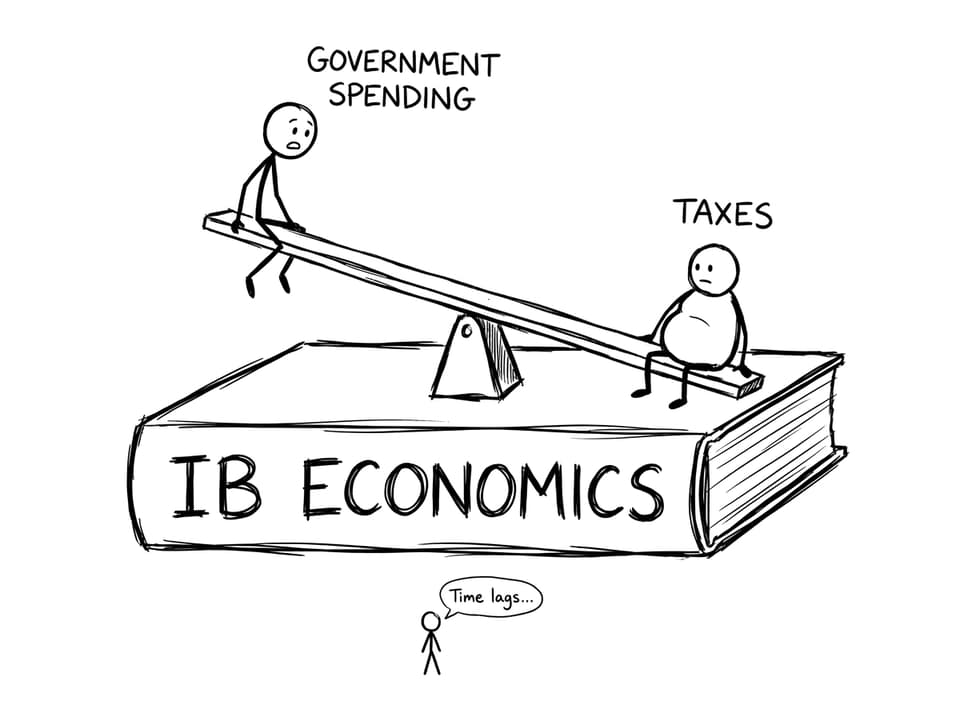
Time lags: recognition, decision, implementation, impact.
-
Crowding out: government borrowing may raise interest rates and reduce private investment.
-
Budget deficits and debt: persistent deficits can limit future policy flexibility.
-
Effectiveness depends on context: deep recessions vs near full employment.
Build your evaluation with Risks and limitations of fiscal policy and deepen the story with How fiscal policy influences the economy.
Conclusion: turn Revision Tips into marks
Fiscal policy questions reward students who can do three things calmly: define, diagram, and evaluate. Keep these Revision Tips close: spending and taxes shift AD; expansionary fights recession, contractionary fights inflation; the multiplier amplifies; and evaluation lives in lags, crowding out, and debt.
When you’re ready to practise, RevisionDojo brings it together with Study Notes, Flashcards, an exam-style Questionbank, AI Chat to fix misconceptions, and Grading tools to sharpen your evaluation. Add Mock Exams, Predicted Papers, a Coursework Library, and Tutors, and you stop revising in circles and start revising in straight lines. That’s what good Revision Tips are for.