
The evolution of animals is the change and diversification of animal populations across generations from shared ancestors. Heritable variation, natural selection, mutation, genetic drift, gene flow, and reproductive isolation changed allele frequencies over time, while fossils and molecular evidence help scientists reconstruct when major animal lineages diverged.
That definition is short. The history behind it spans hundreds of millions of years. For an IB Biology student, however, the goal is not to memorize every branch of the animal kingdom. It is to understand the mechanisms, interpret the evidence, and express the logic precisely under exam conditions.
Evolution of animals at a glance
- Animals share ancient common ancestry and form a related evolutionary group.
- Populations evolve; individual organisms do not.
- Mutation creates new alleles, while sexual reproduction generates new allele combinations.
- Natural selection changes populations when heritable differences affect reproductive success.
- Reproductive isolation can eventually produce new species.
- Fossils, anatomy, DNA, RNA, and protein sequences provide evolutionary evidence.
- Cladograms represent hypotheses about common ancestry, not a ladder of progress.
Use the broader IB Biology evolution and biodiversity guide alongside this overview when connecting animal evolution to the syllabus.
Where did animals come from?
Animals did not appear in their modern forms. Their earliest ancestors were multicellular eukaryotes that emerged from older unicellular lineages. Molecular estimates place animal origins deep in the Precambrian, although exact dates remain uncertain because molecular-clock calculations depend on assumptions and fossil calibration points.
Evidence becomes clearer in younger rocks. Ediacaran ecosystems contained large multicellular organisms by roughly 580 million years ago. During the Cambrian Period, beginning about 539 million years ago, animal diversity in the fossil record expanded dramatically. Many major body plans associated with living animal phyla became visible during this interval.
The phrase Cambrian explosion can be misleading. It was geologically rapid, not instantaneous, and it did not represent animals appearing from nothing. Earlier evolution had already produced multicellularity, developmental mechanisms, ecological interactions, and ancestral lineages.
Later events included vertebrate diversification, colonization of land, repeated adaptive radiations, and mass extinctions. Extinction removed lineages, but it also altered ecosystems and opened ecological opportunities for surviving groups.
How evolutionary change happens
The central chain is simple enough to memorize, but important enough to understand:
Heritable variation → selection pressure → differential reproductive success → inheritance → changing allele frequencies
Mutation introduces new alleles. Meiosis and fertilization rearrange existing alleles into different combinations. Individuals therefore vary in characteristics such as coloration, body size, disease resistance, or behaviour.
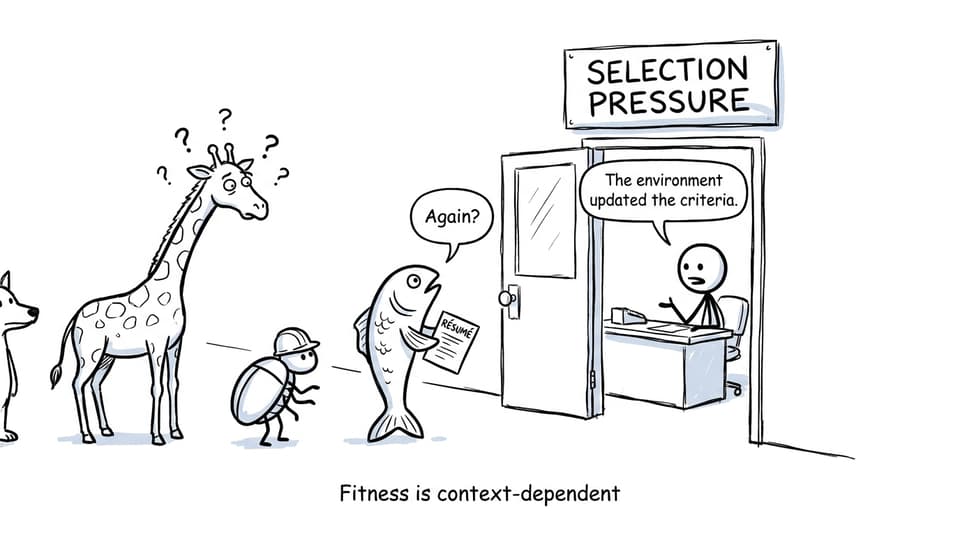
A selection pressure then affects reproductive success. It may be biotic, such as predation or competition, or abiotic, such as temperature or water availability. Individuals with a beneficial heritable phenotype tend to contribute more offspring to the next generation. The associated alleles can consequently become more frequent.
This process is not purposeful. Animals do not develop a needed adaptation because the environment requests one. Selection acts on variation that already exists, while mutation introduces variation without anticipating what will be useful. RevisionDojo’s natural selection topic resources and explanation of why natural selection requires variation are useful for consolidating this sequence.
From adaptation to new animal species
Adaptation and speciation are related, but they are not interchangeable. An adaptation is a heritable characteristic that increases fitness in a particular environment. Speciation is the formation of reproductively isolated lineages.
In allopatric speciation, a geographical barrier separates populations. Mutation, selection, and genetic drift then change their gene pools independently. If the populations eventually become unable to interbreed successfully, reproductive isolation has developed.
Adaptive radiation goes further: one ancestral lineage diversifies into multiple species occupying different ecological niches. This helps explain why islands, lakes, and newly available habitats can contain groups of related species with contrasting forms or feeding strategies. Review these connections in A4.1 Evolution and Speciation.
Evidence for animal evolution
No single fossil or DNA sequence carries the entire argument. Evolution is persuasive because independent lines of evidence converge.
| Evidence | What it can show | Important limitation |
|---|---|---|
| Fossils | Change through time, extinct forms, and chronological patterns | Preservation is incomplete and biased toward hard structures |
| Homologous structures | Similar underlying anatomy inherited from common ancestry | Similar function alone does not prove homology |
| DNA or protein sequences | Degree of molecular similarity between organisms | Similarity must be interpreted using suitable models |
| Cladograms | Proposed branching relationships and common ancestors | They are hypotheses based on available evidence |
| Biogeography | How isolation and geography relate to diversification | Distribution can also be altered by migration and extinction |
Molecular evidence is especially powerful. In general, fewer sequence differences suggest a more recent common ancestor, provided equivalent sequences are compared. Molecular clocks use the accumulation of sequence differences to estimate divergence times, but the results are estimates because mutation rates vary among genes and lineages.
For a focused review, use RevisionDojo’s evidence for evolution notes.
Reading animal cladograms correctly
A cladogram is a branching hypothesis. A node represents a hypothetical common ancestor, terminal branches represent the taxa being compared, and a clade contains an ancestor together with all its descendants.
Two taxa are more closely related when they share a more recent common ancestor. Their visual distance across the page is usually irrelevant. Rotating branches around a node also does not change the relationships.
Do not describe one living species as the ancestor of another living species unless the evidence specifically supports that unusual claim. Humans did not evolve from modern apes; humans and other living apes share ancestral populations.
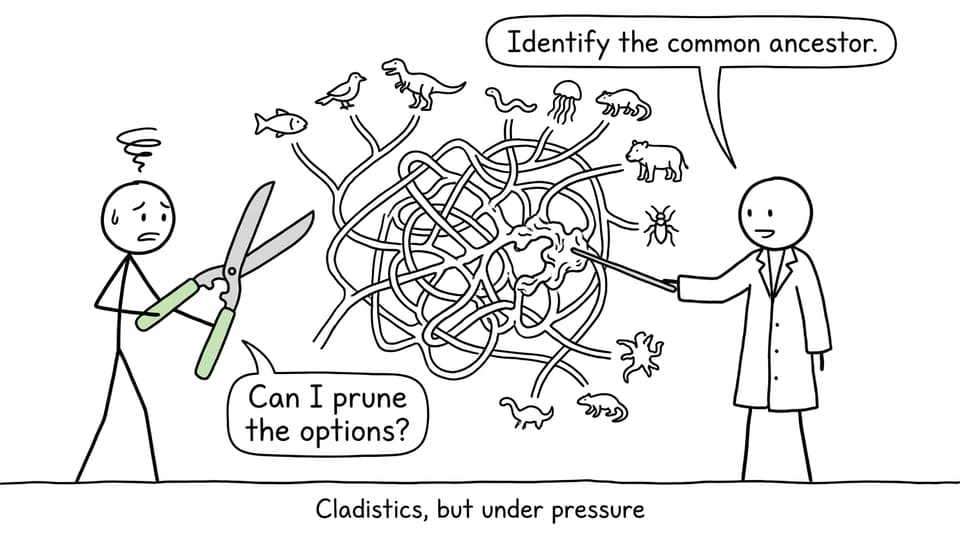
HL students can sharpen this skill with the classification and cladistics Questionbank.
How animal evolution appears in IB exam questions
Questions commonly ask you to explain natural selection, evaluate evolutionary evidence, interpret sequence data, identify clades, or distinguish adaptation from acclimatization. Command terms matter. State needs a concise answer; explain requires linked causes; compare requires similarities and differences.
Consider a hypothetical population of insects in which a genetically determined darker phenotype rises from 20% to 65% after several generations in a dark habitat.
A strong explanation would say:
- The original population contained heritable variation in coloration.
- Dark coloration provided greater camouflage in that environment.
- Darker insects experienced lower predation and reproduced more successfully.
- Their alleles were inherited by a larger proportion of the next generation.
- The frequency of alleles associated with dark coloration increased over generations.
Avoid saying, “The insects became dark so they could survive.” That wording implies need caused the variation. The stronger answer separates pre-existing variation, selection pressure, differential reproduction, and inheritance.
After reviewing the concept, move into the IB Biology Questionbank. Use IB Biology flashcards for definitions, then test application through Biology Predicted Papers.
Common mistakes to avoid
- Treating evolution as individual change: Evolution concerns heritable characteristics or allele frequencies in populations across generations.
- Assuming every feature is adaptive: Traits can also reflect genetic drift, developmental constraints, or evolutionary history.
- Describing evolution as progress: Evolution has no universal endpoint and does not inevitably produce greater complexity.
- Confusing fitness with strength: Biological fitness concerns reproductive contribution in a particular environment.
- Reading cladograms from left to right: Branching order and nodes matter; page position does not.
- Claiming fossils provide a complete record: Fossilization is uncommon, so the record contains gaps and preservation biases.
Quick-reference revision summary
Before the exam, make sure you can:
- define evolution at the population level;
- explain natural selection as a sequence of linked steps;
- distinguish adaptation, acclimatization, and speciation;
- evaluate fossil and molecular evidence;
- identify nodes, clades, and recent common ancestors;
- explain why molecular-clock dates are estimates;
- use precise language about alleles and reproductive success.
The evolution of animals becomes manageable when you stop treating it as one enormous timeline and start seeing a connected set of mechanisms and evidence. RevisionDojo brings those connections together through Study Notes, Flashcards, AI Chat, Questionbank practice, Grading tools, Predicted Papers, Mock Exams, the Coursework Library, and Tutors. Learn the sequence, test it with data, and refine every explanation until each sentence earns its place.