
Ethics in IB Digital Society rarely arrives with a dramatic soundtrack. It shows up quietly, inside an app permission screen you don’t read, a recommendation you didn’t ask for, or a “smart” decision made about you without you in the room.
And that’s why ethics matters so much in IB Digital Society: the most powerful digital systems often feel normal. Your job, especially in exams and the IA, is to make the invisible visible, then judge it with calm, justified reasoning.
If you want the bigger picture of the course, start with What Is IB Digital Society?. This guide focuses on how to handle ethics in a way that earns marks.
Ethics in IB Digital Society (what it actually means)
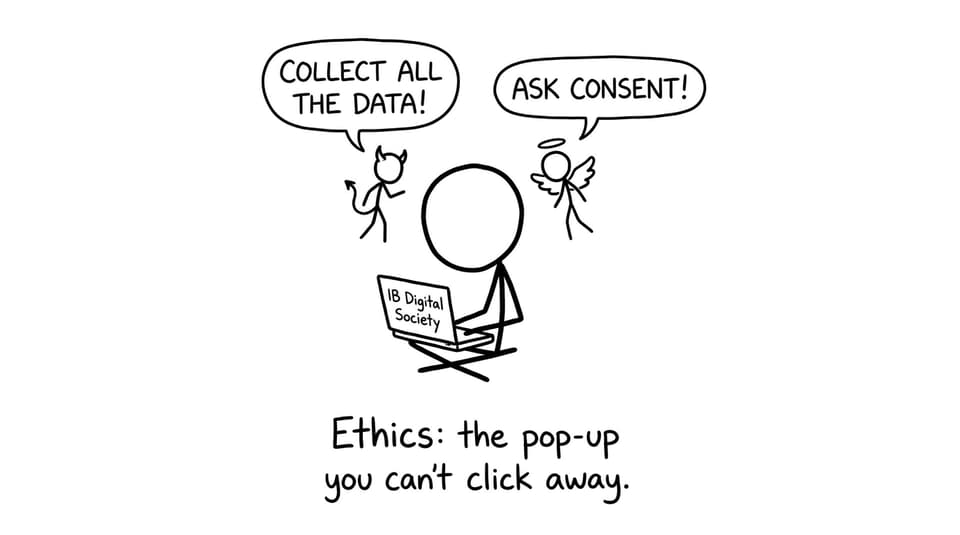
In IB Digital Society, ethics is the structured evaluation of digital systems and their impacts on people and communities. It is not a hunt for a single “correct” moral answer. Instead, you’re expected to show that you can:
-
Identify an ethical dilemma clearly
-
Explain competing values (e.g., safety vs privacy)
-
Compare impacts across different groups
-
Reach a justified judgment based on reasoning and evidence
That last part, justification, is where high-scoring students separate themselves. Ethics in IB Digital Society is something you argue for, not something you announce.
For a syllabus-aligned anchor, review 2.7 Values and ethics and build your definition bank from there.
Quick checklist: your ethical analysis in IB Digital Society
Use this as a fast exam planner for IB Digital Society ethics:
-
Name the system (not just “technology”)
-
Name the ethical tension (privacy vs security, innovation vs harm, etc.)
-
Map stakeholders and who holds power
-
Assess impacts (short vs long term; intended vs unintended)
-
Ask about responsibility (who can change what?)
-
Conclude with conditions (what would make it more ethical?)
When you practice, pair your notes with timed questions from RevisionDojo’s Questionbank to turn ethics into mark-winning structure.
The most common ethical themes (and how to make them exam-ready)
Ethical prompts in IB Digital Society tend to cluster into a few recurring areas. The trick is to connect each one to a real system, then evaluate.
Privacy and surveillance
Don’t stop at “data collection is bad.” Strong IB Digital Society ethics answers explain consent, control, and power.
A useful move: distinguish between voluntary sharing (users choosing to post) and invisible extraction (tracking, data brokerage, inference). Then evaluate whether the benefit (security, personalization, convenience) justifies the intrusion.
Fairness and bias
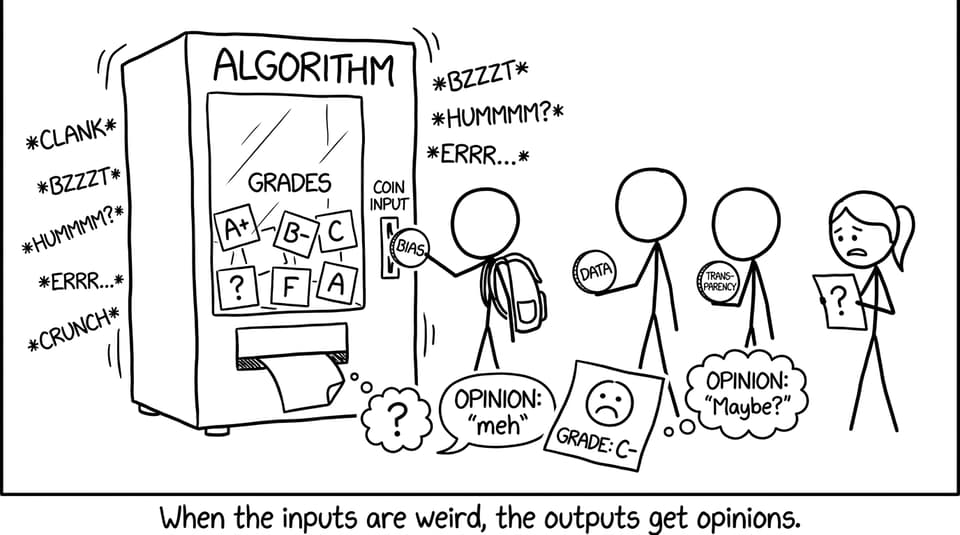
Bias questions often look like “algorithmic discrimination,” but examiners want more than a slogan. In IB Digital Society, ask:
-
What data trained the system?
-
Who designed the categories?
-
Who is most likely to be misclassified?
-
What happens to people who lose out?
Even one concrete example of impact makes your ethics feel grounded rather than theoretical.
Accountability and transparency
A classic IB Digital Society ethics dilemma: harm occurs, but responsibility is distributed. The company blames users, users blame “the algorithm,” and governments lag behind.
In evaluation, separate:
-
Accountability (who should be answerable?)
-
Transparency (can people understand decisions?)
-
Governance (what rules or oversight exist?)
To strengthen your concepts, see IB Digital Society: How All the Core Concepts Fit Together.
Access and inequality
Ethical evaluation in IB Digital Society often hinges on who gets excluded: rural communities, low-income families, disabled users, people with limited language access.
High-scoring responses go beyond saying “the digital divide exists.” They judge whether exclusion is acceptable, avoidable, or an unfair transfer of costs onto those with the least power.
Ethics is not opinion (the exam trap)
Many students lose marks in IB Digital Society by writing in a way that sounds passionate but cannot be assessed. “I think it’s wrong” is not analysis.
Instead, make your thinking auditable:
-
State why it is ethically significant
-
Provide a reasoned chain: design choice → impact → implication
-
Consider at least one serious counterargument
-
Conclude with a justified position (often conditional)
If you want a model for clean, examiner-friendly writing, study How to Structure High-Scoring IB Digital Society Exam Answers.
A simple ethical framework you can actually use
You don’t need to memorize ethical theories to do well in IB Digital Society. But you do need consistent lenses. Try these four “portable principles”:
-
Autonomy: Do people have meaningful choice and informed consent?
-
Harm minimization: What harms exist, and are they preventable?
-
Fairness: Who benefits, who pays, and is that distribution justified?
-
Accountability: Who has the power to fix the problem, and will they?
You can turn these into RevisionDojo Flashcards and drill them daily. Pair them with Study Notes from the IB Digital Society Resources hub so your ethical vocabulary stays precise.
Stakeholders: where your marks quietly come from
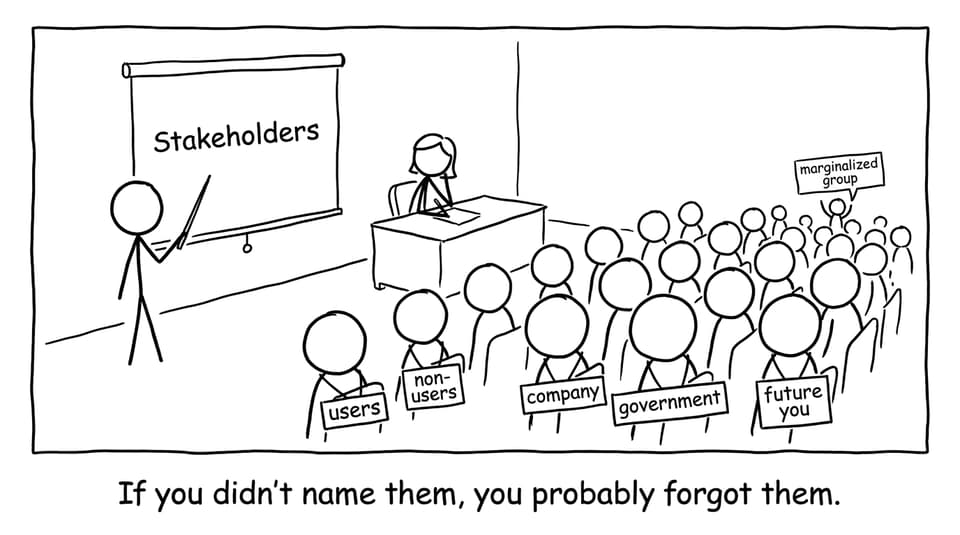
Ethical issues look different depending on who you are. In IB Digital Society, stakeholder analysis is how you prove you understand power.
A strong stakeholder paragraph includes:
-
Users and non-users
-
Developers and companies
-
Governments and regulators
-
Schools, families, and communities
-
Vulnerable or marginalized groups
Then you compare impacts, not just list groups.
Ethics in the IA: make it part of the inquiry, not an appendix
In the IB Digital Society IA, ethics should shape your research focus and analysis, not appear as a late paragraph titled “ethical considerations.”
Practical ways to integrate ethics:
-
Build your research question around a tension (benefits vs harms)
-
Use stakeholder interviews or perspectives where appropriate
-
Evaluate what responsible design or governance would look like
-
Acknowledge uncertainty and trade-offs rather than forcing certainty
If you need help tightening a research question, use How to Write a Strong IA Research Question. And if your IA uses sources heavily, don’t miss Referencing and Academic Honesty in IB Digital Society; ethical thinking includes ethical scholarship.
Closing: the ethical habit that boosts every answer
The quiet superpower in IB Digital Society is this: you learn to pause before calling something “good” or “bad,” and instead ask who benefits, who is harmed, and who has the power to change the outcome.
That habit wins marks in exams, strengthens your IA, and makes your thinking feel mature under pressure. Build it with a steady loop: Study Notes for clarity, Flashcards for language, Questionbank practice for structure, Mock Exams and Predicted Papers for timing, and AI Chat when you get stuck.
If you want one place to pull all of that together for IB Digital Society, start with RevisionDojo’s IB Digital Society Resources hub and practice ethics until it feels like a method, not a mood.