


Electrochemical cells can feel like they’re powered by pure logic: electrons leave, electrons arrive, a voltmeter smiles. Then a diagram shows two beakers and a mysterious U-shaped tube, and suddenly your confidence evaporates.
In IB Chemistry, that U-shaped tube (or soaked strip) is the salt bridge. It’s small, it’s easy to label, and it’s also the reason the whole cell keeps running for more than a moment. If you can explain the purpose of a salt bridge clearly, you unlock a lot of marks in redox and electrochemistry.
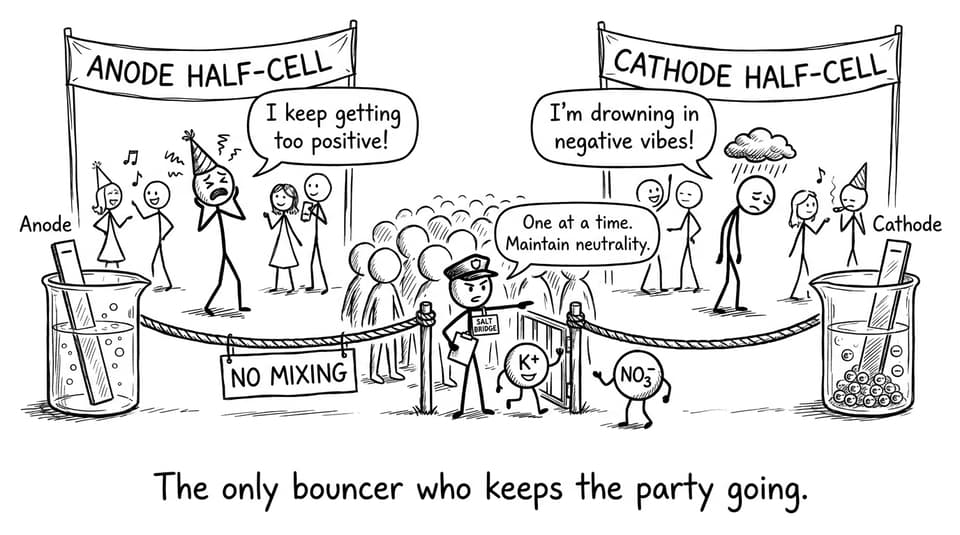
IB Chemistry quick checklist: what a salt bridge must do
Use this as your mental model whenever you see a galvanic cell diagram in IB Chemistry:
-
Maintain electrical neutrality in each half-cell
-
Allow ions (not electrons) to move between half-cells
-
Complete the internal circuit so electron flow can continue in the wire
-
Prevent the two solutions from mixing directly
-
Contain an electrolyte that is inert and won’t precipitate with ions in the half-cells
If you want the syllabus framing alongside practice, pair this with IB Chemistry 9.2 Electrochemical Cells Notes and the Electrochemical cells (HL) Questionbank.
What is a salt bridge (in IB Chemistry terms)?
A salt bridge is a connector between the two half-cells containing an inert ionic solution (often in a U-tube, gel, or soaked filter paper). Common salt bridge electrolytes include KNO₃, KCl, or NaNO₃ because their ions are usually spectators.
In IB Chemistry, the key requirements are:
-
It must provide mobile ions (so it conducts)
-
Its ions must not react with electrode materials or half-cell ions
-
It should not create precipitates that clog ion movement
A solid alternative you’ll also see is a separator/membrane in commercial cells; the function is similar (more on that later).
The purpose of a salt bridge in electrochemical cells
The purpose of a salt bridge is simple to say, but powerful to explain:
A salt bridge maintains electrical neutrality by allowing ion migration between half-cells, completing the circuit and enabling continuous electron flow.
That sentence is basically a mark scheme in IB Chemistry. But to make it feel real, imagine what happens inside the beakers the moment the wire is connected.
Why electrical neutrality matters (and why the cell dies without it)
In a galvanic cell, oxidation and reduction occur in separate compartments. That separation forces electrons to travel through the external circuit (the wire), which is how electrical energy is produced.
-
At the anode, oxidation produces cations in solution (the solution becomes more positive).
-
At the cathode, reduction often consumes cations (or leaves excess anions), making that solution relatively more negative.
Without a way to balance charge, the cell quickly builds an internal “traffic jam” of charge:
-
The anode half-cell becomes too positively charged to keep losing electrons.
-
The cathode half-cell becomes too negatively charged to keep accepting electrons.
So even though the redox reaction is energetically favorable, the charge imbalance stops electron flow. In IB Chemistry language: the circuit is incomplete internally, so the voltage collapses.
For a clean refresher on oxidation and reduction wording, see Electrochemical cells: Oxidation and reduction Notes.

How a salt bridge works: ion flow at anode vs cathode
The salt bridge contains both cations and anions. They move in response to charge build-up.
At the anode (oxidation)
Oxidation produces extra positive charge in solution.
-
Anions from the salt bridge migrate into the anode compartment.
-
This offsets the increasing concentration of cations.
At the cathode (reduction)
Reduction removes positive ions (or makes the solution relatively negative).
-
Cations from the salt bridge migrate into the cathode compartment.
-
This replaces the cations being consumed and keeps charge balanced.
A useful exam phrasing for IB Chemistry: electrons move through the wire; ions move through the salt bridge.
To connect this idea to the bigger galvanic-cell story (anode/cathode, E°cell, direction of electron flow), read Galvanic Cells Explained Simply.
Salt bridge vs porous separator (what IB Chemistry expects)
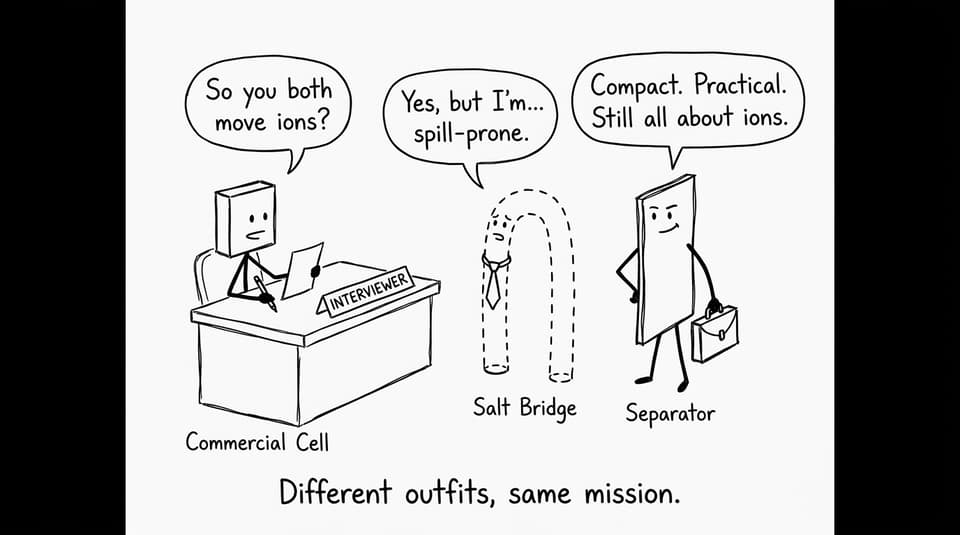
In many real batteries, you won’t see a U-tube. Instead, you’ll see a porous separator or membrane.
Both salt bridges and separators:
-
Allow ions to move
-
Prevent bulk mixing of the half-cell solutions
-
Maintain electrical neutrality
Differences worth mentioning:
-
Separators are solid and compact (better for commercial cells)
-
Salt bridges are often liquid/gel in lab demonstrations
If you want to see how this fits into everyday devices, How Batteries Work (Explained Simply) is a helpful extension for IB Chemistry understanding.
Common IB Chemistry mistakes to avoid
A few traps show up again and again:
-
Saying “it completes the circuit” but not explaining charge balance.
-
Claiming electrons go through the salt bridge (they do not).
-
Using a reactive electrolyte that would form a precipitate (why inert ions matter).
For quick definitions you can borrow in your own wording, use the IB Chemistry Glossary.
Closing: the exam-ready takeaway for IB Chemistry
In IB Chemistry, the purpose of a salt bridge is not decoration and not just “a connector.” It’s the quiet piece that prevents charge from piling up, by letting ions migrate to maintain electrical neutrality in both half-cells. That neutrality keeps the internal circuit complete, so electrons can keep flowing through the external wire.
When you’re ready to lock this in, use RevisionDojo’s Electrochemical cells (HL) topic hub, drill questions in the IB Chemistry Questionbank, and reinforce definitions with the platform’s Study Notes, Flashcards, AI Chat, and Grading tools. The goal isn’t to memorize a sentence; it’s to be able to explain the mechanism calmly under time pressure, exactly what RevisionDojo trains you to do.