
Electrolysis is one of those IB Chemistry topics that feels easy until the first time you’re asked, mid-exam, to predict products and justify them with redox logic. Suddenly the electrodes feel like they’ve swapped names, the ions look suspicious, and water somehow gets involved like an uninvited guest.
The good news: electrolysis is incredibly consistent once you anchor a few truths. This guide makes electrolysis predictable for IB Chemistry, and shows how to turn that predictability into marks.
Electrolysis in IB Chemistry: the one-sentence definition
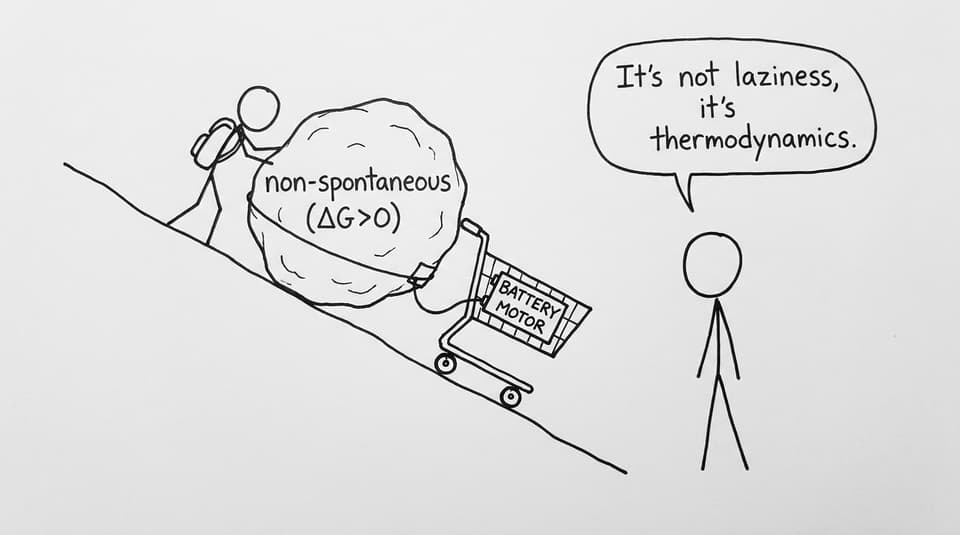
In IB Chemistry, electrolysis means using an external power supply to force a non-spontaneous redox reaction to occur in an electrolytic cell.
Translated into exam language:
-
the reaction needs energy input (so it would not run on its own)
-
electrons are pushed through wires by a power source
-
ions move through the electrolyte to keep charge balanced
If you want the wider redox picture first, pair this with What’s a Redox Reaction? IB Chemistry Explained and Oxidation and Reduction Explained for IB Chemistry.
A 20-second electrolysis checklist (exam-proof)
Use this IB Chemistry checklist before writing any products:
-
Identify if the electrolyte is molten or aqueous
-
Write the ions present (and include H₂O if aqueous)
-
Remember: oxidation at anode, reduction at cathode
-
In an electrolytic cell: anode is positive, cathode is negative
-
Choose which species is more likely to be discharged (especially in aqueous)
-
Balance half-equations with electrons
You can practice these steps quickly with exam-style prompts in the Electrochemical cells (HL) Questionbank.
Electrolytic cells: anode and cathode without the confusion
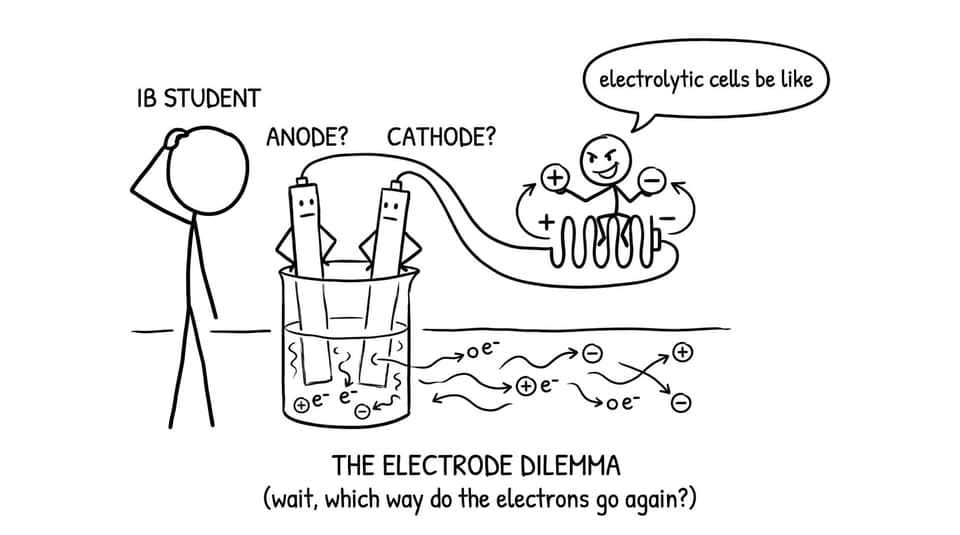
The most common IB Chemistry trap is assuming the electrode signs from galvanic cells.
In electrolysis:
-
Cathode is negative (it is connected to the negative terminal, so it receives electrons)
-
Anode is positive (connected to the positive terminal, so electrons are pulled away)
But the redox rule never changes:
-
Oxidation happens at the anode
-
Reduction happens at the cathode
For a clean explanation you can quote in your own words, see R3.2.5 Electrochemical cells: Oxidation and reduction Notes.
IB Chemistry electrolysis of molten salts: the “simple” case
Molten ionic compounds contain only the ions from that compound. That’s why IB Chemistry questions about molten electrolysis are usually straightforward.
Example: molten NaCl
-
Cathode (reduction): Na⁺ + e⁻ → Na(l)
-
Anode (oxidation): 2Cl⁻ → Cl₂(g) + 2e⁻
Your story here is consistent: cations gain electrons at the cathode, anions lose electrons at the anode.
IB Chemistry electrolysis of aqueous solutions: water changes everything
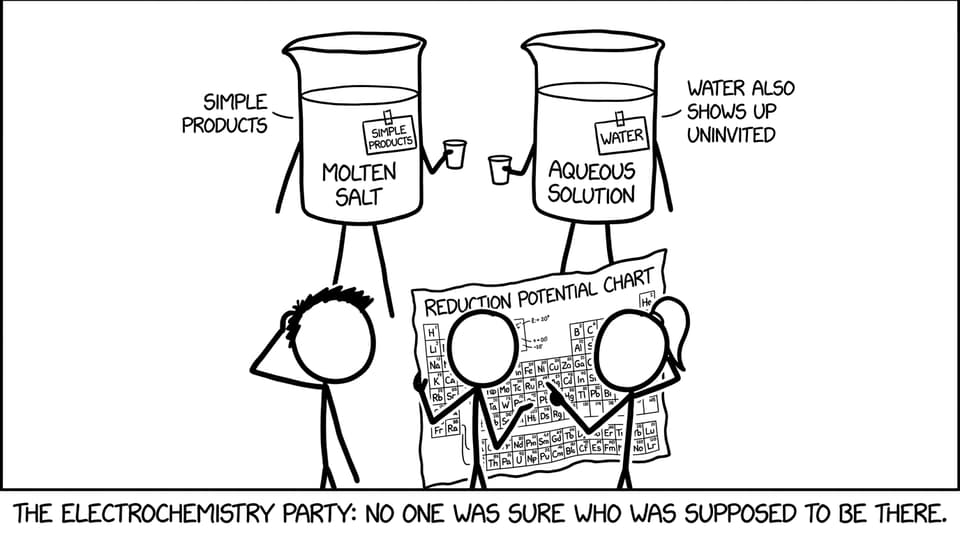
Aqueous electrolysis is where IB Chemistry becomes more like decision-making than memorization.
Because water is present, you’re often choosing between:
At the cathode (reduction)
-
reducing a metal cation to metal
-
or reducing water to hydrogen
At the anode (oxidation)
-
oxidizing an anion (like halides)
-
or oxidizing water/OH⁻ to oxygen
The selection is explained using reduction potentials and discharge preferences. If your foundations on ions and conductivity feel shaky, revise What Electrolytes Do in Chemistry before drilling questions.
Example: aqueous NaCl
-
Cathode: water is reduced to H₂
-
Anode: Cl⁻ is oxidized to Cl₂
That “water vs ion” competition is exactly what examiners like to test in IB Chemistry.
Faraday’s laws in IB Chemistry: turning current into moles (HL)
Faraday-style calculations feel intimidating until you realize they’re just unit discipline.
Core relationships for IB Chemistry:
-
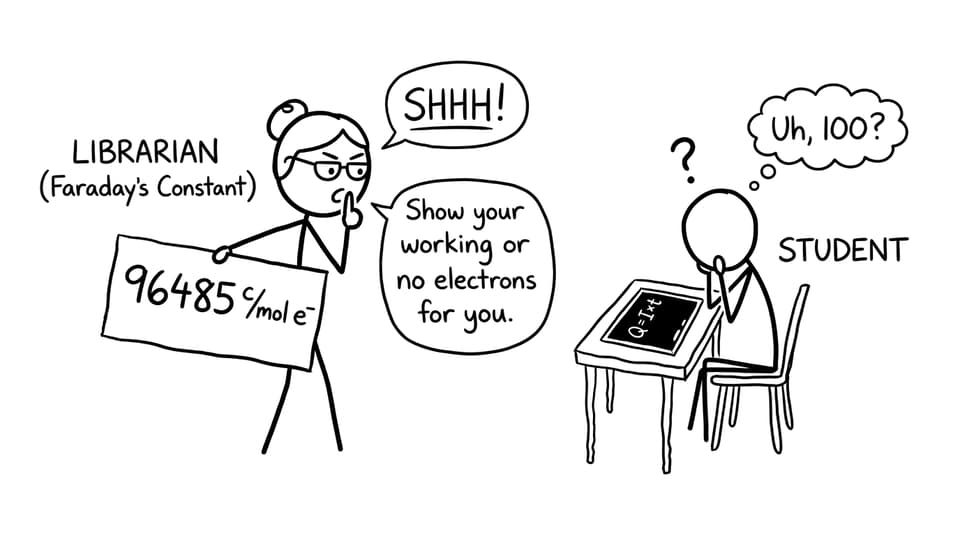
Q = I × t
-
moles of e⁻ = Q / F
-
moles of product = (Q / F) / n (where n = electrons in the half-equation)
Faraday’s constant:
- F = 96485 C mol⁻¹ e⁻ (often rounded)
For a full walkthrough, use Faraday’s Constant Explained, then lock it in with the Flashcards for Electrolysis of aqueous solutions (HL only).
Where electrolysis shows up (and why IB Chemistry loves it)
Electrolysis connects classroom redox to the real world, which is why it appears across IB Chemistry questions:
-
metal extraction (reactive metals need forced reduction)
-
electroplating (controlled deposition of a metal layer)
-
industrial chemical manufacture (e.g., chlorine-related processes)
-
charging rechargeable cells (driving reactions backward)
If you’re building exam stamina, tie this topic into an overall plan using IB Chemistry HL: Complete Guide for Success.
Common IB Chemistry electrolysis mistakes (easy marks to protect)
-
“Electrons move through the electrolyte.” In IB Chemistry, electrons travel in the external circuit; ions carry charge in solution.
-
“Cathode is always positive.” Not in electrolysis. Electrolytic cathode is negative.
-
“Electrolysis is spontaneous.” It requires electrical energy input; that’s the whole point.
Closing: make electrolysis predictable, then make it easy
Electrolysis in IB Chemistry is a story about control: controlling electron flow, controlling which species gets discharged, and controlling your own steps under exam pressure. If you can reliably label the electrodes, write the half-equations, and handle aqueous vs molten rules, you’ve already turned a “confusing” topic into free marks.
To consolidate, build a tight loop: read the relevant notes, drill questions, and use active recall. RevisionDojo makes that loop faster with Study Notes, Flashcards, an exam-style Questionbank, AI Chat for instant explanations, Grading tools to check your working, and realistic Mock Exams plus Predicted Papers for targeted practice. If you want extra structure (or a fast fix for a stubborn misconception), the Tutors and Coursework Library help you stay calm and precise, exactly how IB Chemistry rewards you.